
Yes, realized forex and CFD profits from personal trading capital are generally declared in Spain’s IRPF savings base as capital gains. You’ll pay tax on net gains using the progressive savings scale, need to check whether Modelo 720 applies to foreign brokerage accounts exceeding certain thresholds, and watch for possible autónomo reclassification if your trading resembles a business rather than personal investing.
TL;DR:
- Forex gains are taxed on a progressive scale that combines state and regional rates, which vary depending on your autonomous community and the tax year.
- Most retail traders are classified as personal investors, but high-volume, high-frequency, or externally funded trading may be reclassified as an economic activity, incurring additional obligations.
- Deductible costs include broker commissions, spread costs, account fees, and documented swap charges, with consistent euro conversion rates essential for accurate reporting.
- Losses can offset gains within the same year and be carried forward for up to four years, but untracked losses are lost if not documented properly.
- Foreign accounts must be reported through Modelo 720 if their total value exceeds specified thresholds, with recordkeeping showing account balances at year-end to avoid penalties.
Table of Contents
- Forex Tax Spain: What Rates Apply and Why the Year Matters
- Are Your Forex Gains Capital Gains or a Business Activity?
- Calculating Your Taxable Forex Profit: Deductions and Currency Rules
- Losses, Carryforward Rules, and the 25% Offset Limit
- Modelo 720: Reporting Foreign Broker Accounts
- Filing Modelo 100: From Your Numbers to Your Return
- Two Worked Examples: Retail Trading and Funded-Account Payouts
- Building a Recordkeeping System That Survives an Audit
- Trader Gibkey’s Perspective: Why Bookkeeping Beats Panic
- Where to Verify These Rules Before You File
- Sources
- FAQ
Forex Tax Spain: What Rates Apply and Why the Year Matters
Spain taxes savings base income, which includes most forex and CFD gains, through a progressive scale that combines a state rate and an autonomous-community rate. Those numbers move depending on where you live, because each autonomous community sets its own portion of the scale on top of the state baseline.
This is exactly why so many blog tables disagree with each other. Some quote only the state half of the calculation. Others blend a prior year’s brackets with this year’s thresholds, or skip the regional layer entirely and present a flat national number that doesn’t exist in practice. The AEAT’s official Renta guidance confirms the state and autonomous-community scales are calculated separately, then added together to reach your effective rate.
Before you file, verify the current bracket structure rather than trusting a static figure from last year’s article. A few ways to do that:
- Run your numbers through the AEAT’s official Renta software (Renta WEB), which applies the correct year and region automatically.
- Cross-check the published manual for the applicable tax year rather than a cached version from a previous filing season.
- Confirm your autonomous community’s specific rate, since Madrid, Catalonia, and Andalusia don’t apply identical scales.
- If you moved regions mid-year, check the residency rule AEAT uses to assign your applicable community.
Getting the bracket wrong doesn’t just cost you money. It can trigger a correction notice, and correction notices invite closer scrutiny of everything else on your return.
Are Your Forex Gains Capital Gains or a Business Activity?
Most retail traders operating with their own capital fall into the personal capital gains category, taxed in the savings base as described above. That’s the default assumption under Spanish tax practice: you’re an individual managing your own money, not running a business. But AEAT doesn’t take that classification for granted, and it looks at how you actually trade, not just what you call yourself.
Several red flags push a trader from “personal investor” toward “economic activity,” which is taxed as general income rather than savings income and comes with its own compliance burden:
- Trading with high frequency and volume that resembles a full-time occupation rather than occasional investing.
- Using external capital, employees, or a formal business structure to run your trading operation.
- Advertising trading services, managing money for others, or operating under a registered trade name.
- Maintaining organized business processes, like dedicated office space or systematic client-facing activity, that go beyond personal portfolio management.
If AEAT reclassifies your activity as an economic activity, the consequences run deeper than a different tax rate. You become liable for autónomo social security contributions, your deductible expense categories shift, and your income no longer benefits from the savings base’s flatter structure. According to guidance on foreign investment vehicles in Spain, this distinction becomes especially relevant for traders receiving payouts through funded accounts or prop firms, where the contractual relationship can look more like compensation than a personal capital gain.
Pro Tip: Keep a simple written log of your trading pattern, frequency, and whether you use any external capital. If your activity ever gets questioned, that log is your first line of defense, and it costs you nothing to maintain.
If you’re unsure where you land, a consultation with a Spanish tax advisor before filing season is far cheaper than a reclassification after the fact.
Calculating Your Taxable Forex Profit: Deductions and Currency Rules
Your taxable figure isn’t your raw broker payout. It’s a net number built from your realized trades, minus legitimate costs, converted consistently into euros.
Deductible items typically include:
- Broker commissions charged per trade, provided you can show them on your statement.
- Spread costs, where documented and separable from the raw price movement.
- Platform or account fees tied directly to executing trades, not general subscription costs unrelated to trading activity.
- Overnight financing or swap charges, as long as you keep records showing the amount and date charged.
Currency conversion is where a lot of traders get sloppy, and where AEAT auditors tend to focus. If your account is denominated in US dollars, you need to convert every trade into euros using a consistent, defensible method, typically the European Central Bank’s daily reference rate. Pick one convention (daily rate versus a per-trade rate at execution) and apply it uniformly across the entire tax year. Switching methods mid-year to whichever rate flatters your result is the kind of inconsistency that draws attention during a review.
A practical four-step process to get from raw broker data to a filing-ready figure:
- Export your full broker profit-and-loss statement for the tax year, including every closed position.
- List every deductible cost separately, with supporting documentation for each.
- Apply your chosen conversion method to every transaction, not just the net total.
- Subtract total costs from gross gains to arrive at your net figure for the savings base.
The AEAT’s compensation guidance for the savings base makes clear that only properly substantiated figures survive an audit. A number without a paper trail behind it is a number AEAT can challenge.
Losses, Carryforward Rules, and the 25% Offset Limit
Losing trades aren’t just painful. Handled correctly, they reduce what you owe. AEAT allows negative savings balances to be compensated against gains, and any amount you can’t use in the current year carries forward for up to four years. Miss the paperwork, and you lose that relief permanently once the window closes.
The offset order matters too. AEAT applies a prescribed sequence when netting gains and losses within the savings base, and certain movable-capital negative balances are subject to a 25% limitation when offsetting against other income types in the same category. That limit means you can’t always wipe out a full year’s gains with a single bad quarter, even if the loss is large enough on paper to do so.
Practical steps to keep the relief usable:
- Record every losing trade the same way you record winners, with dates, amounts, and conversion rates.
- Track how much of a prior year’s loss you’ve already used, so you don’t accidentally claim it twice.
- Apply the 25% limit correctly when it’s relevant, rather than assuming full offset is always available.
- Flag the fourth year of any carryforward on your calendar. Once it passes, the relief disappears.
This is where a lot of traders lose money they didn’t need to lose. A real loss that goes untracked is a real loss that never gets used, which defeats the entire purpose of the carryforward mechanism.
Modelo 720: Reporting Foreign Broker Accounts
If you trade forex or CFDs through a broker based outside Spain, Modelo 720 might apply to you, separate from your annual Renta filing. This informational return covers three blocks: foreign bank and brokerage accounts, foreign securities and rights (which can include certain trading account holdings), and foreign real estate.
You generally need to file when any single block’s combined value crosses the applicable reporting threshold. Once you’ve filed for a given block, you don’t need to refile every year automatically. The AEAT’s guidance on filing frequency confirms you only need to refile a block if its combined balance increases by more than €20,000 compared to your last declared figure.
Key practical points:
- Track each of the three blocks separately, since crossing the threshold on one doesn’t automatically trigger reporting on another.
- Take a year-end snapshot of every foreign account balance, even if you don’t think you’re close to the threshold. It’s easier to prove you didn’t need to file than to reconstruct history later.
- Don’t rely on outdated penalty figures circulating online. AEAT’s own FAQ on Modelo 720 confirms the sanctions framework now follows the general regime under Articles 198 and 199 of the General Tax Law, not the far harsher penalties from the earlier regime that get repeated across forums.
- When in doubt about whether a threshold is crossed, confirm with AEAT directly or a tax professional rather than estimating.
Filing Modelo 100: From Your Numbers to Your Return
Once you have a net figure and know your classification, filing is a matter of getting the right number into the right box. Savings base gains from forex and CFD trading go into the capital gains and losses section of Modelo 100, separate from general income like salary or, potentially, reclassified trading activity.
Follow this sequence when you sit down to file:
- Pull your net gain or loss figure from your reconciled broker P&L and conversion workbook.
- Enter it in the savings base capital gains section, applying any available loss offsets from prior years first.
- Cross-check the total against your own worksheet before submitting, not after.
- Retain every supporting document in case AEAT requests substantiation later.
Minimum backup to keep on file includes full broker statements for the year, your daily or per-trade currency conversion log, proof of fees and swap charges, and periodic account balance snapshots. A reasonable retention period is at least four years, matching the carryforward window for losses, though many advisors recommend keeping records longer given how far back an audit can occasionally reach.
Pro Tip: Save your broker’s monthly statements the day they’re issued, not at tax time. Reconstructing a full year of trades from memory in March is how small errors turn into filing mistakes.
If you discover an error after filing, Spain allows for a corrective supplementary declaration. Filing late or incorrectly can trigger surcharges that increase the longer the correction takes, so fix mistakes as soon as you spot them rather than waiting for the next filing season.
Two Worked Examples: Retail Trading and Funded-Account Payouts
Example A: Retail trader with a dollar-denominated account.
- Total closed trades for the year show $12,000 in gross gains on a USD-based broker account.
- Commissions and documented swap charges total $800, leaving a net USD gain of $11,200.
- Converting at the applicable ECB reference rates consistently applied across the year produces a euro-denominated net gain.
- That euro figure enters the savings base and is taxed at the progressive scale rate applicable to the trader’s bracket and autonomous community.
Documentation to keep: full trade log, commission and swap statements, and the conversion rate source used for every entry.
Example B: Funded-account or prop-firm payout.
- A trader receives a payout from a funded-trading program after passing an evaluation and meeting profit targets.
- Whether that payout is a capital gain or income from an economic activity depends on the contract terms and how the arrangement is structured.
- If the relationship resembles compensation for services rather than personal capital gains, reclassification risk rises significantly.
- The trader should retain the funding agreement, payout history, and any correspondence describing the nature of the relationship.
This example demonstrates the classification principle covered earlier: the label on the account matters far less than the substance of the arrangement.
Building a Recordkeeping System That Survives an Audit
A simple worksheet, updated once a year, does most of the heavy lifting for loss relief and audit readiness. Structure it with these fields: tax year, opening carryforward balance, losses realized during the year, losses used against gains, remaining carryforward, and the final year that balance remains usable.
Store broker statements as PDFs and trade logs as CSV files, named by year and broker for quick retrieval. A folder structure like “2026_BrokerName_Statements” and “2026_TradeLog_CSV” saves hours when you’re pulling documentation together at filing time.
| Worksheet field | What it tracks |
|---|---|
| Tax year | The reporting period the row applies to |
| Opening carryforward | Unused loss balance entering the year |
| Losses realized | New losses generated during the year |
| Losses used | Amount offset against gains that year |
| Remaining carryforward | Balance still available for future years |
| Final usable year | The last year this balance can be claimed |
Keep Modelo 720 monitoring on a separate track from your Renta calculations. They follow different rules and different thresholds, and mixing the two into one tracking sheet tends to create confusion at exactly the wrong moment.
Trader Gibkey’s Perspective: Why Bookkeeping Beats Panic
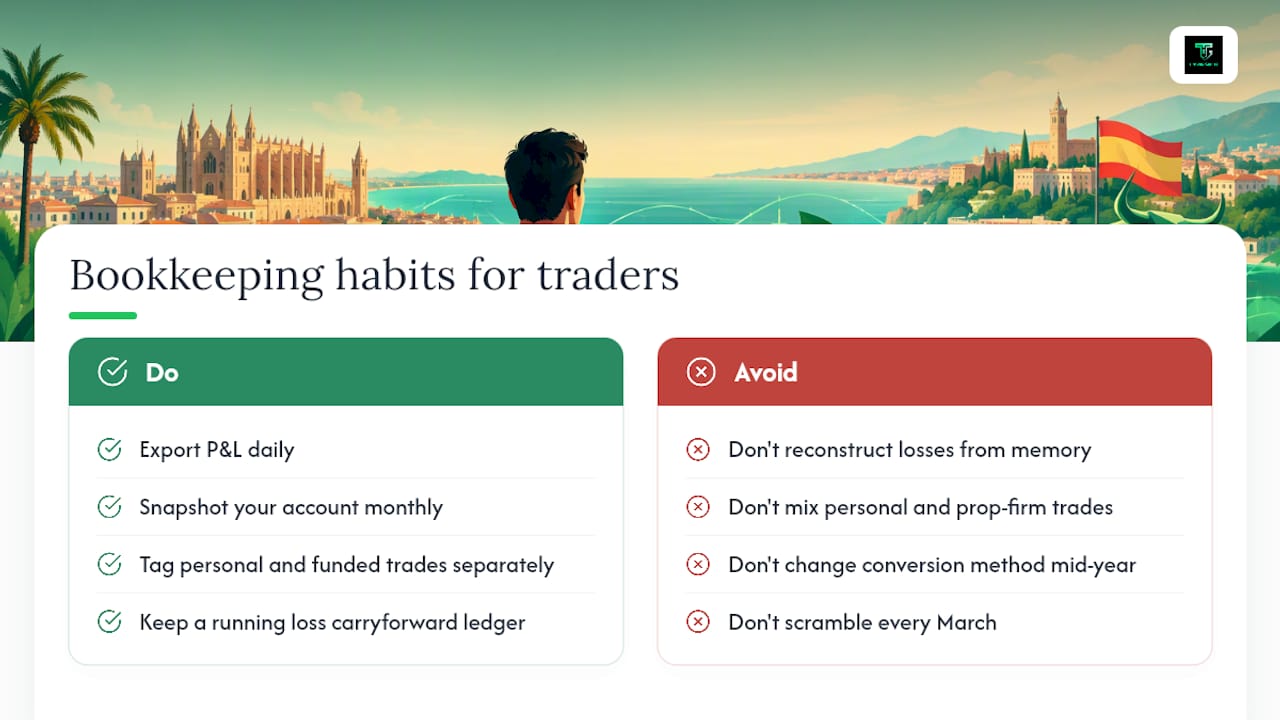
Here’s what we’ve seen separate traders who file cleanly from traders who scramble every March: the clean filers treat their P&L like part of the trade, not an afterthought. Export it daily. Snapshot your account monthly. It takes ten minutes and it means your tax filing is basically already done by the time filing season starts.
A few habits worth building into your routine: tag personal capital trades separately from any funded-account or prop-firm flows, write down your currency conversion method once and stick to it all year, and keep a running loss carryforward ledger instead of reconstructing it from memory each spring. None of this requires new software. It requires discipline, the same discipline that keeps a trading account alive through a losing streak.
If you want a deeper look at how these habits connect to actual profit and loss management, our guide on how much money you can realistically earn from forex trading walks through the numbers traders actually see. And if part of your trading involves other asset classes, our breakdown of what investors owe on crypto gains covers similar reporting logic that applies across markets.
Solid trading and solid bookkeeping aren’t separate skills. They’re the same skill, applied twice.
Traders serious about building this kind of structured, price-action-based approach, backed by 18-plus years of live market experience, can explore Trader Gibkey’s mentorship and course options, including the Price Action (Core) plan at £149 per month, the New Generation Liquidity plan at €349 per year, or single-session mentorship at €149 for traders who want direct, one-on-one feedback before scaling up their strategy.
— Gabriel
Where to Verify These Rules Before You File
Static articles age. Tax brackets, thresholds, and reporting rules don’t stay frozen year to year, so treat the following as your starting point, not your final word:
- The AEAT Renta calculation manual confirms current-year savings base brackets and state versus regional mechanics.
- The AEAT compensation guidance sets out the carryforward and offset order rules.
- The Modelo 720 FAQ pages explain thresholds, filing frequency, and the current sanctions framework.
Always confirm the figures against the current tax year rather than a saved bookmark from a prior filing season.
This article is general information, not a substitute for advice from a qualified financial advisor. Consult a qualified financial professional about your own circumstances before acting on anything here.
Sources
- AEAT — Renta 2025: calculation guidance and main changes
- AEAT — Compensation of negative items (IRPF 2025)
- AEAT — Modelo 720: FAQ on penalties and legal effects
- International Taxation Spain — ETF and foreign funds guidance
FAQ
Do I Have to Pay Tax on Forex Trading in Spain?
Yes. Realized forex and CFD gains for Spanish tax residents trading personal capital are generally taxed in the IRPF savings base as capital gains. Losses can offset gains and carry forward for up to four years.
How Is Forex Income Taxed if I Use a Foreign Broker?
Your gains still go into the savings base on your annual Renta return. Separately, you may need to file Modelo 720 to report the foreign account itself if it crosses the applicable threshold.
Is Foreign Income Taxable in Spain?
Yes, Spanish tax residents are taxed on worldwide income, including gains from foreign brokers. What changes with foreign accounts is the added reporting obligation under Modelo 720, not whether the underlying gain itself is taxable.