
FOMO in trading is defined as the urge to enter a trade impulsively, driven by anxiety rather than a verified setup. Knowing how to handle FOMO in trading is the difference between consistent results and a string of preventable losses. The most effective defense is a pre-trade checklist written in a cold state, before the market opens and before emotion takes over. Pair that with a risk-reward calculator and a strict daily loss limit, and you have a system that blocks impulsive decisions at the source. Trading psychology research calls this the cold-state versus hot-state distinction, and it is the foundation of every strategy covered here.
What is FOMO in trading and why does it occur?
FOMO, the industry term for “fear of missing out,” is a recognized concept in behavioral trading psychology. It describes the emotional state where a trader feels compelled to enter a position without meeting their own criteria, simply because price is moving fast or others appear to be profiting.
Several triggers make FOMO worse:
- Market momentum: A fast-moving candle creates the illusion that opportunity is disappearing by the second.
- Social media noise: Social media and market hype amplify FOMO, encouraging overtrading and impulsive entries without trading plans. Seeing others post winning trades while you sit on the sidelines is a direct emotional trigger.
- Unrealized opportunity fear: Watching a trade you skipped run 200 pips in your direction rewires your brain to “act faster next time,” even when acting faster is exactly what hurt you before.
- Volatility spikes: High-volatility sessions, like major news events, create urgency that bypasses rational thinking.
The cold-state versus hot-state framework explains why FOMO is so hard to fight in real time. In a cold state, before the session starts, you think clearly and set rules you believe in. In a hot state, during live market action, your brain runs on a different operating system. Emotion overrides logic, and the rules you wrote feel less urgent. Cold-state pre-written trade rules outperform willpower by blocking FOMO impulses triggered in the hot state. That is why preparation, not discipline alone, is the real solution.
What tools and preparation help traders prevent FOMO trades?
Preparation is the strongest FOMO filter you have. The goal is to make as many decisions as possible before the market opens, when your thinking is clear and your emotions are neutral.
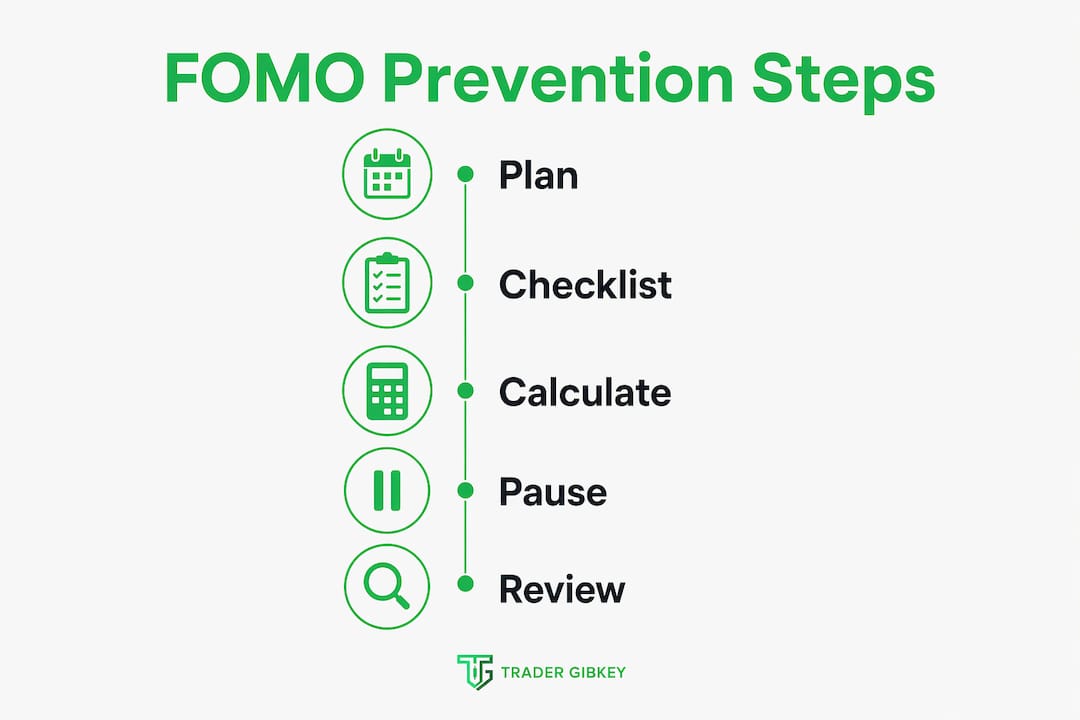
The pre-trade checklist
Creating a pre-trade checklist in a cold state ensures trades meet pre-defined criteria and blocks impulsive FOMO trades. Write your checklist the night before or at least one hour before your session. Every potential trade must pass every item on the list before you touch the order button.
A solid checklist covers:
- Is there a clear price action signal at a key level?
- Does the trade align with the higher timeframe trend?
- Is the risk-reward ratio at least 1:2?
- Is the entry within my planned session hours?
- Have I checked the economic calendar for news risk?
If a trade fails even one item, you skip it. No exceptions.
The Risk Reward Calculator
Using a Risk Reward Calculator pre-trade helps disqualify emotionally driven FOMO trades that lack adequate risk/reward. You input your actual entry, stop-loss, and target prices. If the math does not show at least a 1:2 ratio, the trade does not qualify. This single step removes a large category of impulsive entries because FOMO trades almost never have good math behind them.

| Preparation Tool | What It Does | When to Use It |
|---|---|---|
| Pre-trade checklist | Filters trades against pre-set criteria | Before every session |
| Risk Reward Calculator | Confirms minimum 1:2 ratio | Before every entry |
| Economic calendar | Flags high-impact news events | Morning of each session |
| Trading journal | Tags and stores FOMO trade data | After every session |
Pre-market routine
Pre-market routines such as meditation and economic news reviews prepare the mind for disciplined trading and reduce impulsive behavior. Even five minutes of calm focus before your session improves your adherence to your plan. Review your checklist, check the news schedule, and set your daily loss limit before price starts moving.
Pro Tip: Write your maximum daily loss and maximum trade count on a sticky note and place it next to your screen. Seeing it physically makes it harder to ignore when emotions run hot.
How to execute trades with discipline and avoid impulse decisions?
Preparation sets the rules. Execution is where you follow them under pressure. Here is a step-by-step process for staying disciplined at the moment of decision.
- Run the checklist first. Before you click anything, go through every item on your pre-trade checklist. If you skip this step even once, the habit breaks down.
- Calculate the risk-reward ratio. Open your calculator and input the numbers. A trade that does not meet the 1:2 minimum gets rejected, regardless of how strong the setup feels.
- Apply a two-minute pause. If you feel urgency, that is a signal to wait, not act. Set a two-minute timer. Most FOMO impulses fade within 90 seconds when you stop staring at the chart.
- Avoid social media during active trading hours. Ignoring social media and sticking to verified facts reduces noise and emotional overload. Close Twitter, Discord, and Telegram while your session is live.
- Stop trading after hitting your daily limit. Daily loss limits and trade count caps prevent revenge trading and emotional burnout triggered by FOMO. When you hit your limit, close the platform. Not “one more trade.” Done.
- Log the trade, whether you took it or not. If you felt FOMO but skipped the trade, write it down. That data is valuable.
Pro Tip: If you find yourself justifying why “this one is different,” that thought is the FOMO talking. A setup that truly meets your criteria does not need justification.
Common mistakes traders make dealing with FOMO and how to avoid them
Most FOMO-related losses come from the same handful of errors. Recognizing them in advance makes them easier to catch in real time.
- Chasing momentum without set criteria. A fast-moving candle is not a trading signal. Entering because price is moving fast is the definition of a FOMO trade. The fix is a written trading plan that defines exactly what a valid setup looks like.
- Ignoring risk management rules. A strict 1% risk per trade limit reduces emotional stakes and protects traders from catastrophic losses fueled by FOMO. When you risk too much, every trade feels life-or-death, which makes FOMO worse.
- Revenge trading after a loss. After a losing trade, the brain stops trading the chart and starts trading the pain. Entering immediately after a loss to “get it back” is one of the most destructive FOMO patterns. The daily loss limit rule exists specifically for this moment.
- Overexposure from no position limits. Taking multiple simultaneous trades because “everything looks good” is a FOMO pattern disguised as confidence. Set a maximum of two or three open positions at any time.
- Skipping the trade review. Journaling FOMO trades by tagging them enables retrospective review, awareness, and systematic improvements. If you never look back at your impulsive entries, you repeat the same mistakes indefinitely.
The pattern across all these mistakes is the same: emotion replaces process. The fix is always the same too: return to the process.
How to build long-term habits that reduce trading anxiety and FOMO
Managing fear of missing out is not a one-time fix. It is a practice you build over months. The traders who stay consistent are the ones who treat their mental habits with the same seriousness as their technical setups.
- Journal every session. Write what you planned, what you did, and how you felt. Over time, patterns emerge. You will start to see exactly which market conditions or emotional states trigger your FOMO.
- Embrace probabilistic thinking. Accepting uncertainty and embracing a probabilistic trading mindset helps traders avoid the emotional urgency underlying FOMO. No single trade defines your results. Your edge plays out over hundreds of trades, not one.
- Practice mindfulness during stress. Mindfulness and breathing exercises during trading reduce anxiety and help regain rational control after emotional spikes. Three slow breaths interrupt the fight-or-flight response before it takes over your decision-making.
- Set realistic goals. Expecting to catch every move is the root of FOMO. Accepting that you will miss trades, and that missing them is sometimes the right call, changes your relationship with the market.
- Take breaks and protect your energy. Trading fatigued is trading emotional. Schedule days off. Step away from screens between sessions. Your decision quality drops sharply when you are mentally depleted.
“The goal is not to catch every trade. The goal is to execute your best trades consistently and protect your capital on the rest. Patience is not passive. It is the most active discipline in trading.”
Key Takeaways
Handling FOMO in trading requires pre-session preparation, objective tools like a Risk Reward Calculator, and hard rules that remove emotion from the execution process.
| Point | Details |
|---|---|
| Write rules in a cold state | Create your checklist before the session, when emotion is not influencing your thinking. |
| Use a Risk Reward Calculator | Reject any trade that does not meet a minimum 1:2 ratio before you enter. |
| Apply a daily loss limit | Stop trading the moment you hit your loss cap to prevent revenge trades. |
| Journal FOMO trades | Tag and review impulsive entries to identify patterns and improve over time. |
| Build pre-market routines | Meditation, news review, and checklist prep before the session reduce in-session impulsive behavior. |
What I have learned about FOMO after 18 years of live trading
The single most underrated FOMO defense I know is writing your rules when you are calm. Not when the market is open. Not when a setup is forming. Before any of that. When you write your criteria in a cold state, you are essentially making decisions for your future emotional self, the one who will be staring at a fast-moving chart and feeling the pull to act.
The Risk Reward Calculator changed how I think about impulsive entries. For real. When you run the numbers on a FOMO trade, the math almost never works. The stop is too wide, the target is too close, or the entry is already extended. Seeing that on screen kills the urge faster than any mental pep talk.
Journaling is the part most traders skip, and it is the part that compounds the most. When you tag a FOMO trade and review it a week later, you see yourself clearly. You see the pattern. That awareness is what builds long-term trading discipline over time.
Patience is not waiting for something to happen. It is the active choice to protect your edge by not trading when conditions are not right. That mindset shift is what separates traders who last from those who burn out.
— Gabriel
How Tradergibkey supports disciplined, FOMO-free trading
Tradergibkey was built around one idea: practical experience beats generic theory. With over 18 years in live Forex markets, the focus has always been on giving traders real tools and real frameworks, not abstract advice.
The Tradergibkey platform covers risk management fundamentals, pre-trade preparation, and price action strategies that give you a clear edge without emotional guesswork. You get access to structured guides, community support, and the kind of mentorship that helps you build confidence trade by trade. If you are ready to trade with a plan and stop chasing setups, start here at Tradergibkey.
FAQ
What is the fastest way to stop a FOMO trade?
Apply a two-minute pause before entering. Most FOMO impulses fade within 90 seconds when you stop watching the chart and breathe.
How does a Risk Reward Calculator help with FOMO?
It forces you to run the math before entering. FOMO trades almost never meet a minimum 1:2 risk-to-reward ratio, so the calculator disqualifies them objectively.
Should I journal trades I did not take?
Yes. Logging skipped FOMO setups and reviewing them later shows you whether your discipline saved you or cost you, and that data sharpens your decision-making over time.