
An inside bar is a two-candle price-action pattern: the second candle’s high and low sit entirely within the range of the previous candle, called the mother bar. The single rule that matters most in inside bar trading is this: trade the breakout of the mother-bar range with context, not the small candle sitting inside it.
That distinction changes everything about how you approach the setup. A raw inside bar means nothing on its own. It only becomes tradeable when it follows a strong impulsive move or forms at a key structural level, where the pause represents real hesitation rather than random noise.
- Inside bar = smaller candle fully contained inside the prior candle’s range.
- Trade the mother-bar breakout, not the inside candle’s tiny range.
- Best inside bars follow an impulse or sit at swing support/resistance.
Pro Tip: Skip any inside bar that forms in the middle of nowhere. If it isn’t attached to a clean impulse or a level you’d mark on a clean chart, it’s noise, not a signal.
Key Takeaways
Inside bar trading works when you filter for context, trade the mother-bar breakout with defined risk, and size positions from the stop distance every time.
| Point | Details |
|---|---|
| Definition first | An inside bar sits fully within the mother bar’s high and low; without that, it isn’t valid. |
| Trade the breakout, not the candle | Entries trigger off the mother-bar high or low, ideally on a confirmed close. |
| Filter before you trade | Trend, structure, and session context separate winning setups from fakeys. |
| Size from the stop | Calculate position size from stop distance and a fixed risk percent, not gut feel. |
| Mentorship speeds the learning curve | Trader Gibkey’s live sessions and community help traders apply these rules with direct feedback. |
Table of Contents
- How to Recognize a Valid Inside Bar Setup
- What Are the Common Inside Bar Variations?
- Step-By-Step Inside Bar Breakout Setup
- How Do You Avoid False Breakouts on Inside Bars?
- Which Timeframes and Markets Work Best for Inside Bars?
- What Do Real Inside Bar Trade Walkthroughs Look Like?
- Quick Pre-Trade Checklist for Inside Bar Setups
- Why Trading the Compression Matters More Than the Candle
- Build These Setups Into a System, Not a Guessing Game
- Sources
- FAQ
How to Recognize a Valid Inside Bar Setup
The formal rule is simple: the inside bar’s high must be lower than the mother bar’s high, and its low must be higher than the mother bar’s low. Both conditions have to hold. Some traders loosen this to allow an equal high or equal low, but a stricter definition filters out weaker setups before you ever risk money.
A few edge cases trip up newer traders. Long wicks on the inside bar can make it look invalid at a glance even when the body qualifies. Two or three inside bars can stack inside the same mother bar, which is fine and often more informative than a single one. And a very small mother bar produces an inside bar with almost no range at all, which is rarely worth trading on its own.
Before marking any bar tradeable, run it through a short mental checklist:
- Does the mother bar have a meaningful range, not a tiny doji-like candle?
- Did a real impulsive move precede this compression?
- Is the pattern sitting at a level you’d already have marked (swing high/low, prior structure)?
- Is this forming during an active session with real participation, not a thin holiday tape?
Pro Tip: Print out ten inside bars from your own chart history and mark which ones passed all four checks. You’ll see fast how few actually qualify, and that’s the point.
What Are the Common Inside Bar Variations?
Not every inside bar behaves the same way, and lumping them together is where a lot of traders lose money.
- Single inside bar after an impulse. This is the cleanest continuation setup. Momentum pauses, then usually resumes in the same direction.
- Multiple consecutive inside bars. Two or three bars coiling inside the same mother bar build stronger compression, and that often means a bigger breakout, though it can take longer to resolve.
- Fakey / Hikkake patterns. Price breaks one side of the mother bar, traps breakout traders, then reverses hard the other way. This is the pattern’s most dangerous cousin.
- Inside bars at support/resistance. These carry higher reversal odds, but they still need a confirmed close before you trust the flip.
Step-By-Step Inside Bar Breakout Setup
Here’s the mechanical version you can actually test on a demo chart or your own trade log.
- Mark the mother-bar range. Draw the high and low of the mother bar the moment the inside bar closes.
- Choose your entry trigger. Place a buy stop a few pips above the mother-bar high, or a sell stop below the mother-bar low. Some traders wait for a full candle close beyond the range for stronger confirmation, which cuts down on false breaks.
- Set your stop loss. Classic placement puts the stop on the opposite side of the mother bar. On more volatile pairs or higher timeframes, an ATR-based buffer works better than a fixed pip distance.
- Define your target. A minimum 1:2 risk to reward is a reasonable floor. Many traders scale out in two legs, taking partial profit at 1:1 and trailing the rest behind structure.
- Size the position. Calculate lot size from your stop distance and a fixed account risk percent, usually 0.5% to 1% per trade.
- Small mother bars give you tighter stops and easier position sizing.
- Wide mother bars demand smaller size to keep risk consistent.
- Never size by “feel” — calculate it from the stop distance every time, using rules like those in Trader Gibkey’s risk management guide.
How Do You Avoid False Breakouts on Inside Bars?
Most inside bars are low quality on their own. What separates a winning setup from a trap is the filter stack you run before pulling the trigger, and experienced traders consistently point to context over pattern as the deciding factor.
- Trade with the dominant trend. Check the higher-timeframe swing structure or a moving average slope before taking the breakout direction.
- Look for structure confluence. An inside bar sitting at a prior swing low or a liquidity sweep zone carries far more weight than one floating in open air.
- Watch volume and session timing. Breakouts during London or New York opens tend to have real participation behind them; breakouts during thin Asian hours often fade.
- Wait for a higher-timeframe close. If the daily inside bar breaks intraday but closes back inside the range, that’s a strong warning sign, not a green light.
Pro Tip: Run every setup through the same three filters, in the same order, every single time. Inconsistent filtering is how good traders talk themselves into bad trades.
Which Timeframes and Markets Work Best for Inside Bars?
Daily charts produce the fewest but highest-quality inside bar setups, often aligning with where larger players are positioned. Fewer signals, but the ones that trigger tend to carry further.
- Daily charts: Highest reliability, lowest frequency. Good for swing traders who don’t need constant action.
- 4-hour and 1-hour charts: A solid middle ground, more setups with still-reasonable reliability.
- 15-minute and below: Frequent inside bars, but the false-break rate climbs fast. Only worth it with strict filters and real screen time.
- Best markets: Major FX pairs, large-cap indices, and liquid commodities. Thin, illiquid instruments produce erratic breakouts that don’t respect the pattern.
What Do Real Inside Bar Trade Walkthroughs Look Like?
Trending continuation. A currency pair rallies hard for six candles, then prints an inside bar at the top of the move. Price closes above the mother-bar high the next session. Entry on the break, stop below the mother-bar low, target at 1:2. Trade works because the pause sat directly on top of fresh momentum.
Reversal at resistance. Price grinds up into a well-marked resistance level and forms an inside bar right at that ceiling. The breakout attempt fails, price closes back inside, then reverses down through the mother-bar low. The lesson: the level mattered more than the pattern.
Multiple inside bar breakout. Three inside bars coil inside one mother bar over several sessions. When the breakout finally comes, it’s sharp and sustained, consistent with how coiling compression tends to resolve.
After every trade, log the entry rationale, which filters were present, your emotional state going in, and the actual outcome. That journal is where real improvement happens, not in the next setup you take.
Pro Tip: Review your last twenty inside bar trades and sort them by which filters were present. You’ll likely find your winners cluster around two or three specific conditions.
Quick Pre-Trade Checklist for Inside Bar Setups
Run this before every entry:
- Valid pattern: High/low fully contained in the mother bar? Green if yes.
- Trend bias: Aligned with higher-timeframe direction? Green if yes, amber if neutral.
- Structure confluence: At a real level or liquidity zone? Red if floating alone.
- Stop and size: Stop placed beyond mother bar, size calculated from risk percent? Red if guessed.
Why Trading the Compression Matters More Than the Candle
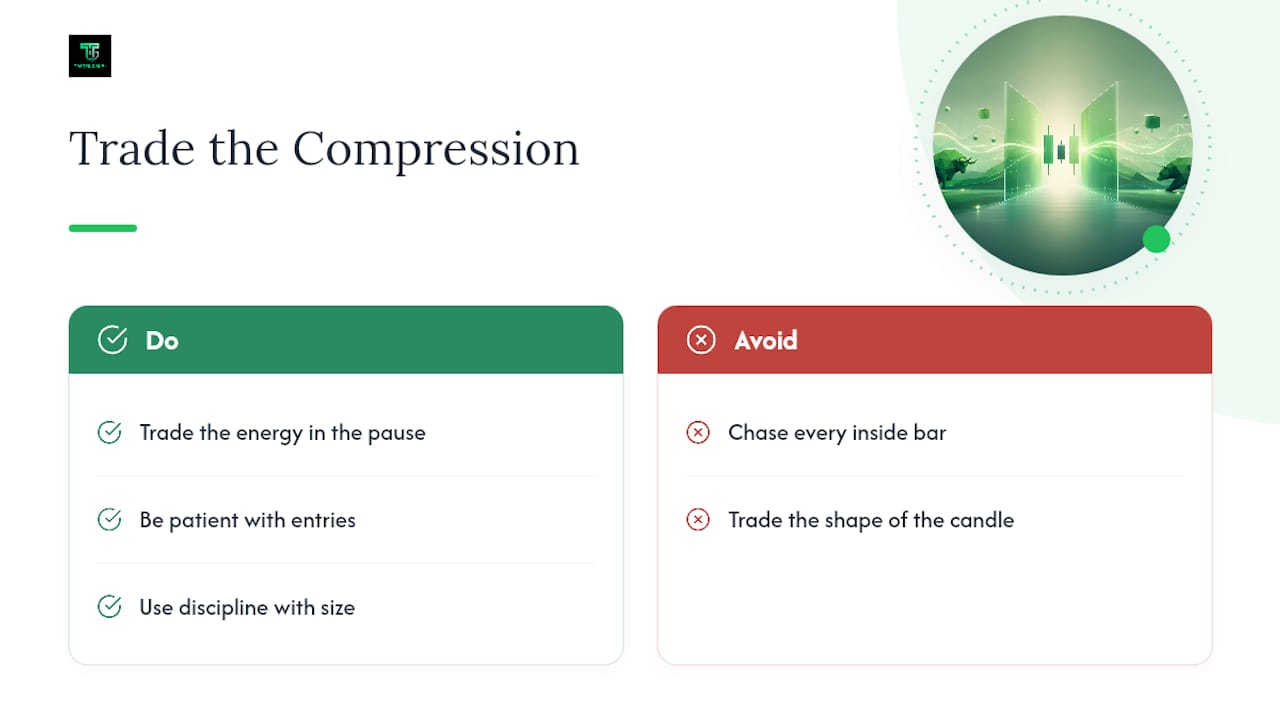
Every mentorship session I run comes back to the same point: you’re trading the energy stored in that pause, not the shape of the candle. Traders who chase every inside bar burn through their edge fast.
Pro Tip: Patience with entries and discipline with size beats a perfect pattern every time. Slow down, wait for the close, size it right.
Build These Setups Into a System, Not a Guessing Game
Reading a chart correctly once is easy. Doing it consistently, under pressure, with your own money on the line, is a different skill entirely. That’s the gap structured mentorship closes faster than trial and error ever will.

Trader Gibkey’s live trading sessions walk through setups like these in real time, with direct feedback on your entries, stops, and journaling instead of generic theory. You get structured courses, mentorship, and access to a trading community built around the same price-action principles covered here, backed by over 18 years of live market experience. If you’re ready to stop guessing on which inside bars actually matter, start with Trader Gibkey’s courses and mentorship and get direct guidance on your next setup.
Sources
- Inside Bar Strategy: A simple yet powerful trading technique for all markets (FTMO / OANDA)
- Inside Bar Trading Strategy Explained: Rules, Entry, Exit & Real Trading Examples - The First Time Investor
- Indicator
Study these on higher timeframes first, then keep a trade journal to track which filters actually improve your results.
This article is general information, not a substitute for advice from a qualified financial advisor. Consult a qualified financial professional about your own circumstances before acting on anything here.
FAQ
What is an inside bar in trading? It’s a candle whose high and low sit completely inside the previous candle’s range, called the mother bar.
Do inside bars work better on certain timeframes? Yes. Daily charts give fewer but higher-quality signals; lower timeframes produce more false breaks.
What’s the biggest mistake traders make with inside bars? Trading every inside bar they see instead of filtering for trend, structure, and session context first.