
A professional FX trader manages risk to a written plan, meets measurable performance metrics, and treats the market as a business rather than a game. The fastest realistic path to get there: structured education first, then validated testing, then funded or scaled live trading.
Here’s the short version you can scan right now:
- Structured education: Learn price action, risk management, and strategy design from a proven curriculum
- Validated testing: Backtest your system, forward-test it on demo, then run a small live trial
- Funded or scaled live trading: Apply for a funded account or scale your own capital once your metrics hold
That sequence is not optional. Skip a step and you’re gambling, not trading.
Table of Contents
- What does a professional forex trader actually do?
- Core skills every serious trader must build
- How to become a professional FX trader, step by step
- Which platforms and tools should you use as a U.S. trader?
- How do you test a strategy before trading it live?
- How do you choose a mentor or course worth paying for?
- What can you realistically earn as a professional forex trader?
- U.S. regulation, compliance, and tax basics for forex traders
- Why Tradergibkey’s mentorship accelerates your path to professional trading
- Key Takeaways
- What most traders get wrong about becoming a professional
- Tradergibkey: structured mentorship for traders who are serious about going pro
- Useful sources and further reading
- FAQ
What does a professional forex trader actually do?
A hobbyist trades on instinct and hopes. A professional trades on rules and measures outcomes. The distinction is accountability: a pro tracks every trade, reviews performance weekly, and makes decisions based on data rather than emotion. Scale matters too. A professional is responsible for protecting capital, whether that’s their own or an institution’s, and they answer to metrics.
Common professional roles include:
- Proprietary trader: Trades a firm’s capital under defined risk limits
- Fund manager: Allocates across currency positions for investors
- Funded account trader: Passes an evaluation, trades firm capital remotely, keeps a profit split
- Independent professional: Trades personal capital full-time with institutional-grade discipline
- Strategy developer: Builds and maintains systematic models for institutions or hedge funds
The execution environment differs significantly from retail. Institutional traders access deeper liquidity, tighter spreads, and more order types. Retail traders using platforms like MetaTrader 4 or MetaTrader 5 work with market-maker or ECN execution, which is functional but carries more slippage on large size. TradingView adds charting depth and community-built indicators that many professionals layer on top of their execution platform. Tradergibkey’s curriculum is built around these exact tools, teaching students to use them the way working traders do, not the way demo tutorials present them.
One figure worth knowing: The forex market trades roughly $7.5 trillion per day, making it the largest and most liquid financial market in the world. That liquidity is both the opportunity and the challenge for anyone trying to trade it professionally.
Core skills every serious trader must build
Risk management is the foundation, not an afterthought. Before you think about entries, you need a hard rule on position sizing. Most professionals risk a small percentage of account equity per trade to manage risk effectively. That single constraint is what keeps a losing streak from becoming a wipeout.
Execution discipline comes next. Knowing your setup is one thing; taking it at the right price, with the right stop, without hesitation is another. Professionals practice this until it’s mechanical. Emotional execution is the enemy of consistent results.
Strategy design and FX market analysis require you to understand why a setup works, not just what it looks like. Forex trading strategies are objective rule sets covering entry, exit, position sizing, and risk management. They can be manual or automated, but they must be written down and testable. Vague strategies produce vague results.

Journaling is the skill most traders skip and most professionals swear by. Every trade gets logged: the setup, the entry, the emotion at entry, the exit, and what you’d do differently. Over 50–100 trades, patterns emerge. You stop guessing why you’re losing and start seeing it clearly.
Mindset and time management are practical skills, not soft ones. Professionals schedule their trading sessions, set pre-session routines, and build in a hard stop after a defined loss threshold. They treat stress like a signal, not a badge of honor. If you’re trading exhausted or angry, you’re running a different operating system than the one your strategy was built on.
Pro Tip: Strategy selection should match your time availability and psychological capacity, not just your profit target. A scalper’s mindset and a swing trader’s mindset are genuinely different. If you hate sitting in front of screens for hours, a 15-minute scalping strategy will break your discipline faster than any losing trade will.
Understanding trading psychology is not optional at the professional level. The brain stops trading the chart and starts trading the pain after a few losses. Recognizing that shift before it happens is what separates consistent traders from the ones who blow up.

How to become a professional FX trader, step by step
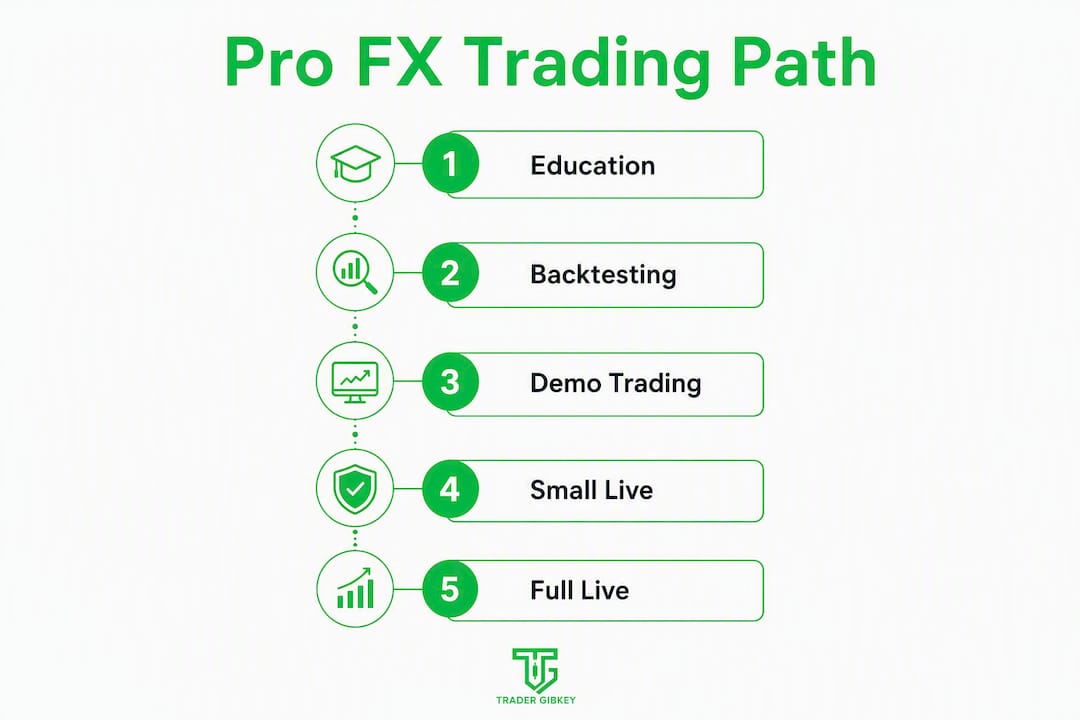
Follow these phases in order. Rushing to live capital before your system is validated is the single most common reason traders fail.
Phase 1: Education and skill-building
- Complete a structured course covering price action, risk management, and strategy design
- Study the mechanics of the pairs you plan to trade (correlations, session behavior, news sensitivity)
- Learn your platform inside out: order types, charting tools, and execution settings
- Begin a trading journal from day one, even if you’re only paper trading
Phase 2: Backtesting and demo validation
- Backtest your strategy manually across at least 100–200 historical trades
- Record expectancy, win rate, profit factor, and max drawdown from your backtest data
- Run the same system on a demo account for at least 60 days in real-time conditions
- Only progress when your demo metrics match your backtest targets
Phase 3: Small live account
- Fund a small live account (many traders start with $500–$2,000) and trade minimum position sizes
- Apply the same rules you used in demo, without exception
- Track slippage, spreads, and emotional differences from demo trading
- Do not scale size until you’ve completed at least 50 live trades with consistent metrics
Phase 4: Scaling or seeking funded capital (ongoing)
- Apply for a funded account evaluation once your live metrics meet institutional targets
- Or scale your own capital gradually, increasing position size only after each profitable quarter
Timeline reality check:
- Most traders reach consistent demo profitability within a year of focused study
- Reaching consistent live profitability takes about one to two years for many
- Passing a funded account evaluation and maintaining it requires additional time and discipline
Typical cost estimates:
- Quality structured course or mentorship may cost a few hundred to over a thousand dollars
- Charting software subscriptions often require annual fees
- Funded account evaluation fees vary depending on provider
- Many traders begin with small live accounts to limit risk
Day trading specifically requires focused time, fast decision-making, and strict risk controls. It’s not a part-time activity. If your schedule doesn’t allow dedicated session blocks, swing trading or position trading will serve your development better.
Milestone checklist before scaling:
- Minimum 100 documented trades in your journal
- Equity curve trending upward over the last 50 trades
- Max drawdown below your defined threshold
- Profit factor above 1.5 on live trades
- No revenge trades in the last 30 sessions
Which platforms and tools should you use as a U.S. trader?
MetaTrader 4 remains the most widely supported execution platform globally, with a massive library of expert advisors and custom indicators. MetaTrader 5 adds more order types, a built-in economic calendar, and better multi-asset support. For charting and analysis, TradingView is the professional standard: clean interface, community scripts, and real-time alerts that work across devices. Most serious traders use MT4 or MT5 for execution and TradingView for analysis.
Platform selection by use case:
- MetaTrader 4: Best for automated strategies, large indicator library, widely supported by U.S.-accessible brokers
- MetaTrader 5: Better for multi-asset trading, more advanced order types, built-in depth of market
- TradingView: Best for charting, strategy visualization, and community-built tools
Understanding session overlap windows matters for execution quality. The London/New York overlap (8 AM–12 PM ET) consistently produces the highest liquidity and tightest spreads on major pairs.
Broker selection checklist for U.S. traders:
- Confirm NFA membership via the NFA’s BASIC lookup tool
- Confirm CFTC registration for retail forex dealers
- Check the customer agreement for order execution policies and slippage disclosure
- Verify leverage limits (U.S. rules cap retail forex leverage at 50:1 on major pairs, 20:1 on minors)
- Look for segregated client funds and clear margin call procedures
- Avoid brokers that cannot produce a clear regulatory registration number
U.S. regulatory note: The CFTC and NFA jointly regulate retail forex in the United States. Any broker offering forex to U.S. retail clients must be registered as a Retail Foreign Exchange Dealer (RFED) with the CFTC and be an NFA member. Verifying this takes under two minutes on the NFA BASIC site and is non-negotiable before depositing funds.
Brokers like FxPro publicly list their regulatory authorizations as an example of transparency. Use that standard as your baseline: if a broker doesn’t make its regulatory credentials easy to find, that’s your answer.
How do you test a strategy before trading it live?
The professional testing sequence runs in one direction: backtest, then forward test, then paper trade, then small live. Never skip ahead.
Backtesting best practices:
- Use multiple years of historical data across different market conditions
- Record every signal your rules would have generated, not just the ones that look good
- Calculate expectancy: (Win rate × Average win) minus (Loss rate × Average loss)
- Iterative development works: start with simple support/resistance rules, then add filters like minimum move size or volume confirmation to improve signal quality
Performance metrics to track:
- Expectancy: Should be positive; above 0.5R is a solid target
- Profit factor: Total gross profit divided by total gross loss; target above 1.5 for live trading, above 2.0 for funded account applications
- Win rate: Less important than expectancy, but know yours
- Average R: Average return in multiples of your risk per trade
- Max drawdown: Your system’s worst peak-to-trough loss; keep it below your hard stop threshold
- Sharpe/Sortino ratio: Measures return relative to risk; higher is better, with Sortino penalizing only downside volatility
Journal template: what to record on every trade:
- Date, pair, session, and timeframe
- Setup type and entry trigger
- Entry price, stop loss, take profit, and position size
- Emotional state at entry (calm, hesitant, confident, anxious)
- Exit price and outcome in R
- Follow-up action: what you’d do differently and why
Review your journal weekly. Look for patterns in your losing trades. Most traders find that 80% of their losses cluster around 2–3 behavioral mistakes, not strategy failures. Fixing those is faster than rebuilding a system. You can also use Tradergibkey’s guide to spotting ineffective systems to distinguish a broken strategy from a fixable execution habit.
How do you choose a mentor or course worth paying for?
Mentorship accelerates learning when it provides live feedback on real trades, a verified track record, and a curriculum you can follow step by step. The problem is that the forex education space has more noise than signal. Here’s how to filter it.
Questions to ask before paying:
- Can you show audited or verified trading results, not just screenshots?
- How often do you run live trading sessions, and can I attend one before I buy?
- What does your refund policy look like if the course doesn’t deliver?
- Do students get direct feedback on their trades, or just pre-recorded content?
- What’s the typical student outcome after completing the program?
Red flags that should stop you immediately:
- Guaranteed returns or specific profit percentages promised
- “Secret” systems that can’t be explained in plain terms
- Anonymous track records with no verifiable source
- Pressure to buy a funded account challenge before you’ve completed any training
- No community or peer review component
- Coaches who can’t explain why a setup works, only what it looks like
How to validate claims:
Request a sample session or trial period. Ask to see student results from people who started where you are now. Check whether the community is active and whether the mentor engages directly. Online forex communities with active mentor participation are a strong signal of genuine investment in student outcomes.
Strategy selection is not one-size-fits-all. A good mentor tailors the approach to your time availability, chart preference, and psychological capacity rather than handing you a generic system and calling it done.
What can you realistically earn as a professional forex trader?
Earnings vary enormously based on capital, risk tolerance, and consistency. There’s no honest flat answer. What you can control is your risk per trade and your adherence to your system. What you cannot control is whether the market cooperates in any given month.
Example scenarios (illustrative, not guaranteed):
| Scenario | Starting Capital | Avg. Monthly Return | Annual Estimate |
|---|---|---|---|
| Conservative | Moderate capital size | Low monthly return | Corresponding annual earnings |
| Typical professional | Larger capital | Moderate monthly return | Estimated annual earnings |
| Funded account (scaled) | Institutional capital | Moderate to high trader returns | Variable earnings depending on profit splits |
Professional performance metric targets:
| Metric | Target Range | Notes |
|---|---|---|
| Max drawdown | Below your defined threshold | Institutional-grade funded account standard |
| Profit factor | Above 2.0 | Required for most funded account evaluations |
| Win rate | 40–60% | Less important than R-multiple and expectancy |
| Max drawdown | Below 3.5% | Institutional-grade funded account standard |
| Monthly return | 3–6% | Sustainable range; above 10% monthly is high risk |
Key caveats:
- Scale only after meeting your drawdown and profit factor targets consistently
- Compounding modest monthly returns over 2–3 years outperforms chasing large monthly gains with high leverage
- Funded account splits typically range from 70–90% to the trader; read the terms carefully
- Treat your first year of live trading as tuition, not income
U.S. regulation, compliance, and tax basics for forex traders
U.S. traders should verify NFA/CFTC registration before funding any broker account, and treat forex tax reporting as potentially ordinary income under Section 988 unless they have made a specific election otherwise. Both points require action before you trade, not after.
Broker compliance checklist:
- Confirm CFTC registration as an RFED (Retail Foreign Exchange Dealer)
- Confirm NFA membership via the NFA BASIC lookup
- Read the customer agreement for execution policies, margin maintenance requirements, and dispute resolution
- Note that U.S. rules limit retail forex leverage to 50:1 on major pairs and 20:1 on minor pairs
- Avoid offshore brokers that are not registered with U.S. regulators; they offer no CFTC or NFA protections
Tax treatment basics:
- Most U.S. retail forex gains default to Section 988 treatment: taxed as ordinary income
- Section 1256 treatment (60/40 capital gains split) may apply in specific circumstances, but requires a contemporaneous election and professional guidance
- Keep detailed records of every trade: date, pair, entry/exit prices, and profit/loss in USD
- Consult a CPA with forex trading experience before filing; the rules are specific and the IRS treats forex differently from equities
This article is general information, not tax or legal advice. Confirm current rules with the IRS or a qualified tax professional for your specific situation.
Why Tradergibkey’s mentorship accelerates your path to professional trading
Structured, mentor-led learning compresses the timeline from beginner to consistent trader by replacing trial-and-error with a tested system and direct feedback. That’s the core value proposition of any serious mentorship program, and it’s what Tradergibkey is built around.
Tradergibkey brings over 18 years of live market experience to its curriculum, with a focus on practical price action strategies rather than theoretical frameworks that don’t hold up in real conditions. The program is designed for traders who want to move from uncertain to confident, with a clear structure rather than a pile of disconnected content.
What the Tradergibkey program includes:
- Structured course modules covering price action, risk management, and strategy design
- Live trading sessions where students watch and ask questions in real time
- Journaling tools and system templates to track performance from day one
- Daily market analysis to contextualize what students are learning
- Community access with peer feedback and mentor engagement
- Trading psychology support to address the emotional side of consistent execution
The program is available on a monthly or annual subscription, with a lifetime package option for traders who want permanent access. Mentorship packages are available separately for traders who want direct one-on-one feedback. A private Telegram channel provides weekly and monthly market analysis for traders who want ongoing support without a full course commitment.
Key Takeaways
Becoming a professional forex trader requires a structured sequence: education, validated testing, and disciplined live trading, with institutional-grade metrics guiding every decision to scale.
| Point | Details |
|---|---|
| Follow the sequence | Education, then backtesting, then demo, then small live, then scale. Never skip a phase. |
| Track institutional metrics | Target a profit factor above 2.0 and max drawdown below 3.5% before seeking funded capital. |
| Verify your broker | Confirm NFA membership and CFTC registration before depositing any funds as a U.S. trader. |
| Journal every trade | Log setup, emotion, and outcome on every trade; review weekly to find behavioral patterns. |
| Tradergibkey mentorship | Tradergibkey’s structured curriculum, live sessions, and community provide a tested path to consistent trading. |
What most traders get wrong about becoming a professional
The conventional wisdom says you need a better strategy. The traders who actually make it say you need better habits. That gap is where most aspiring professionals stall.
What I see consistently is that the traders who progress fastest are not the ones who found the “right” system first. They’re the ones who committed to journaling before they felt ready, who reviewed their trades when it was uncomfortable, and who asked for feedback on their worst decisions rather than their best ones. The strategy matters, but it’s the third or fourth most important variable, not the first.
The psychological pitfall that derails more traders than any market condition is the belief that a losing streak means the system is broken. Usually it means the trader is. Mentorship addresses this directly because a mentor can see the difference between a strategy failure and an execution failure, and most traders cannot make that distinction alone when they’re in the middle of a drawdown.
The other thing worth saying plainly: the traders who treat their first 12–18 months as a learning investment rather than an income source almost always come out the other side with a real edge. The ones who need it to work financially from month one almost never do. That’s not pessimism. It’s the pattern.
Tradergibkey: structured mentorship for traders who are serious about going pro
Tradergibkey gives you what free resources can’t: live feedback on your actual trades, a verified price action system, and a community of traders working through the same process you are. That combination shortens the learning curve in a way that self-study rarely does.
The program covers everything from foundational price action to advanced risk management, with live sessions, journal templates, and daily market analysis included. You get a structured path, not a content library you have to figure out on your own.
Subscription options include monthly and annual plans, with a lifetime access package for traders who want to commit fully. Mentorship packages are available for direct one-on-one coaching. The private Telegram channel is available separately for ongoing market analysis and community support.
If you’re ready to trade with a system you can trust, start with Tradergibkey and see what structured mentorship actually looks like in practice.
Useful sources and further reading
Use these to verify regulators, study strategy frameworks, and explore platform documentation:
- NFA BASIC Lookup Tool — Verify any U.S. forex broker’s NFA membership and registration status
- CFTC Retail Forex Information — Official CFTC guidance for retail forex traders in the United States
- Investopedia: Forex Trading Strategies — Foundational overview of strategy design, backtesting, and system development
- Admiral Markets: Forex Strategy Guide — Practical breakdown of strategy types by timeframe and trader profile
- IG: Forex Day Trading Guide — Day trading requirements, strategies, and execution considerations
- Tradergibkey Blog — Internal resources on price action, psychology, journaling, and strategy validation
- Ashraf Laidi — Independent strategist and author of Currency Trading & Intermarket Analysis; useful for intermarket and macro context
Tax disclaimer: Forex tax treatment in the United States is specific and fact-dependent. Consult a CPA with forex trading experience for guidance on your individual situation before filing.
FAQ
What is a pro FX trader? A professional FX trader manages risk to a written plan, tracks performance metrics, and treats trading as a business. The key difference from a hobbyist is accountability and consistency, not just profitability.
How long does it take to become a professional forex trader? Most traders reach consistent live profitability in 12–24 months of focused, structured practice. Rushing to live capital before validating a system on demo is the most common reason that timeline stretches further.
Do I need a large account to trade forex professionally? No. Many professionals start with small live accounts and scale through funded account programs once their metrics qualify. Capital size matters less than discipline and verified performance.