
A tailored trading approach is a method built around you: your risk tolerance, your schedule, your psychology, and your edge in the market. It is the opposite of copying a generic system and hoping it fits. The Taylor Trading Technique, developed by George Douglas Taylor and published in his 1950 book The Taylor Trading Technique, is one of the clearest historical examples of this philosophy in action. Taylor observed that markets cycle in roughly 2–3 day rhythms, alternating between trending moves and trading ranges. He built an entire framework around that rhythm, classifying each trading day as one of three types:
- Buy Day: The market pulls back to a low where buyers step in.
- Sell Day: Price rallies from the Buy Day low, offering a selling opportunity at or near the high.
- Sell Short Day: The market fails to hold the Sell Day high, creating a short entry.
This three-day cycle gives traders a repeatable structure for timing entries and exits. The technique does not eliminate uncertainty, but it replaces guesswork with a disciplined, observable framework.
How George Douglas Taylor’s market rhythm actually works
Taylor’s core insight was that markets do not move randomly from day to day. They tend to oscillate in predictable blocks, and a trader who learns to read those blocks gains a timing edge that generic strategies simply do not offer.
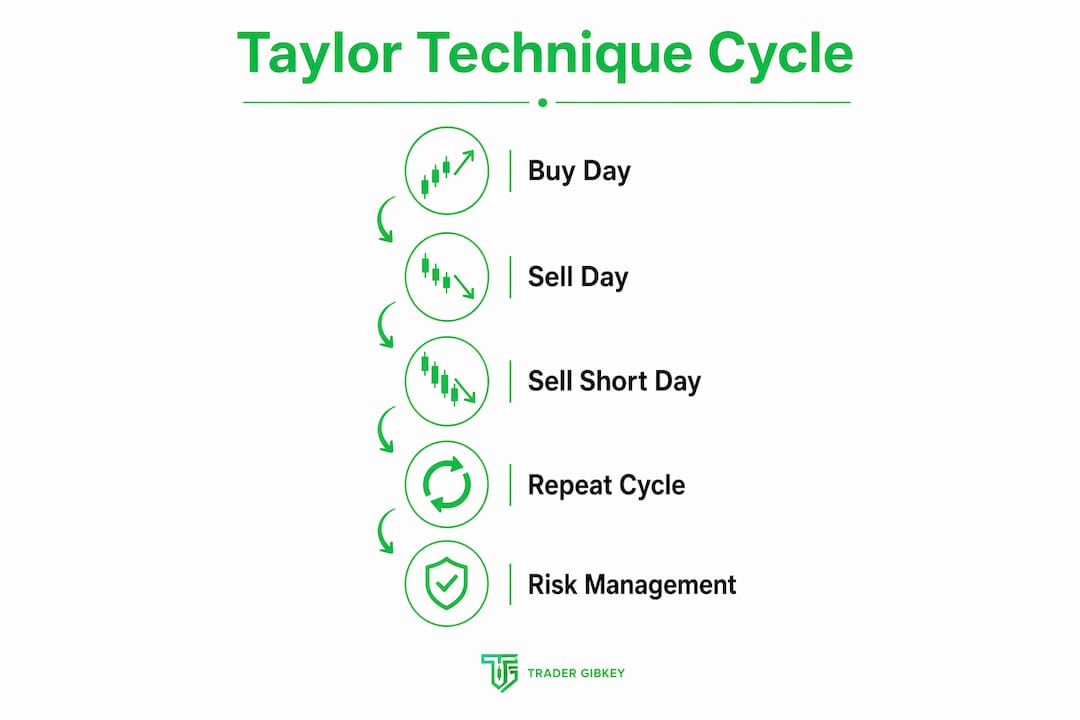
The rhythm works like this: after a multi-day decline, a Buy Day forms when price drops to a level where demand absorbs selling. The following Sell Day sees price push higher, often back toward recent resistance. If that rally stalls and reverses, the third day becomes a Sell Short Day, where the failed high signals a short opportunity. Then the cycle resets.

Taylor documented this behavior in the 1950s by keeping meticulous handwritten records of daily price action, long before electronic charting existed. His method was rooted in observation, not theory. That grounding in raw price data is exactly why the technique still resonates with traders who study price action today.
Shorter-term and intermediate-term traders tend to lean heavily on technical analysis, and Taylor’s framework fits squarely in that camp. The previous day’s high and low serve as the key reference points for each new session, making the method objective and testable.
How the Taylor Trading Technique works in practice
Applying the technique day to day comes down to a clear sequence of observations and decisions.
Step-by-step process:
- Record the previous day’s high and low. These are your reference levels for the current session.
- Classify the current day. Based on where you are in the cycle, label the day as Buy, Sell, or Sell Short.
- Wait for price to reach the expected level. On a Buy Day, wait for a pullback toward or below the prior low before entering long. Do not chase.
- Set your exit before you enter. On a Sell Day, target the prior high or a logical resistance level. Know where you are getting out before price gets there.
- On a Sell Short Day, look for a failed rally. If price pushes above the prior high and then reverses, that failure is your signal.
- Log every trade. Taylor kept written records; you should too, especially by tracking options trades systematically. Tracking options trades systematically, for example, is a practice that applies directly here.
Common limitations to keep in mind:
- The cycle does not always run in a clean three-day sequence. Strong trending markets can extend Buy Days or skip Sell Short Days entirely.
- News events and macro catalysts can override the rhythm without warning.
- The technique works best on liquid markets with clear daily price structure, such as major forex pairs, equity indices, or futures.
- Misclassifying the current day in the cycle is the most frequent mistake beginners make. When in doubt, sit out.
Pro Tip: If you cannot clearly identify which day in the cycle you are on, that ambiguity is a signal to skip the trade. Forcing a classification is how the technique breaks down.
How to implement a personalized strategy using the Taylor Technique
Knowing the theory is one thing. Building it into a trading plan you can actually execute under pressure is another. Here is how to make the Taylor Technique your own.
- Define your risk per trade first. Standard risk guidelines place per-trade risk at 0.5%–1.0% of account equity, with a daily loss limit set at twice that figure. Build those numbers into your plan before you place a single trade.
- Write specific entry triggers, not vague labels. “Buy Day entry” is not enough. Your rule might be: “Enter long when price trades below yesterday’s low by at least 5 pips and closes back above it on the 15-minute chart.” Vague entry criteria produce inconsistent results every time.
- Set your stop-loss before you enter. Place it at a level that proves your cycle classification wrong, not at a round number that feels comfortable.
- Define conditions to skip trades. High-impact news releases, low-volume sessions, and days when the cycle is unclear are all valid reasons to stand aside. Knowing when not to trade is as valuable as knowing when to trade.
- Narrow your instrument list. Focusing on a narrow set of correlated assets and deeply understanding their price behavior gives you a decisive edge over traders who jump between markets.
- Keep a trading diary. Document the cycle classification, entry trigger, stop level, and outcome for every trade. That record is how you spot where your application of the technique drifts from the rules.
Pro Tip: Simplicity protects you. If your entry rule takes more than two sentences to explain, it is probably too complicated to execute consistently under live market conditions.

Key points to carry forward from the Taylor Technique
The Taylor Trading Technique works because it gives structure to something most traders treat as noise: the day-to-day rhythm of price. Here is what matters most.
- The three-day cycle (Buy, Sell, Sell Short) gives you a framework for anticipating market behavior rather than reacting to it.
- The previous day’s high and low are your anchors. Every decision flows from those two numbers.
- Personalization is not optional. The technique gives you the structure; your risk rules, instrument selection, and entry triggers make it yours.
- Skipping trades is part of the strategy. When the cycle is unclear, the correct move is no move.
- Consistency compounds. A trader who applies a clear, personalized method across hundreds of trades will outperform one who switches systems at the first losing streak.
- The technique is most effective when paired with a written trading plan that specifies every rule in advance.
Developing your own trading plan: risk management and goal setting
A tailored trading approach without a written plan is just an idea. The plan is what makes it executable.
Start with risk. Risking 0.5%–1.0% of account equity per trade, with a daily loss limit at twice that figure, is the professional standard. Hit the daily limit and you stop trading until you review. No exceptions. This single rule prevents the kind of catastrophic drawdown that ends trading careers.
Risk management is the core foundation of any successful trading strategy. Without it, even a well-calibrated technique like Taylor’s can destroy an account during a losing streak.
Goals need the same specificity. A SMART goal for a trader might be: “Increase portfolio value over the next 12 months, measured through a documented trading diary reviewed weekly.” That is specific, measurable, and time-bound. “Make more money” is not a plan.
- Backtest against failure modes, not just peak conditions. Stress-testing your strategy against high-volatility periods and low-liquidity sessions reveals weaknesses that a clean historical backtest will hide.
- Avoid information overload. Too many indicators cause analysis paralysis. The Taylor Technique uses price alone. That is a feature, not a limitation.
- Keep a trading journal. Log every trade with the cycle classification, entry rationale, and outcome. Review it weekly. That review loop is where improvement actually happens.
- Review your risk management rules regularly. Markets change, and your position sizing should reflect your current account size and confidence level.
Pro Tip: If you cannot explain why you entered a trade in one sentence, the strategy is not tailored enough yet. Clarity in your reasoning is the clearest sign that a plan is genuinely yours.
The psychological side matters too. Over-complexity is a confidence killer. A plan you fully understand and believe in is one you will actually follow when the market moves against you. If you cannot own the analysis, you cannot act on it with conviction.
Key Takeaways
A tailored trading approach built around the Taylor Trading Technique gives traders a structured, repeatable framework for timing entries and exits based on a three-day market rhythm.
| Point | Details |
|---|---|
| Three-day cycle structure | Buy, Sell, and Sell Short Days provide a repeatable framework for anticipating daily market behavior. |
| Risk per trade standard | Professional guidelines place per-trade risk at 0.5%–1.0% of account equity, with a daily loss limit at twice that figure. |
| Specific entry triggers | Vague labels produce inconsistent results; every entry rule must be observable and testable. |
| Skip-trade discipline | Defining when not to trade is as important as defining when to enter. |
| Written plan requirement | A documented plan with cycle rules, risk limits, and a trading diary is what converts a technique into a sustainable strategy. |
FAQ
What is the Taylor Trading Technique? It is a structured trading method developed by George Douglas Taylor that uses a three-day market rhythm, classifying each day as a Buy Day, Sell Day, or Sell Short Day to guide entry and exit timing.
How much should I risk per trade in a tailored trading plan? The professional standard is 0.5%–1.0% of account equity per trade, with a daily loss limit set at twice that amount.
Can the Taylor Technique work for forex trading? Yes. The technique applies well to liquid forex pairs because they produce clear daily price structure, making the previous day’s high and low reliable reference levels.