
A trading session overlap is defined as the period when two major forex market sessions are open simultaneously, concentrating liquidity and creating the most active trading conditions of the day. The forex market runs 24 hours, but not all hours are equal. The four main sessions, Sydney, Tokyo, London, and New York, each attract different participants and currency pairs. When two sessions run at the same time, order flow spikes, spreads tighten, and price moves with more conviction. Understanding when sessions overlap is one of the most practical edges you can build into your trading routine.
What is a trading session overlap, and why does it matter?
A session overlap is not just a scheduling curiosity. It is the single most reliable window for finding liquid, fast-moving markets in forex. When two major financial centers are both active, institutional banks, hedge funds, and retail traders all compete in the same pool. That competition narrows spreads and generates the kind of directional price action that supports breakout and momentum strategies.
The forex market has no true downtime. The four sessions connect end to end across the globe. Sydney runs from 21:00 to 06:00 UTC, Tokyo from 00:00 to 09:00 UTC, London from 07:00 to 16:00 UTC, and New York from 12:00 to 21:00 UTC. Each session hands off to the next, but the handoff periods are where the real action concentrates.
Traders who ignore session timing often wonder why their setups work in one part of the day and fail in another. The answer is almost always liquidity. A technically perfect setup in a low-volume window will often produce wide spreads, slow fills, and choppy price action. The same setup during an overlap can produce clean, fast movement.

What are the major forex trading sessions and their standard hours?
The four sessions each have a distinct personality shaped by the financial centers they represent. Sydney is the quietest, driven largely by Australian dollar and New Zealand dollar flows. Tokyo brings in Japanese yen pairs and some activity in the Australian dollar. London is the largest single session by volume, covering European currencies and setting the tone for much of the day. New York mirrors and extends London’s momentum, with heavy USD flow across all major pairs.
| Session | UTC hours | Key pairs | Activity level |
|---|---|---|---|
| Sydney | 21:00–06:00 | AUD/USD, NZD/USD | Low |
| Tokyo | 00:00–09:00 | USD/JPY, AUD/JPY | Moderate |
| London | 07:00–16:00 | EUR/USD, GBP/USD | High |
| New York | 12:00–21:00 | EUR/USD, USD/CAD | High |
The London session alone accounts for the largest share of daily forex volume. New York amplifies that volume when it opens at 12:00 UTC. The overlap between these two sessions is where the market reaches its peak activity. Sydney and Tokyo are worth understanding, but they operate at a fraction of the volume seen during the European and American hours.
One thing traders often miss: the sessions do not simply turn on and off at their listed times. Activity builds in the 30 minutes before a session opens and fades gradually after it closes. The listed UTC times are the formal open and close, but the real energy shifts slightly around those marks.
Which session overlaps carry the most liquidity and volatility?
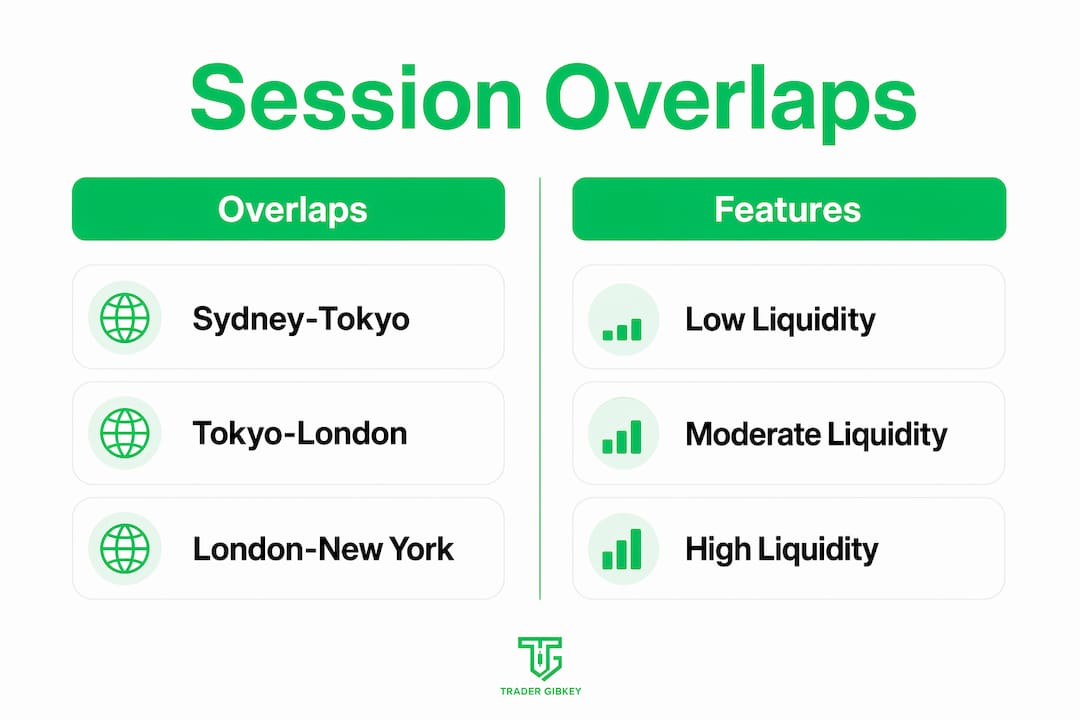
Three distinct overlap windows exist in the forex trading day. Each has a different character, and knowing which one fits your strategy is more useful than trying to trade all three.
The Sydney-Tokyo overlap runs from approximately 00:00 to 06:00 UTC. This is the quietest of the three. AUD, NZD, and JPY pairs see steady flow, but overall volume stays low. Scalpers and range traders sometimes find clean setups here, but breakout traders will find the moves too small to justify the risk.
The Tokyo-London overlap lasts roughly 1–2 hours, from about 07:00 to 09:00 UTC. It is shorter and less liquid than the London-New York window, but it still generates notable volatility in EUR/JPY and GBP/JPY. The London open is one of the most watched moments in the trading day. Institutional desks in Europe begin executing large orders, and that order flow often creates sharp moves in yen crosses and European pairs.
The London-New York overlap runs from 12:00 to 16:00 UTC and is the most significant period in the entire forex trading day. EUR/USD average hourly range peaks at 14:00 UTC during this window. EUR/USD, GBP/USD, and gold all see their sharpest price movements here. This is where the majority of institutional volume crosses the market.
| Overlap | UTC timing | Liquidity | Key pairs | Best for |
|---|---|---|---|---|
| Sydney-Tokyo | 00:00–06:00 | Low | AUD/USD, NZD/JPY | Range trading |
| Tokyo-London | 07:00–09:00 | Moderate | EUR/JPY, GBP/JPY | Breakout at London open |
| London-New York | 12:00–16:00 | Highest | EUR/USD, GBP/USD, gold | Momentum, breakout |
Pro Tip: If you can only trade one window per day, make it 12:00 to 16:00 UTC. That four-hour block consistently produces the tightest spreads and the most defined price moves of the entire trading day.
How do session overlaps influence trading strategies and costs?
Overlaps directly reduce your cost to trade. EUR/USD spreads tighten to their narrowest during the London and London-New York windows. In the quiet pre-London hours, those same spreads can double. Every pip of spread you pay is a pip your trade needs to recover before it becomes profitable. Trading during overlaps puts that math in your favor from the start.
The increased volatility during overlaps also opens up specific strategy types that simply do not work in low-volume conditions:
- Breakout trading: The London open at 07:00 UTC frequently breaks out of the Asian session range. Price has been consolidating for hours, and European institutional flow triggers the move.
- Momentum trading: The London-New York overlap sustains directional moves long enough for momentum entries to play out. You are not fighting thin markets or random noise.
- News trading: Most high-impact economic releases from the US and Europe fall within the London-New York overlap. Volume is already elevated, so the market can absorb and react to news more cleanly.
- Swing trade entries: Even if you hold trades for days, entering during an overlap gives you a cleaner fill and a tighter initial spread.
Contrast this with trading during the Sydney session or the dead zone between New York close and Sydney open. Spreads widen, volume drops, and price action becomes choppy and unreliable. Setups that look perfect on a chart can fail simply because there is not enough participation to push price through key levels.
Risk management also changes during overlaps. Volatility is higher, which means stop losses need more room. A stop that works fine during a quiet Asian session may get hit by normal overlap noise before the trade has a chance to develop. Sizing down slightly during high-volatility overlap periods is a practical adjustment, not a sign of weakness.
Pro Tip: Always check your broker’s spread schedule before trading. Some brokers widen spreads artificially around news events even during high-liquidity overlap windows. Knowing your actual cost in advance prevents surprises.
How can traders use session overlaps in their daily routine?
Building overlaps into your routine starts with one hard rule: track all session times in UTC. Tracking in UTC eliminates errors caused by daylight saving time changes and regional time zone differences. Your local clock shifts twice a year. UTC does not. One missed adjustment can put you an hour off on the London open, which is enough to miss the best part of the move.
Here is a practical daily framework built around session overlaps:
- Set your clock to UTC. Most trading platforms display UTC. If yours does not, add a UTC clock to your workspace.
- Mark the Tokyo-London overlap (07:00–09:00 UTC). Watch for breakouts from the Asian range. EUR/JPY and GBP/JPY are the pairs to focus on here.
- Prepare for the London-New York overlap (12:00–16:00 UTC). This is your primary trading window. Review your setups, check the economic calendar for US and European releases, and have your levels ready before 12:00 UTC.
- Convert UTC to your local time once and write it down. Do this at the start of each month to account for any daylight saving changes in your region.
- Avoid trading the 21:00–00:00 UTC window unless you specialize in AUD or NZD pairs. Volume is at its lowest, and the risk-to-reward on most setups deteriorates.
If you are an Asian-based trader with limited availability during the London-New York overlap, focus on the Tokyo-London window and JPY pair setups. The moves are smaller, but the structure is cleaner than trading the dead hours of the Sydney session. Matching your schedule to the best available overlap is always better than forcing trades during low-volume periods.
Aligning your schedule with high-activity windows consistently produces better outcomes than trading low-liquidity hours. This is not theory. It shows up in tighter fills, cleaner price action, and fewer random stop-outs.
Key Takeaways
Session overlaps are the highest-probability windows in the forex trading day, and the London-New York overlap from 12:00 to 16:00 UTC is the most liquid and active period available to any trader.
| Point | Details |
|---|---|
| Definition of overlap | Two major sessions open simultaneously, concentrating liquidity and tightening spreads. |
| Best overlap window | London-New York (12:00–16:00 UTC) offers the highest volume and sharpest price moves. |
| Cost advantage | Spreads narrow during overlaps, reducing the cost of every trade you place. |
| Strategy alignment | Breakout and momentum strategies perform best during high-liquidity overlap windows. |
| UTC tracking | Always use UTC to track session times and avoid daylight saving errors. |
Why I stopped ignoring session timing early in my career
For the first few years of trading, I treated the forex market like it was always the same. I would pull up a chart at whatever time suited me and look for setups. Sometimes they worked. More often, they did not. I blamed my analysis. I blamed my entries. The real problem was that I was often trading in windows where the market had no real intention of moving anywhere.
The shift happened when I started logging not just my trades but the time of day I took them. The pattern was obvious within a month. My losing trades clustered in the pre-London hours and the late New York session. My winning trades clustered in the London-New York overlap. I had not changed my strategy at all. I had just started paying attention to when I was trading.
The mistake I see most often now is traders chasing setups during the Asian session on EUR/USD. The pair is technically active, but the range is narrow and the moves are often reversed when London opens. You can be right about direction and still lose because you entered at the wrong time. Timing is not a secondary consideration. It is part of the trade.
My hard rule now: if a setup does not fall within a meaningful overlap window, I wait. The market will give you another opportunity during a better window. Forcing a trade during dead hours because you are bored or impatient is how you bleed your account slowly. Discipline around session timing is one of the simplest and most underrated edges in this business.
— Gabriel
Sharpen your timing with Tradergibkey
Understanding session overlaps is one piece of the puzzle. Knowing exactly how to read price action within those windows, manage risk, and build a consistent routine is where real progress happens.

Tradergibkey’s trading courses and mentorship cover session-based strategy in depth, with practical frameworks built from over 18 years of live market experience. You get structured lessons, a community of active traders, and direct access to guidance that goes well beyond theory. If you are ready to trade smarter and stop leaving money on the table during low-volume hours, Tradergibkey is the place to build that foundation.
FAQ
What is the best time of day to trade forex?
The London-New York overlap from 12:00 to 16:00 UTC is the best time to trade forex. EUR/USD sees its highest average hourly range during this window, with the tightest spreads and strongest price moves of the day.
When do the London and New York sessions overlap?
The London and New York sessions overlap from 12:00 to 16:00 UTC. This four-hour window is the most liquid period in the forex market.
Why should I track forex sessions in UTC?
UTC eliminates errors caused by daylight saving time changes across different regions. Your local clock shifts seasonally, but UTC stays constant, keeping your session timing accurate year-round.