
Every trade idea you share should include five things: the symbol and timeframe, a clear directional scenario, key levels (entry, targets, stop), a specific invalidation point, and a brief risk note. That single structure separates a useful post from noise — and it’s the foundation of every constructive trading strategy worth discussing.
Here’s a copy-ready checklist you can use right now:
- Symbol + timeframe: e.g., EUR/USD, 4H
- Scenario: bullish, bearish, or neutral — and the one-sentence reason why
- Key levels: entry zone, first target, final target
- Invalidation point: the exact price where the thesis is wrong
- Position-sizing note: percent risk per trade (a commonly recommended conservative range)
- One question for reviewers: e.g., “Does my stop placement make sense given this support zone?”
- Risk disclaimer: “Educational only — not financial advice”
Keep your chart clean. Mark only what supports your thesis. According to MetaTrader’s Ideas guidelines, a high-quality idea includes the asset, timeframe, scenario, key levels, and a specific invalidation point — and publishers should always include a risk disclaimer and avoid any language that promises guaranteed profit.
Key Takeaways
Sharing trade ideas constructively requires a five-field template, a systematic evaluation checklist, and a feedback loop that converts community input into hard rules.
| Point | Details |
|---|---|
| Use the five-field template | Every shared idea needs symbol/timeframe, scenario, levels, invalidation, and a risk note. |
| Limit per-trade risk | Risk 0.5%–2% of account capital per trade and size positions from your stop distance. |
| Ask one specific question | Targeted reviewer questions (“Is my stop correct?”) produce ruleable feedback; general ones produce noise. |
| Journal every shared idea | Log the plan, feedback received, execution result, and the rule you created from the outcome. |
| Tradergibkey mentorship | Structured mentor-led reviews and live critique sessions convert repeated mistakes into tested rules. |
Table of Contents
- Where do you find high-quality trade ideas?
- How do you evaluate any trade idea before acting on it?
- How do you write a trade idea that’s actually worth sharing?
- How do you share constructively in a trading community?
- Turning a community idea into an executable trade plan
- What are the red flags in community trade ideas?
- Which tools speed up idea discovery, sharing, and evaluation?
- When does mentorship make more sense than community feedback alone?
- Legal and compliance considerations when sharing trade ideas publicly
- Why structured sharing changed how I make decisions
- Tradergibkey’s structured mentorship gives you a real feedback loop
- Sources
- FAQ
Where do you find high-quality trade ideas?
The source of an idea shapes how easy it is to verify, replicate, and share. Not all sources suit every timeframe, and some are far more community-friendly than others.
Main source types
- Technical chart platforms (e.g., TradingView’s public ideas feed): annotated setups with visible logic, best for swing and positional traders. High replicability. Easy to backtest visually.
- News and event scanners (e.g., Benzinga Pro, Briefing.com): catalyst-driven ideas tied to earnings, macro data, or Fed decisions. Best for day traders. Hard to backtest systematically.
- Algorithmic and AI screeners (e.g., Trade Ideas, Finviz): filter-based discovery using price action, volume, or momentum criteria. Good for scalp and day setups. Backtestability depends on the screener’s export features.
- Watchlists and alerts: your own curated list of setups in progress. Highest personal relevance, lowest noise. Suitable for any timeframe.
- Mentor or paid rooms (e.g., Warrior Trading): live commentary with real-time rationale. Excellent for learning execution context. Hard to verify independently.
- Community threads (forums, Discord, Telegram): broad discovery, high noise. Useful for generating hypotheses, not for direct execution.
Online communities and social platforms are valuable for discovery and discussion, but clarity, data-backed arguments, and privacy should always come first when you’re sharing publicly.
Source comparison by timeframe and verification ease
| Source type | Best timeframe | Ease of backtesting | Community feedback usefulness | Automation support |
|---|---|---|---|---|
| Technical chart platforms | Swing / Positional | High (visual replay) | High — levels are visible | Alerts, chart templates |
| News / event scanners | Day / Scalp | Low (event-dependent) | Medium — context needed | News alerts |
| AI / algorithmic screeners | Scalp / Day | Medium (filter logs) | Low — logic often opaque | Full automation |
| Watchlists and alerts | Any | High (your own data) | Medium — personal context | Price alerts |
| Mentor / paid rooms | Day / Swing | Low (live only) | High — live critique | Replay recordings |
| Community threads | Any | Low | Medium — noisy | Manual only |
Quick trust signals to look for: a clear thesis, a named invalidation level, a replicable entry trigger, and no “guaranteed profit” language. If any of those are missing, treat the idea as incomplete.
How do you evaluate any trade idea before acting on it?
A reproducible evaluation checklist protects you from acting on incomplete setups. Run every idea — yours or someone else’s — through these steps before committing capital.
-
Check market context. Is the idea aligned with the dominant timeframe trend? Is the asset liquid enough to fill your order without significant slippage? What is the current volatility regime — is the stop distance realistic?
-
Verify the mechanics. Is there a clear entry trigger (a candle close, a level break, a specific price)? Is the invalidation point defined — not vague, but a precise level? Are the targets realistic given recent price structure?
-
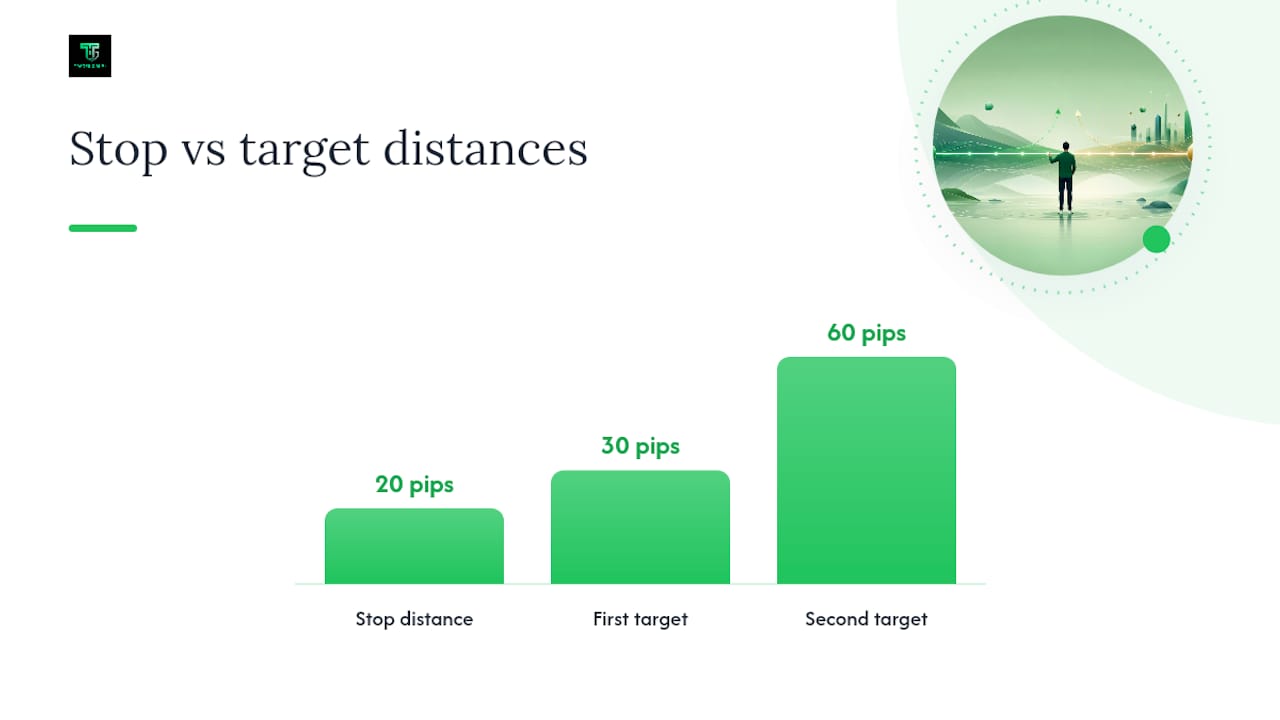
Calculate risk-reward. A minimum 1:2 risk-reward ratio is a common baseline. If the stop is 20 pips and the first target is 30 pips, the math barely works. If the target is 60 pips, you have room.
-
Quantify position size. Use the stop distance and your percent-risk rule to size the trade. Investopedia’s day-trading guidance recommends limiting per-trade risk to the 0.5%–2% range. On a $10,000 account risking 1%, your maximum loss per trade is $100 — your position size follows from there.
-
Assess edge. Is this setup unique to current conditions, or is it a generic pattern? Can you find similar historical examples? Has anyone backtested the logic, even informally?
-
Check verifiability. Can another trader replicate the entry from the description alone? If not, the idea isn’t ready to share or act on.
Pro Tip: Before acting on any community idea, ask one question: “Can I define exactly where I’m wrong?” If the answer is no, decline the trade. A missing invalidation point is the single most reliable red flag in shared ideas.
The ICT trading framework — which sequences bias, liquidity sweep, entry, and management into a repeatable logic — is a useful model for understanding why sequence-based documentation makes ideas easier to evaluate and review.
How do you write a trade idea that’s actually worth sharing?
A shareable idea isn’t just a chart screenshot with arrows. It’s a structured post that lets another trader understand your logic, challenge your assumptions, and give you targeted feedback. Here’s a ready-to-copy template.
The shareable trade idea template
- Title: One line — asset, direction, timeframe (e.g., “GBP/USD Bearish Continuation — 4H”)
- One-sentence thesis: Why you expect this move (e.g., “Price rejected the weekly resistance zone and broke the 4H structure to the downside”)
- Timeframe: Primary and confirmation timeframe
- Levels: Entry zone, stop (invalidation), Target 1, Target 2
- Invalidation: The exact price that proves the thesis wrong
- Trade plan: Intended position size (% risk), order type (limit/market/stop-limit)
- Edge statement: Why this setup has a statistical or structural reason to work
- Reviewer question: One specific question (e.g., “Is my stop above the right swing high?”)
- Disclaimer: “For educational purposes only — not financial advice”
Filled examples across timeframes
Scalp (5-minute, EUR/USD): Thesis: Price swept the Asian session low and reversed with a bullish engulfing candle. Entry: 1.0845. Stop: 1.0838 (below the sweep low). Target 1: 1.0858. Target 2: 1.0870. Invalidation: close below 1.0838. Question: “Does the engulfing candle confirm enough momentum for this entry?”

Day trade (1H, GBP/JPY): Thesis: London open broke above the overnight range high with volume expansion. Entry: 192.40 on retest. Stop: 191.90. Target 1: 193.20. Target 2: 194.00. Invalidation: close back inside the overnight range. Question: “Is the retest entry better than a breakout entry here?”
Swing trade (Daily, USD/CAD): Thesis: Weekly bearish order block confluence with a descending trendline rejection. Entry: 1.3780 limit. Stop: 1.3840. Target 1: 1.3680. Target 2: 1.3580. Invalidation: daily close above 1.3840. Question: “Does the weekly context support a multi-week hold, or is this a one-week setup?”
For chart annotations, keep charts clean — mark only the levels that support your thesis. A clean entry screenshot with the key zone highlighted is more useful than a chart covered in indicators. Editorial picks on platforms like TradingView reward educational clarity over visual complexity.
How do you share constructively in a trading community?
Sharing a trade idea is only half the process. The other half is how you ask for feedback and how you give it. Most community posts fail because they invite general opinions instead of targeted critique.
When posting your idea:
- Share the original plan before the trade, not after. Post-trade commentary is outcome-focused and teaches you nothing about decision quality.
- Include a chart screenshot with your key levels marked.
- Ask one specific question — not “What do you think?” but “Is my stop above the correct swing high, or should it be at the next structure level?”
- Treat every response as a hypothesis, not a verdict. You own the trade and the final decision.
When giving feedback:
- Be chart-based. Reference a specific level, candle, or structure in your response.
- Tie your comment to a ruleable change: “If you move the stop to X, your risk-reward improves to 1:3 without changing the thesis.”
- Avoid outcome-focused comments (“That trade worked, great call”). Focus on the process.
- If the idea is missing an invalidation point, say so directly. That’s the most useful feedback you can give.
Structured community review works best when it includes the original plan, chart evidence, one specific question, the result, and a proposed next rule — so feedback becomes a testable change rather than a vague opinion.
Turning a community idea into an executable trade plan
Reading a good idea and executing it well are two different skills. Here’s how to convert a shared setup into a trade you can actually manage.
- Define the precise entry trigger. A zone is not an entry. Decide: limit order at the top of the zone, market order on a candle close, or stop-limit above a level. Write it down.
- Confirm the stop location. The invalidation point from the idea becomes your stop. Place it at the level that proves the thesis wrong, not at a round number that feels comfortable.
- Set your targets. First target at the nearest significant structure level. Final target at the idea’s stated objective. Plan your scaling: partial close at Target 1, trail the remainder.
- Calculate position size. Formula: (Account balance × % risk) ÷ stop distance in dollars. On a $10,000 account risking 1% with a 20-pip stop on EUR/USD (approx. $20 per standard lot), your position size is $100 ÷ $20 = 5 mini lots. See risk management rules for a full breakdown.
- Choose your order type. Limit orders give better fills but may not trigger. Market orders guarantee entry but carry slippage risk. Stop-limit orders work well for breakout entries where you want confirmation before filling.
Journal template for every shared idea you act on:
- Date and source of the idea
- What feedback you received and what you changed
- Entry, stop, targets as executed
- Result (in R, not dollars)
- The one rule you created or confirmed from this trade
A trading plan built around this execution checklist keeps you from improvising under pressure.
What are the red flags in community trade ideas?
Not every shared idea deserves your capital. Some patterns reliably signal low-quality setups, and recognizing them fast protects your account.
Red flags to check before acting:
- No invalidation point — the idea has no defined “I’m wrong” level
- Overloaded chart — more than three or four indicators, making the actual logic invisible
- “Guaranteed profit” or “can’t lose” language — a hard disqualifier per MetaTrader’s publishing standards
- No position-sizing guidance — the idea treats all accounts as identical
- Confirmation bias framing — the post only shows evidence that supports the direction and ignores contrary signals
- Copying without context — your broker’s spread, execution speed, and account size may make the original entry unworkable for you
Red flag checklist (run before acting on any community idea):
- [ ] Is there a specific invalidation level?
- [ ] Is the chart readable without the author’s explanation?
- [ ] Does the risk-reward work at your account size and broker’s spread?
- [ ] Is the entry trigger replicable from the description alone?
- [ ] Does the idea acknowledge what would make it wrong?
Pro Tip: Paper trade or backtest any community idea at small scale before committing real capital. Even a 10-trade sample on a demo account tells you whether the logic holds in current market conditions.
Recognizing ineffective trading systems early is a skill that saves far more money than any single good trade earns.
Which tools speed up idea discovery, sharing, and evaluation?
You don’t need a complex setup. A lightweight workflow covering four use cases — discovery, publishing, backtesting, and journaling — handles most of what a serious trader needs.
By use case:
- Idea discovery: TradingView’s screener and public ideas feed, Finviz for equity setups, Trade Ideas for AI-driven scans. Each lets you filter by technical criteria and see what other traders are watching.
- Chart publishing: TradingView is the standard for annotated chart sharing. It saves chart state, supports screenshots, and has a built-in community for feedback. Capital Companion offers AI-assisted chart analysis for traders who want a second opinion on their annotations.
- Backtesting: TradingView’s built-in replay tool for manual backtesting, plus dedicated platforms for systematic testing. The ICT framework’s sequence-based logic is particularly well-suited to manual replay because each step is discrete and checkable.
- Alerts and watchlists: TradingView price alerts, broker-native alerts, or Finviz email alerts. Set alerts at your key levels so you’re not staring at charts all day.
- Journaling: Dedicated journals like Edgewonk or TraderVue track R-multiples, setup tags, and feedback notes. A simple spreadsheet works too — the habit matters more than the tool.
Tool selection principles: prefer tools that let you save and restore chart state, export screenshots for review posts, and tag setups by type. Avoid indicator presets that clutter your chart before you’ve even defined your thesis. A clean chart is a shareable chart.
When does mentorship make more sense than community feedback alone?
Community feedback is valuable, but it has limits. If you’re making the same mistake across multiple trades, or if you can’t translate a good idea into a consistent execution process, community commentary alone rarely fixes the problem.
Signs you need structured mentorship:
- You execute inconsistently — same setup, different results, no clear reason why
- You keep repeating the same mistake (wrong stop placement, early exits, oversizing) despite knowing it’s wrong
- You can’t convert a good idea into a written, ruleable plan
- Your journal shows patterns you can’t explain or correct on your own
- You’re learning from community posts but have no way to verify whether the feedback you’re getting is sound
What structured mentorship delivers that community threads don’t:
- Live critique of your specific trades, not generic commentary
- A structured feedback loop that converts observations into hard rules
- Real-time trade discussion during market hours, so you see decision-making in context
- Accountability — someone who checks whether you followed your plan, not just whether you profited
- Journaling support that turns post-trade notes into durable process improvements
When evaluating a mentor, look for demonstrable market experience, a clear and teachable process, and a requirement that you journal and test ideas before trading them live. A mentor who doesn’t ask to see your journal isn’t running a feedback loop — they’re running a signal service.
Tradergibkey’s live trade discussion format and structured review sessions are built around exactly this model: mentor-led critique, real-time context, and journal-backed improvement. If you’re at the stage where community feedback has stopped moving the needle, a structured learning roadmap is the logical next step.
Legal and compliance considerations when sharing trade ideas publicly
Sharing trade ideas publicly in the United States carries real legal weight. The line between sharing an idea and providing investment advice is not always obvious, and crossing it without proper registration can create serious regulatory exposure.
Key principles for U.S.-based traders sharing publicly:
- Investment Adviser registration: Under the Investment Advisers Act of 1940, anyone who provides investment advice for compensation — including indirectly through paid subscriptions or tip sheets — may be required to register with the SEC or their state regulator. Sharing free educational content is generally lower risk, but charging for trade ideas or signals moves you into regulated territory.
- The “educational only” disclaimer matters, but it’s not a shield. A disclaimer does not automatically exempt you from registration requirements if the substance of what you’re sharing functions as personalized investment advice. The SEC looks at the nature of the content, not just the label.
- No pump-and-dump. Sharing a trade idea in a public forum while holding a position in that asset, with the intent to profit from others buying in, is market manipulation under SEC and FINRA rules. Always disclose your position when sharing publicly.
- Privacy: Avoid sharing account screenshots that reveal personal financial details. On public platforms, your post is permanent and searchable.
- FINRA Rule 2210 governs communications with the public for registered representatives. If you work at a broker-dealer, your firm’s compliance department must approve public trade commentary before it’s posted.
The practical takeaway: keep your public posts educational, include a clear disclaimer, disclose any position you hold in the asset you’re discussing, and consult a securities attorney if you plan to monetize trade idea sharing in any form.
This section is general information, not legal advice. Consult a qualified securities attorney or compliance professional for guidance specific to your situation.
Why structured sharing changed how I make decisions
The honest truth about sharing trade ideas is that most traders do it backward. They post after the trade, when the outcome is already known, and they frame the post around the result rather than the process. That’s not sharing — that’s scorekeeping.
What changed my decision quality was forcing myself to write the plan before the entry. The act of filling out the template — thesis, levels, invalidation, question for reviewers — exposes every weak assumption before it costs you money. If you can’t write a clean one-sentence thesis, the idea isn’t ready. That’s the template doing its job.
Community feedback sharpened that further, but only when I asked specific questions. “What do you think?” gets you noise. “Is my stop above the right swing high?” gets you a chart-based answer you can turn into a rule. Treat every piece of feedback as a hypothesis, test it in your journal, and keep only what holds up across a sample of trades.
The traders who improve fastest aren’t the ones who find the best ideas. They’re the ones who build the tightest feedback loops between idea, execution, and review.
Tradergibkey’s structured mentorship gives you a real feedback loop
Most traders have no shortage of ideas. What they lack is a structured process to evaluate them, execute them with discipline, and learn from the outcome. That gap is exactly what Tradergibkey’s mentorship program is built to close.

With over 18 years of live Forex trading experience, Tradergibkey offers mentor-led trade reviews, live trading sessions, and a journal-backed feedback system that converts community commentary into tested, ruleable strategies. You get a trading-plan checklist on onboarding, recorded sessions you can revisit, and direct critique of your specific setups — not generic advice.
What’s included:
- Mentor-led trade analysis and live critique sessions
- Community feedback loop with structured review format
- Journaling tools and trading system templates
- Risk management training and price action strategy frameworks
- Onboarding with a personalized trading-plan checklist
If you’re ready to move from collecting ideas to building a repeatable process, start with Tradergibkey’s mentorship program and get your first trade reviewed with a structured template.
Sources
These sources cover the mechanics of idea structure, community publishing norms, risk management, and evaluation frameworks:
- FAQ: Ideas — MetaTrader Help Center
- Trading Ideas and Technical Analysis From Top Traders
- Community Trade Review for Better Trading Feedback
- Investopedia — Day trading tips for beginners
- Shareing Ideas on TradingView: Go From Newbie to Top Author
- How to Share and Discuss Trading Ideas Online - FinanceWorld - Trading Signals and Asset Management
This article is general information, not a substitute for advice from a qualified financial advisor. Consult a qualified financial professional about your own circumstances before acting on anything here.
FAQ
What must every shared trade idea include? At minimum: the asset and timeframe, a directional scenario, key levels (entry, stop, targets), a specific invalidation point, and a short risk disclaimer stating the idea is educational only.
How much should you risk per trade when acting on a community idea?
When should you seek mentorship instead of relying on community feedback? When you’re repeating the same execution mistakes despite knowing them, or when you can’t convert a good idea into a written, ruleable plan that holds up across multiple trades.