
A trading community is a structured group of traders who share real-time market analysis, strategies, and emotional support to improve each other’s trading outcomes. These groups exist on platforms like Discord, Telegram, Reddit, and specialized forums, and they range from casual chat groups to formal mentorship programs. The core purpose is simple: trading alone is hard, and trading with peers accelerates learning in ways that solo study rarely matches. Whether you trade Forex, stocks, or futures, the right community can be the difference between spinning your wheels and actually building consistent habits.
What is a trading community, and what types exist?
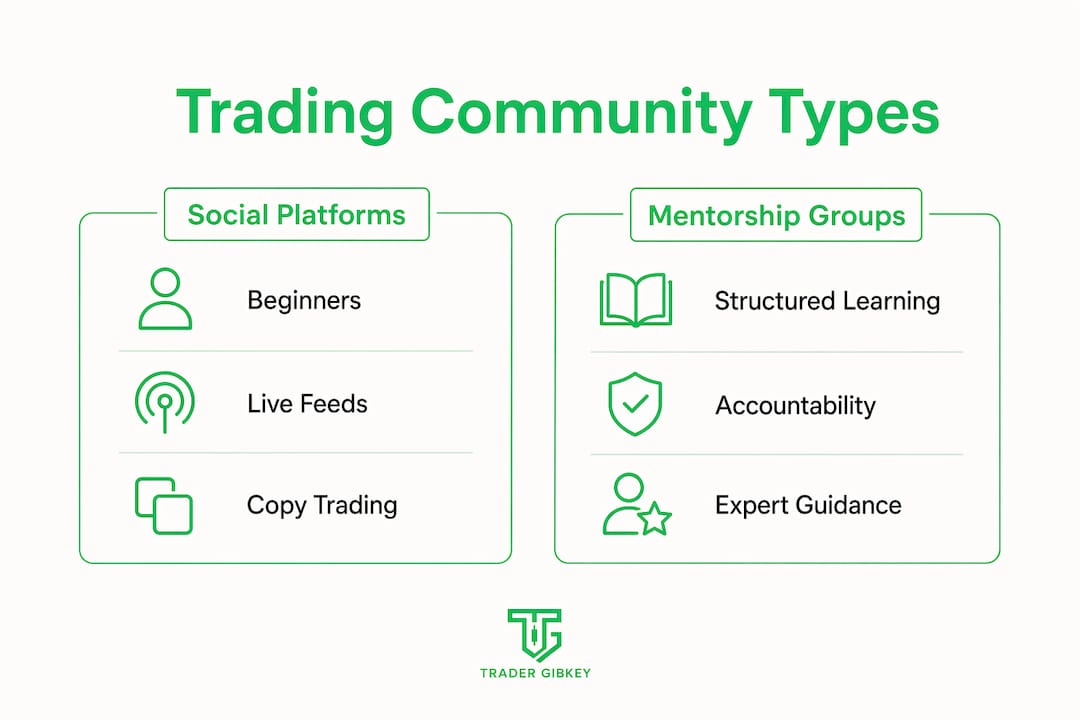
A trading community is any organized group where traders exchange ideas, review setups, and hold each other accountable. The term covers a wide range of formats, from loosely moderated Telegram channels to tightly structured mentorship programs with live sessions and curriculum.

Retail trading communities use platforms like Discord, Telegram, and forums where members share charts, strategies, and market commentary, speeding up learning over solo study. That speed matters because pattern recognition in trading takes years to develop alone, but accelerates sharply when you can watch how experienced traders read the same chart you are looking at.
The five main community types each serve a different trader need:
- Social trading platforms (like eToro’s CopyTrader feature): let you mirror the portfolios of experienced traders in real time, which is useful for beginners building intuition
- Forum-based communities (like Reddit’s r/Forex or BabyPips): offer long-form discussion threads where traders analyze past trades and debate strategy
- Real-time chat groups on Telegram and Discord: deliver live commentary during market hours, which sharpens decision-making under pressure
- Education-first groups: provide structured lessons, recorded sessions, and direct mentorship, making them the closest thing to a formal trading school
- Prop firm communities: support traders going through funded account evaluations, where psychological pressure is especially high
Trading communities typically include all four of these formats in some combination. The table below compares them at a glance.
| Community type | Best for | Key feature |
|---|---|---|
| Social trading platforms | Beginners learning by observation | Portfolio copying in real time |
| Forum-based communities | Strategy research and post-trade review | Long-form discussion threads |
| Real-time chat groups | Active traders during market hours | Live setups and commentary |
| Education-first groups | Structured skill development | Curriculum, mentorship, and feedback |
| Prop firm communities | Funded account candidates | Psychological support during evaluations |
What are the benefits and challenges of joining a trading community?
The benefits of joining a trading community go well beyond getting trade ideas. A strong trading community provides structure, accountability, and exposure to trading styles you would never encounter on your own. That exposure is what improves your routines over time.
The core benefits include:
- Accelerated learning: Watching how other traders frame a setup teaches you to see the market differently, faster than reading alone
- Accountability: Posting your trades publicly creates a natural pressure to follow your rules, which reduces impulsive decisions
- Emotional support: Losing streaks feel less isolating when peers normalize them and help you stay rational
- Blind spot exposure: Other traders catch execution errors and broker behavior patterns you miss when you only review your own trades
- Style diversity: Seeing how scalpers, swing traders, and position traders approach the same market builds a more complete picture
The challenges are real too. Not every community is worth your time, and some actively hurt your trading.
- Noise overload: High-volume chat groups produce more bad ideas than good ones, and filtering takes discipline
- Groupthink: When everyone agrees on a trade, contrarian signals get ignored, which is exactly when the market tends to reverse
- Signal dependency: Relying on someone else’s calls without understanding the logic behind them builds zero skill
Pro Tip: Before joining any community, spend one week reading the chat history without participating. If the dominant tone is hype and prediction, leave. If it is analysis and review, stay.
Trading communities can amplify noise and risk, so treat them as tools while maintaining disciplined risk control and verifying information independently. That is not a reason to avoid communities. It is a reason to choose carefully.
How do trading communities improve performance and mindset?
Community feedback does something solo journaling cannot: it surfaces blind spots you do not know you have. Community feedback exposes execution gaps, broker behavior patterns, and liquidity traps that solo study overlooks, turning peer input into testable rules. The key word is testable. You do not just accept what someone says in a chat. You take it back to your journal and verify it against your own data.
The psychological benefits are equally significant. Peer-to-peer discussions prevent isolation and help traders maintain psychological balance during stressful phases like prop firm evaluations. When you are in a drawdown, your brain stops trading the chart and starts trading the pain. A community that normalizes losses and keeps you focused on process is one of the few things that can interrupt that cycle.
Here is how community interaction builds better performance over time:
- Live trade review: Watching peers analyze a setup in real time trains your eye to spot the same patterns faster in future sessions
- Post-trade discussion: Explaining your reasoning to others forces clarity and reveals logical gaps in your decision-making
- Shared routines: Morning briefings, pre-market checklists, and end-of-day reviews become habits when the group practices them together
- Accountability check-ins: Weekly performance reviews with peers create a feedback loop that solo traders rarely build on their own
“Trading success is built through consistent habits within a supportive community that enforces discipline, especially during high-stress periods.” — Topstep, lessons from Alex Ferreira
Real-time community discussions let traders see setups and market reactions live, which builds both better decision-making and emotional control. That combination is what separates traders who survive drawdowns from those who blow up during them.
The best communities do not just offer encouragement. The best active trading communities provide continuous, structured feedback instead of generic praise, which improves decision-making efficiency in live markets. Generic encouragement feels good. Structured feedback makes you better.
How to find and get the most from a trading community
Finding the right group starts with knowing what you actually need. A beginner who needs structure should not join a fast-moving Discord signal group. A price action trader should not spend time in a community built around indicator-heavy strategies. Fit matters more than size.
Follow these steps to find and use a community well:
- Define your trading style first: Know whether you trade Forex, stocks, or futures, and whether you are a day trader, swing trader, or position trader. Communities built around your style will give you relevant feedback.
- Start with free options: Reddit’s r/Forex, BabyPips forums, and public Discord servers let you evaluate community quality before paying for access. Spend two weeks observing before engaging.
- Check the quality of discussion: Look for communities where members post trade journals, share losses openly, and debate logic rather than just post wins. That culture produces real learning.
- Engage actively: Post your own trades, ask specific questions, and offer feedback to others. Passive lurking produces passive results.
- Verify everything independently: Effective participation requires cautious evaluation of shared information. Cross-check any setup or strategy against your own journal before acting on it.
Pro Tip: Look for communities that include a trading mentorship group component. Peer discussion is valuable, but a mentor who has traded live for years can compress your learning curve in ways peers alone cannot.
Avoid communities that charge high fees for “exclusive signals” without teaching the logic behind them. You are not paying for calls. You are paying for education. If the community cannot explain why a trade makes sense, the signal is worthless.
Key Takeaways
A trading community accelerates skill development, builds discipline, and provides psychological support that solo trading cannot replicate, making community membership one of the most practical steps a developing trader can take.
| Point | Details |
|---|---|
| Community definition | A trading community is a group sharing real-time analysis, strategies, and peer support to improve outcomes. |
| Types vary widely | Options range from social trading platforms and forums to real-time chat groups and mentorship programs. |
| Benefits go beyond trade ideas | Accountability, blind spot exposure, and emotional support are the most underrated community benefits. |
| Mindset improvement is real | Peer feedback normalizes losses and builds the consistent habits that discipline requires. |
| Fit matters most | Choose a community aligned with your trading style, not the largest or most active one available. |
Why I think trading alone is the most expensive mistake you can make
I spent the first two years of my trading career convinced that isolation was discipline. I thought asking for help meant weakness. What it actually meant was that I kept repeating the same execution mistakes with no one to catch them.
The shift happened when I started reviewing trades with other Forex traders who had more screen time than I did. Within weeks, I saw patterns in my own behavior that I had been blind to for months. My entries were solid. My exits were emotional. I would never have seen that without someone else pointing it out.
What I have learned over 18 years in live markets is that community does not replace your own work. It multiplies it. You still need to do the screen time, build the journal, and develop your own edge. But the feedback loop that a good community creates compresses the timeline dramatically.
The traders I have seen grow fastest are not the ones who studied the most in isolation. They are the ones who found a community with honest feedback, stayed humble enough to hear it, and used it to build better habits. That is the real value of a trading study group. Not the signals. The mirror.
— Gabriel
Tradergibkey: courses, mentorship, and community in one place
Tradergibkey was built for traders who are serious about improving, not just collecting strategies. With over 18 years of live Forex trading experience, Gabriel teaches price action methods that work in real market conditions, not just in backtests.
The Tradergibkey community gives you access to structured courses, direct mentorship, and a group of traders who review real trades with honest feedback. You get the accountability of a peer group and the guidance of an experienced mentor in the same place. If you are ready to stop trading in isolation and start building real consistency, explore the courses and community at Tradergibkey.
FAQ
What is a trading community in simple terms?
A trading community is a group of traders who share market analysis, strategies, and support to help each other improve. Members connect through platforms like Discord, Telegram, or specialized forums.
Are trading communities worth joining for beginners?
Yes. Beginners benefit from observing experienced traders, getting feedback on early mistakes, and building habits within a structured group environment.
How do I avoid bad trading communities?
Look for communities that discuss losses openly, explain the logic behind trades, and offer structured feedback. Avoid groups that focus on signals, hype, or guaranteed results.