
The bid-ask spread is defined as the difference between the highest price a buyer will pay and the lowest price a seller will accept in any financial market. That gap is not random. It is the fundamental transaction cost you pay on every single trade, whether you realize it or not. Market makers and liquidity providers sit at the center of this process, earning their profit by buying at the bid and selling at the ask. Understanding the bid-ask spread is the first step toward trading with real awareness, not just hope.
What is bid-ask spread and how does it work?
The bid price is the maximum a buyer offers for an asset. The ask price is the minimum a seller will accept. The spread is simply Ask Price minus Bid Price. You can also express it as a percentage: (Ask minus Bid) divided by Ask, multiplied by 100.
Here is a quick example. EUR/USD is quoted at 1.0850 bid and 1.0852 ask. The spread is 2 pips. That 2-pip gap is the cost you absorb the moment you enter the trade. Your position starts in a small loss, and the market must move in your favor just to break even.
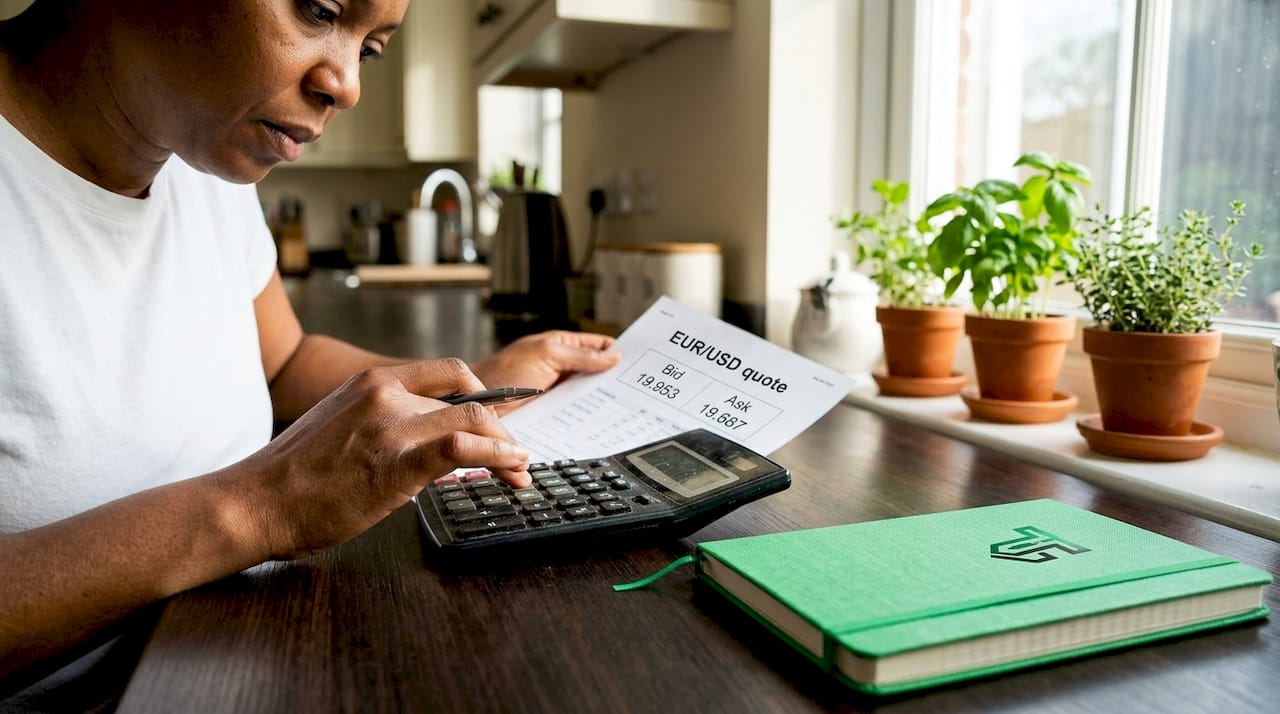
The spread is also the cost of immediacy. When you execute a market order, you are paying for the convenience of entering or exiting a trade right now, at the current price. That convenience has a price, and the spread is it.
How does the bid-ask spread reflect market liquidity?
Spread size is a direct signal of market liquidity. A tight spread means many buyers and sellers are active, orders fill quickly, and prices are stable. A wide spread means fewer participants, slower execution, and higher risk of slippage.
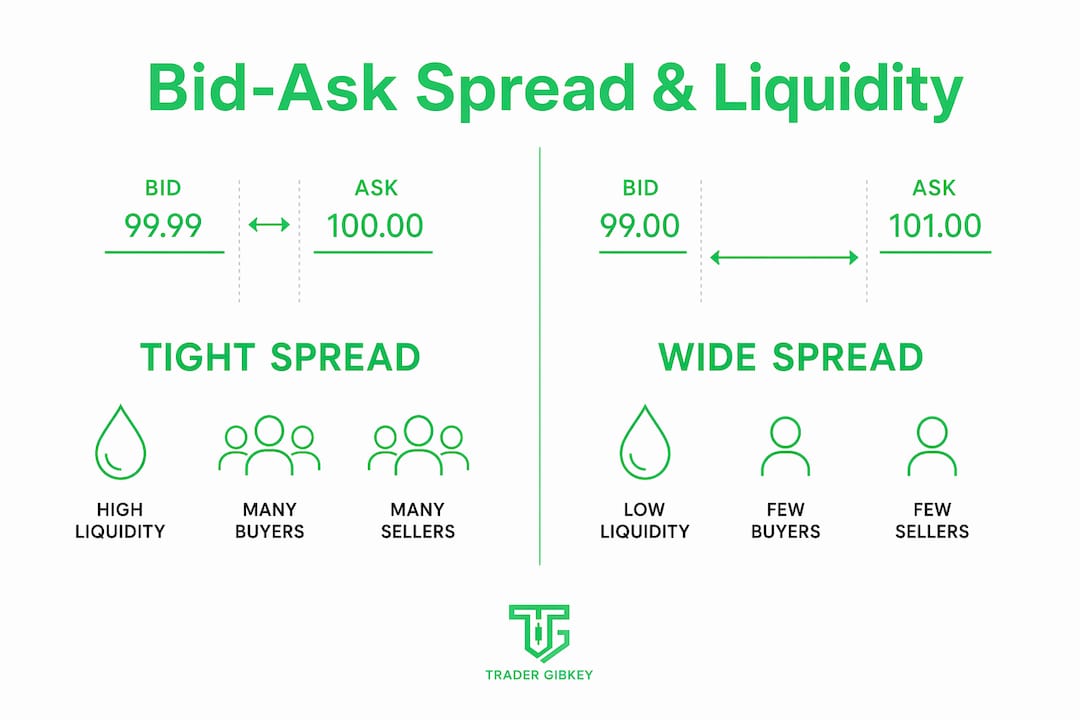
The contrast between liquid and illiquid markets is stark. EUR/USD spreads typically run 0.5–2 pips in normal market conditions. USD/TRY, an exotic pair with far fewer participants, can show spreads of 50–150 pips. That difference is not cosmetic. It represents a real cost difference that compounds across dozens of trades.
Spread also signals the supply-demand balance in real time. When demand drops or uncertainty rises, spread widens as a warning that the market is less healthy. Experienced traders read this signal before deciding whether to execute.
Key points to watch:
- Tight spread: High liquidity, lower cost, faster fills
- Wide spread: Low liquidity, higher cost, execution risk
- Sudden widening: Possible volatility spike or news event approaching
- Stable spread: Calm market conditions, predictable execution
Pro Tip: Before entering any trade, check the current spread relative to its normal range. If the spread is unusually wide, wait. Entering during a spike in spread costs you more than you might expect.
What factors influence the size of the bid-ask spread?
The spread is not fixed. It moves constantly based on several real market forces. Understanding those forces helps you anticipate when costs will be higher and plan accordingly.
-
Market maker risk. Market makers earn by buying at the bid and selling at the ask. When risk rises, they widen the spread to protect themselves. The spread is their compensation for providing liquidity at all times.
-
Volatility and news events. Spread widening happens in seconds during unstable conditions. A central bank announcement, a surprise economic report, or a geopolitical shock can cause spreads to multiply instantly. Liquidity providers pull back, and the gap between bid and ask grows fast.
-
Trading volume. High-volume sessions attract more participants. More participants mean tighter spreads. Low-volume periods, like late Friday afternoons or early Asian sessions for European pairs, tend to show wider spreads.
-
Time of day. Spreads are typically tightest during peak session overlaps. The London-New York overlap, for example, is the most liquid window for major Forex pairs. Spreads widen outside those windows. Knowing your market session timing directly affects your cost per trade.
-
Asset type. Major currency pairs carry tighter spreads than exotic pairs, small-cap stocks, or thinly traded instruments. Choosing your instrument is choosing your baseline cost.
Pro Tip: Avoid trading major news releases unless you have a specific strategy for it. Spreads can widen so fast during a release that your intended entry price becomes irrelevant.
How does the bid-ask spread affect your trading costs and strategy?
Every trade you open starts with an immediate unrealized loss equal to the spread. That is not a flaw in the system. That is the system. Opening a trade always costs you the spread upfront, and the market must move in your direction before you reach breakeven.
This reality hits short-term traders hardest. A scalper who targets 5-pip moves on EUR/USD with a 2-pip spread needs the market to move 2 pips just to get flat. That is 40% of the target consumed before the trade even starts working. Active traders who ignore spread costs often wonder why their results underperform their analysis.
Market orders vs. limit orders
The order type you choose directly affects how much spread you pay.
- Market orders execute immediately at the current bid or ask. You pay the full spread, no negotiation.
- Limit orders let you set the price you are willing to pay or accept. You may get a better fill, or the order may not fill at all if price never reaches your level.
Limit orders give you price control. Market orders give you execution certainty. Neither is universally better. The right choice depends on your strategy and how much you value speed versus cost.
Spread and risk management
Spread affects where you set your stop loss and take profit. If your stop is 10 pips away and the spread is 2 pips, your effective risk is already 20% consumed. Liquidity and slippage interact with spread in low-liquidity markets, making execution less predictable. Building spread into your risk calculations is not optional. It is part of honest trade planning.
What practical tips help beginners manage the spread?
Managing the spread starts with awareness. Most beginners treat it as background noise. Traders who account for it consistently make better decisions about when and what to trade.
Here are the habits that make a real difference:
- Choose liquid instruments. Major Forex pairs like EUR/USD, GBP/USD, and USD/JPY carry the tightest spreads. Starting with these reduces your baseline cost significantly.
- Trade during peak hours. The London-New York session overlap offers the tightest spreads for most major pairs. Avoid trading in thin markets unless your strategy requires it.
- Use limit orders when possible. Setting your entry price rather than accepting the market price can reduce your effective spread cost. Experienced traders prefer limit orders for this exact reason.
- Watch the spread before entering. A spread that is twice its normal size is a signal, not just a cost. It tells you the market is uncertain. Waiting for it to normalize often leads to better fills.
- Factor spread into your targets. If your take profit is 20 pips and the spread is 3 pips, your actual target requires a 23-pip move. Adjust your math accordingly.
Many beginners mistakenly treat the spread as a fixed fee rather than a dynamic market signal. That misunderstanding leads to unexpected losses and confusion about why trades that looked right still lost money. Treating the spread as a live market indicator changes how you read price action entirely.
Pro Tip: Keep a simple log of the spread at your entry time for each trade. After 20 trades, you will see patterns in when your costs are highest and lowest. That data is worth more than most indicators.
Key takeaways
The bid-ask spread is the real cost of every trade you make, and managing it starts with knowing when it is wide, why it widens, and how your order type affects what you actually pay.
| Point | Details |
|---|---|
| Spread definition | The spread equals Ask Price minus Bid Price and represents your entry cost on every trade. |
| Liquidity signal | Tight spreads indicate high liquidity; wide spreads warn of volatility or thin markets. |
| Spread is dynamic | Market makers widen spreads during news events and volatility to manage their own risk. |
| Order type matters | Limit orders give price control; market orders guarantee execution but cost the full spread. |
| Factor spread into targets | Always include the spread in your stop loss and take profit calculations for accurate risk planning. |
Why beginners consistently underestimate the spread
I have watched traders blow through accounts not because their analysis was wrong, but because they never accounted for what the spread was actually costing them. They would nail the direction, set a reasonable target, and still lose. The spread was eating into every trade before it had a chance to breathe.
The part that surprises most people is how much the spread changes. They check it once during a calm session, assume it stays that way, and then get hit with a 3x spread during a news release they forgot was scheduled. That is not bad luck. That is a gap in preparation.
What I tell every new trader is this: the spread is not your enemy, but ignoring it is. Watch it like you watch price. Notice when it widens. Ask yourself why. That habit alone will put you ahead of most retail traders who never think about it at all. Connecting spread behavior to liquidity and market structure is where real understanding begins.
The traders who last are the ones who treat every cost as part of their edge calculation. Spread included.
— Gabriel
Tradergibkey can help you trade with real market awareness
Understanding the spread is one piece of a much larger picture. At Tradergibkey, we teach traders how to read market conditions, manage transaction costs, and build strategies grounded in 18 years of live market experience, not theory.
If you are ready to stop guessing at costs and start trading with a clear plan, Tradergibkey’s price action strategies give you the structure to do exactly that. You will also find practical guidance on managing trading risk so the spread never catches you off guard again. Real traders. Real methods. Real results.
FAQ
What is the bid-ask spread in simple terms?
The bid-ask spread is the difference between the highest price a buyer will pay and the lowest price a seller will accept. It is the cost you pay to enter any trade immediately at market price.
Why does the spread widen during news events?
Market makers increase the spread during high volatility to protect themselves from rapid price moves. This spread widening can happen in seconds and significantly raises your entry cost.
Should beginners use market orders or limit orders?
Limit orders give you control over your entry price and can reduce spread costs. Market orders guarantee execution but require you to accept the full current spread.