
Start emotion-tagging every trade you take, and enforce one pre-committed rule before you open your next position. That single combination does more for your results than any new indicator or strategy tweak. Forex psychology, the study of how emotions and mental states shape your trading decisions, is where most retail losses actually originate. The chart is rarely the problem. Your reaction to it often is.
Quick-start actions you can copy into your journal today:
- Add an “Emotional State” field to every trade log entry. Use a simple five-label taxonomy: Calm, Anxious, FOMO, Revenge, Overconfident.
- Write one implementation intention before each session: “If I hit my daily stop-loss of X, I will close the platform and not reopen it until tomorrow.”
Pro Tip: Paste this checklist into your journal template right now: (1) What is my emotional state? (2) Does this setup match my written plan? (3) Is my stop pre-set and non-negotiable? If any answer is “no,” sit out the trade.
Table of Contents
- What forex psychology really is, and why willpower alone won’t fix it
- The emotions and biases that most often sabotage forex traders
- Why forex creates psychological challenges other markets don’t
- Practical steps to improve your trading psychology and execution
- When mentorship or coaching is the right next step
- Key Takeaways
- The routine that actually fixed my psychological failures
- Tradergibkey gives you the structure that solo trading can’t
- Useful sources for deeper study
- FAQ
What forex psychology really is, and why willpower alone won’t fix it
Trading psychology is the emotional and mental patterning that shapes every decision you make in the market. Fear, greed, overconfidence, and anxiety are not character flaws. They are predictable outputs of a brain that was never designed for probabilistic risk-taking under financial pressure.
The behavioral finance concept that explains most common trader errors is prospect theory, developed by Daniel Kahneman and Amos Tversky. Its central finding: people weight losses roughly twice as heavily as equivalent gains. In trading, that 2:1 asymmetry shows up as a specific, repeatable pattern. You cut winning trades early because a small gain feels fragile, and you hold losing trades too long because closing them makes the loss real.
This is why “just follow your rules” fails so often under pressure. The brain running a losing trade is not running the same operating system as the brain that wrote the rules. Willpower narratives put the blame on discipline. Behavioral finance puts it where it belongs: on predictable cognitive architecture. Once you accept that, you can design systems that work with your brain instead of demanding it override itself.
The emotions and biases that most often sabotage forex traders
Cognitive and emotional biases cluster into recognizable patterns. Here is what each one looks like in a live forex session, and the warning sign to watch for:
- Loss aversion: You widen a stop or remove it entirely on a losing EUR/USD trade because closing it feels worse than holding. Warning sign: you are editing a stop after entry.
- Overconfidence: After three winning trades in a row, you double your position size on the fourth without adjusting your risk rules. Warning sign: sizing is driven by recent results, not your plan.
- Anchoring: You entered GBP/JPY at 190.00 and keep referencing that price as a reason to hold, even though price action has shifted. Warning sign: your exit logic references your entry price, not current structure.
- Confirmation bias: You only read analysis that agrees with your open trade. Warning sign: you feel annoyed when you see a counter-argument.
- Recency bias: Two bad sessions make you hesitate on a textbook setup. Warning sign: your confidence in the strategy tracks your recent P&L, not the strategy’s long-run edge.
- Herding: You enter a trade because “everyone on the forum is long.” Warning sign: your rationale is social, not technical.
- FOMO: Price moves 80 pips without you and you chase the move at a poor entry. Warning sign: you entered after the setup was already gone.
- Revenge trading: After a stop-out, you immediately re-enter at a larger size to “get it back.” The brain stops trading the chart and starts trading the pain. Warning sign: your next trade was placed within two minutes of a loss.
- Decision fatigue: By the third hour of a session, your rule-following degrades. Warning sign: you cannot clearly articulate why you took the last trade.
For beginners who want a deeper look at these behavioral errors, common trading mistakes are covered in detail in a dedicated guide.
Self-diagnosis checklist (run this mid-session):
- Am I trading a setup, or trading a feeling?
- Has my position size changed from my plan without a written reason?
- Have I moved or removed a stop since entry?
- Am I placing this trade because I just had a loss?
Why forex creates psychological challenges other markets don’t
Forex is not just another market with a different ticker. Its structural features actively amplify the biases above, and understanding that changes how you design your rules.
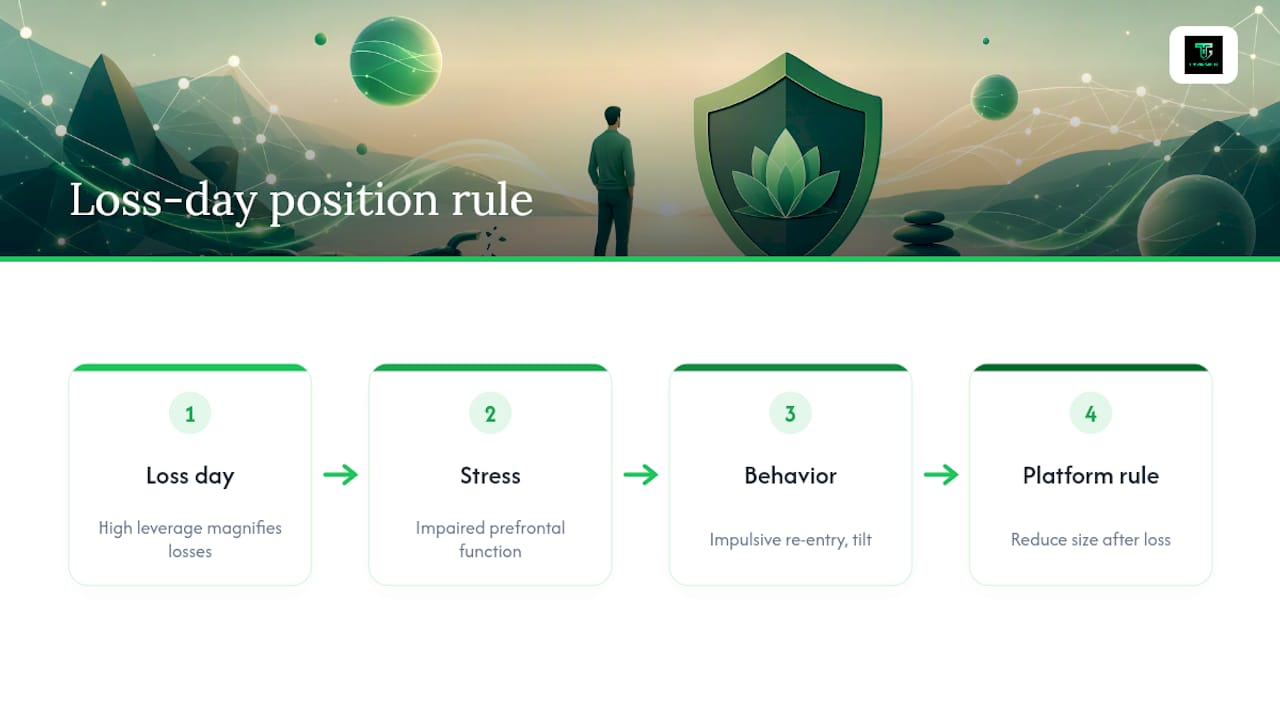
High leverage is the biggest multiplier. A very high leverage ratio means a relatively small adverse move can wipe your account. Loss aversion, already a 2:1 cognitive bias, gets layered on top of real, large-dollar swings. The emotional reaction is not irrational given the stakes. It is proportionate to the actual risk, which is why position sizing is a psychological tool as much as a financial one.
The 24-hour session removes the natural circuit breaker that equity traders get. There is no closing bell to force a reset. Fatigue accumulates across sessions, decision quality degrades, and the temptation to “make it back tonight” is always one click away. Tilt, revenge trading, and moving stops are all more common in markets that never close.
Fast macro-driven moves (NFP releases, central bank decisions, geopolitical events) can gap price through stops in seconds. That kind of loss, sudden and uncontrollable, triggers a stress response that impairs prefrontal cortex function. The result is impulsive re-entry, not rational reassessment.
Correlated currency pairs create a hidden risk that compounds emotional pressure. If you are long EUR/USD and GBP/USD simultaneously, you are not diversified. A dollar-strength move hits both positions at once, doubling the emotional load of a single macro event.
Pro Tip: Reduce your position size significantly on any day you have already hit a loss. Set this as a hard platform rule, not a mental note. The goal is not to avoid all risk. It is to keep your emotional state inside the range where your prefrontal cortex stays in charge.
Practical steps to improve your trading psychology and execution
Improving your forex mindset is a process, not a moment of insight. Here is a step-by-step framework organized around the three phases of every trade.
Pre-trade
- Write your trading plan in “if–then” format. Not “I will trade EUR/USD today,” but “If price returns to the 1.0850 demand zone and closes above it on the 15-minute chart, I will enter long with a 20-pip stop.” Implementation intentions create strategic automaticity. Under stress, your brain executes the pre-written rule instead of improvising.
- Set your session stop-loss before you open the platform. Decide the maximum dollar loss for the day. Write it down. If you hit it, the session ends. No exceptions.
- Run the pre-trade checklist. Does this setup match my written criteria? Is my stop pre-set? What is my emotional state right now?
In-trade
- Use affect labeling, not suppression. When you feel the urge to move a stop, name the emotion out loud or in writing: “I am feeling fear right now.” Neuroscience research shows that labeling an emotion reduces amygdala activity and re-engages prefrontal regulation. Suppression does the opposite: it increases cognitive load and makes rule-following harder.
- Use a physiological sigh for immediate stress reduction. A double inhale through the nose followed by a long exhale activates the parasympathetic nervous system faster than standard deep breathing. Two cycles takes under 20 seconds and measurably reduces the stress response that impairs decision-making.
- Redirect attention to process, not P&L. Close the floating P&L display if your platform allows it. Your job is to manage the trade according to the plan, not to watch a number.
When mentorship or coaching is the right next step
Some psychological barriers do not respond to solo journaling. If you recognize yourself in any of the following, outside support is worth considering.
Signs you need outside help:
- You break your rules consistently, even after identifying the pattern in your journal.
- Your position sizes escalate after losses, not decrease.
- You have had two or more sessions where you blew past your daily stop-loss.
- Your trading performance regresses during periods of personal stress, and you cannot stabilize it.
Questions to ask any coach or mentorship program:
- What specific metrics do you track with students?
- Do you provide live session access, or only recorded content?
- What is your process for identifying and addressing individual psychological patterns?
- What happens if the program does not work for me?
Red flags to walk away from:
- Promises of guaranteed returns or specific win rates.
- No transparency about risk rules or drawdown management.
- Pressure to upgrade or upsell before you have seen results.
- No live trading component.
One thing coaching cannot do: create an edge where none exists. If your strategy has a negative expected value, no amount of psychological work will make it profitable. Coaching helps you execute a good strategy consistently. It does not replace the strategy. The inclusive trading education approach at Tradergibkey is built around exactly this distinction.
Key Takeaways
Forex psychology is the single largest driver of retail trading losses, and the highest-leverage fix is a structured journal with emotional-state tagging combined with pre-committed implementation intentions.
| Point | Details |
|---|---|
| Emotion-tag every trade | Add a five-label emotional-state field to your journal to identify which states cost you money. |
| Use implementation intentions | Write “if–then” rules before each session; they execute automatically under stress, unlike vague goals. |
| Affect labeling beats suppression | Naming an emotion out loud reduces amygdala activity and restores prefrontal control in-session. |
| Run a 60-trade experiment | Compare 30 baseline trades to 30 intervention trades; pre-register your stopping rule before you start. |
| Tradergibkey for structured support | Tradergibkey’s courses, mentorship, and journaling tools provide a structured framework for building consistent execution. |
The routine that actually fixed my psychological failures
The conventional advice on trading psychology is to “stay disciplined” and “control your emotions.” That framing misses the point entirely. Discipline is not a character trait you either have or lack. It is a system you either build or don’t.
What most traders underestimate is how fast emotional state can shift mid-session, and how invisible that shift is while it is happening. You do not notice you are in revenge mode. You notice it afterward, when you are looking at a position three times your normal size and wondering how you got there. The journal does not prevent that shift. It makes the pattern visible across sessions, which is what allows you to design a rule that catches it before it costs you.
The weekly routine that consistently produces improvement is simple: review your journal on Sunday (not during the trading week), identify the one emotional pattern that appeared most often, write one new implementation intention targeting it, and test it for the next 30 trades before changing anything else. That is it. No meditation retreat required.

The other thing worth saying plainly: most traders who struggle with psychology are not struggling with psychology. They are struggling with an unclear trading plan. When the rules are vague, every decision becomes a judgment call, and judgment calls under pressure default to emotion. A precise, written plan with hard rules is the foundation. Everything else, the journaling, the labeling, the experiments, builds on top of it.
Tradergibkey gives you the structure that solo trading can’t
If you have read this far and recognized your own patterns in the biases, the revenge trades, the broken rules, the next step is not more reading. It is a structured environment where those patterns get tracked, named, and corrected with live feedback.
Tradergibkey’s courses and mentorship program are built around exactly the framework described in this article: written trading plans, risk management rules, journaling templates with emotional-state fields, and live trading sessions where you can see how an 18-year market veteran handles the same psychological pressure you face. The private community adds accountability that solo journaling cannot replicate. You get daily market analysis, direct mentorship access, and a system that converts your journal data into measurable progress rather than vague self-assessment.
If you are ready to trade your plan instead of your feelings, explore the Tradergibkey courses and mentorship options and find the program that fits your current level.
Useful sources for deeper study
The research and applied articles below form the foundation of this guide. Each one is worth reading in full.
- Prospect theory — Wikipedia
- Trading psychology: How to develop a trader mindset | Britannica
- Trading psychology — Investopedia
- Putting Feelings Into Words: Affect Labeling and the Neuroscience Evidence — PMC
- How to Control Your Emotions While Trading (What Neuroscience Actually Says) — The Wall Street Coach
- Emotional Regulation for Traders and Investors: Control — M1 Performance Group
- Trader psychology – Why your brain is your biggest risk | Forex mechanics
For a journal template and structured trading plan, the Tradergibkey course and mentorship program includes downloadable tools built around the methodology in this article.
FAQ
What is forex psychology? Forex psychology is the study of how emotions and cognitive biases, like fear, greed, and loss aversion, influence trading decisions and outcomes in the currency market.
Why do traders keep breaking their own rules? Under stress, catecholamine release impairs prefrontal cortex function, the part of the brain responsible for rule-following. Pre-committed “if–then” rules and physiological resets help restore that control.
How do I know if my psychology is improving? Run a 60-trade experiment: 30 trades at baseline, 30 with your new protocol. Compare win rate, average R, and the count of emotional-state trades between the two groups.