
An Inversion Fair Value Gap (IFVG) is defined as a Fair Value Gap that flips its polarity when price closes decisively beyond its boundaries, transforming a former support zone into resistance or a former resistance zone into support. This concept sits at the core of ICT (Inner Circle Trader) methodology and modern price action analysis. Understanding the IFVG gives you a clear behavioral checkpoint. It tells you when the market has rejected your original trade idea and shifted control to the other side. Traders who recognize this flip early avoid holding onto invalidated setups and position themselves for the next high-probability move.
What is a Fair Value Gap and how does it form?
A Fair Value Gap (FVG) is a three-candle price imbalance where a strong impulse candle moves so fast that it leaves an unmitigated zone between the wicks of the candles before and after it. The gap represents an area where price did not trade efficiently. Markets tend to return to these zones to “fill” the imbalance before continuing in the original direction.
The boundaries of an FVG are straightforward. The upper boundary is the low of the candle before the impulse. The lower boundary is the high of the candle after the impulse. Everything between those two points is the gap zone.

Bullish and bearish FVGs behave differently on the chart.
| Feature | Bullish FVG | Bearish FVG |
|---|---|---|
| Direction of impulse | Strong upward candle | Strong downward candle |
| Zone acts as | Support on retracement | Resistance on retracement |
| Entry expectation | Buy on return to zone | Sell on return to zone |
| Invalidation signal | Full candle close below zone | Full candle close above zone |
Price typically respects an FVG on the first or second retest. When it does, the zone confirms its role and traders use it as an entry area. When price blows through the zone with a full candle body close, the original imbalance has failed. That failure is exactly what creates an IFVG.
Key behaviors to watch around FVG zones:
- Price often consolidates near the zone before reacting
- Partial fills are common; a full fill does not always invalidate the zone
- High-volume impulse candles create the most reliable FVG zones
- FVGs on higher timeframes carry more weight than those on lower timeframes
How does an Inversion Fair Value Gap form and what does it signify?
An IFVG forms when price closes decisively beyond the original Fair Value Gap with a full candle body close. A wick alone does not confirm the inversion. The full body close is the hard rule. That close signals that the original imbalance has been consumed and the zone has switched roles.
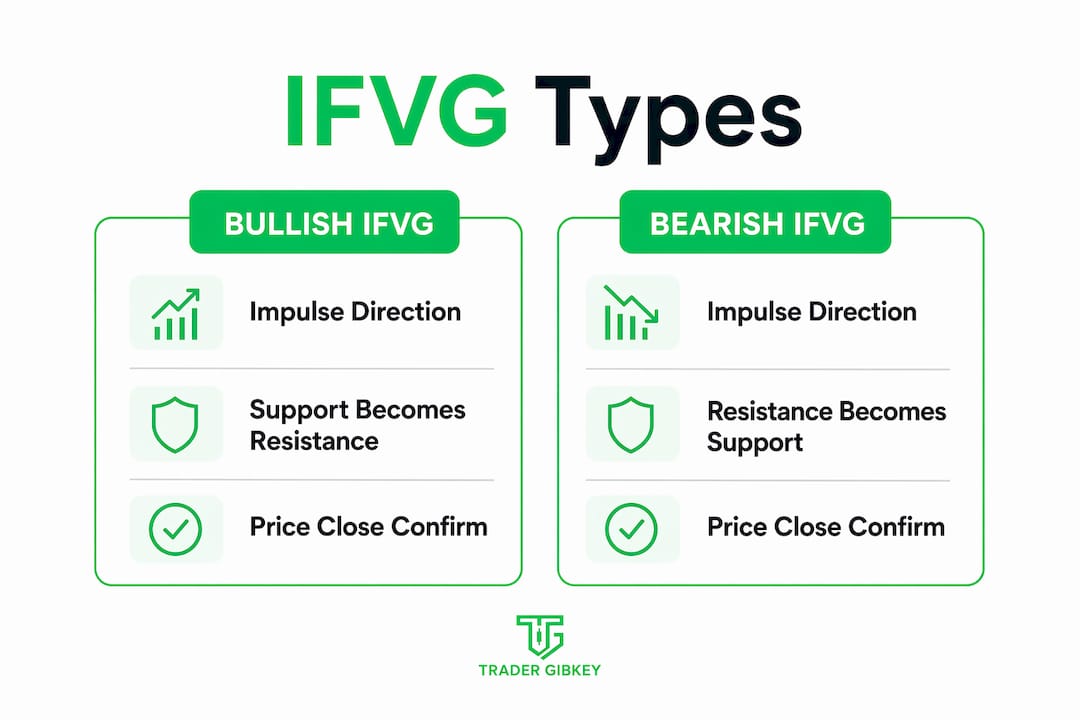
The polarity flip works like this. A bullish FVG that was acting as support becomes resistance once price closes below it with a full body. A bearish FVG that was acting as resistance becomes support once price closes above it with a full body. The zone does not disappear. It stays on the chart, but now it attracts price from the opposite direction.
The psychology behind this is important. Before the inversion, buyers were defending the bullish FVG. When price breaks through it, those buyers are trapped. Their stop losses get hit, and the zone now attracts sellers who use it as a new supply area. Liquidity sweeps that exhaust resting orders typically precede the IFVG formation, trapping traders on the wrong side and fueling momentum in the new direction.
Signs that confirm a valid IFVG formation:
- Full candle body close beyond the original FVG boundaries
- A preceding liquidity sweep that clears stop orders
- Rejection candle or Change of Character (CHoCH) on a lower timeframe after the break
- Increased volume on the impulse candle that breaks the zone
Pro Tip: Mark your IFVG zones immediately after the confirming candle closes. Do not wait for price to return to the zone before drawing it. Waiting causes you to miss the setup or draw the zone incorrectly under pressure.
How should traders interpret and use IFVGs in trading strategies?
The IFVG is best treated as a behavioral checkpoint rather than a mechanical buy or sell signal. When an FVG you were watching gets inverted, the market is telling you directly that your original bias was wrong. Accepting that quickly is what separates disciplined traders from those who hold losing trades hoping for a reversal.
Here is a practical step-by-step framework for trading IFVG retests:
- Identify the original FVG on your primary timeframe and mark its upper and lower boundaries clearly.
- Wait for the inversion confirmation. A full candle body close beyond the zone confirms the polarity flip. Do not act on wicks.
- Drop to a lower timeframe and look for a Change of Character (CHoCH) or Market Structure Shift (MSS) that confirms the new directional bias.
- Wait for price to retest the inverted zone. The IFVG now acts as the new support or resistance. This retest is your entry area.
- Place your stop loss beyond the far boundary of the IFVG zone. A close beyond that boundary invalidates the setup entirely.
- Set your target at the next significant liquidity level, order block, or premium/discount zone on the higher timeframe.
Entry style matters. An aggressive entry means entering as soon as price touches the IFVG zone on the retest. A conservative entry means waiting for a rejection candle or CHoCH confirmation on a lower timeframe before entering. Conservative entries reduce your win rate slightly but significantly improve your risk-to-reward ratio because your stop is tighter.
IFVG signals should never be used as standalone mechanical triggers. Combine them with confirmation from lower timeframes and market structure to filter out weak setups.
Pro Tip: If you find yourself rationalizing why a broken FVG “might still work,” that is the exact moment to step back. The IFVG is the market’s answer. Trust the structure, not your attachment to the original idea.
What nuances and confluence factors improve IFVG trading success?
Not all IFVGs carry equal weight. The efficacy of IFVG setups critically depends on contextual alignment with institutional order blocks and premium/discount zones. An IFVG that forms inside a higher timeframe premium zone (for a bearish setup) or a discount zone (for a bullish setup) carries far more probability than one that forms in the middle of a range.
Structural alignment is non-negotiable. An IFVG that goes against the dominant higher timeframe trend carries significantly more risk. The market structure must support the direction of your IFVG trade. If the higher timeframe is bullish and you are trading a bearish IFVG, you are fighting the dominant flow.
Confluence factors that increase IFVG reliability:
- Higher timeframe order block overlapping with the IFVG zone
- IFVG forming inside a premium or discount zone relative to the range
- Volume confirmation on the impulse candle that created the inversion
- CHoCH or MSS on a lower timeframe confirming the structural shift
- Clean liquidity sweep before the inversion, confirming stop-order exhaustion
Common pitfalls to avoid:
- Trading IFVGs in isolation without checking higher timeframe context
- Entering on the first touch of the zone without any rejection confirmation
- Ignoring the dominant trend direction and trading counter-trend IFVGs
Pro Tip: Before marking an IFVG as tradeable, ask yourself: does the higher timeframe structure support this direction? If the answer is no or unclear, skip the setup. Patience here protects your account.
What are the common risk management practices when trading IFVG setups?
Risk management is the foundation of every IFVG trade. Professional guidelines recommend risking no more than 1–2% of your account on any single trade. That limit applies to IFVG setups just as it does to any other strategy.
Stop loss placement is specific to the zone. Place your stop beyond the far boundary of the IFVG zone, not just a few pips outside the entry candle. A close beyond the zone boundary invalidates the setup. Your stop should reflect that reality.
Position sizing adjusted by stop-loss distance relative to the IFVG zone ensures consistent risk per trade. Use a position size calculator that accounts for your account size, the stop distance in pips, and your maximum risk percentage. This removes guesswork and keeps your exposure consistent across different setups.
Risk management checklist for IFVG trades:
- Risk no more than 1–2% of account per trade
- Place stop loss beyond the full IFVG zone boundary, not just the entry candle
- Calculate position size based on stop distance, not a fixed lot size
- Align the trade with higher timeframe bias before entering
- Respect IFVG failure signals and exit immediately when the zone is broken again
Overtrading is a real risk when you start seeing IFVGs everywhere on the chart. Not every inverted FVG is worth trading. Quality over quantity is the rule. Wait for the setups that check all the boxes before committing capital.
Key Takeaways
The Inversion Fair Value Gap is a polarity flip signal that requires full candle body confirmation, higher timeframe alignment, and structural confluence to deliver reliable trading setups.
| Point | Details |
|---|---|
| IFVG definition | A Fair Value Gap that flips polarity after a decisive full candle body close beyond its boundaries. |
| Confirmation requirement | A full candle body close is required; wicks alone do not confirm the inversion. |
| Behavioral checkpoint | Use IFVG to recognize when your original bias is invalidated and adjust without emotional attachment. |
| Confluence is mandatory | Align IFVG setups with higher timeframe order blocks and premium/discount zones for higher probability. |
| Risk control | Risk no more than 1–2% per trade and size positions based on stop-loss distance to the IFVG zone. |
Why I think most traders misuse the IFVG concept
Most traders I see treat the IFVG as a simple flip signal. Price breaks the FVG, they flip their bias, and they enter immediately. That approach loses money consistently. The IFVG is not a trigger. It is a warning.
What the IFVG actually tells you is that the original market participants defending that zone have been defeated. The zone has changed hands. But that does not mean the new direction has momentum yet. You still need confirmation. You still need structure. Entering the moment the zone flips is like betting on a new team before they have scored a single point.
The traders who use IFVGs well are the ones who treat them as a filter for their existing bias. When the higher timeframe is bearish and a bullish FVG gets inverted, that inversion confirms the bearish story. It is not a new idea. It is validation of what the structure was already saying. That alignment is where the real edge lives.
I have also seen traders ignore IFVGs entirely because they were too attached to their original setup. The market broke their FVG, and instead of accepting the inversion, they kept waiting for price to come back and respect the original zone. That is the brain trading the pain, not the chart. The IFVG is the market’s clearest message that the trade idea is done. Accepting it early is a skill worth building. Combine IFVG with a solid strategy validation process and you will make far fewer costly mistakes.
— Gabriel
Sharpen your edge with Tradergibkey
Understanding the IFVG is one piece of a larger price action framework. Tradergibkey has spent over 18 years trading live markets and building structured educational resources that go beyond theory.

The Tradergibkey blog covers everything from risk management fundamentals to advanced price action setups, with practical tutorials built for traders who want real skills, not generic advice. Whether you are just getting started with Fair Value Gap strategies or refining your IFVG entries, the resources at Tradergibkey give you a structured path forward. Explore the full blog, review the strategy guides, and connect with a community of traders who are applying these concepts in live markets every day.
FAQ
What is an IFVG in trading?
An IFVG (Inversion Fair Value Gap) is a Fair Value Gap that has flipped its polarity after price closes decisively beyond its boundaries, turning a former support zone into resistance or vice versa.
How do you confirm an IFVG has formed?
A full candle body close beyond the original FVG boundaries confirms the inversion. Wicks alone do not count as confirmation.
Should you trade every IFVG you see?
No. Only trade IFVGs that align with the higher timeframe trend and show confluence with order blocks or premium/discount zones. Setups without structural alignment carry significantly higher risk.