
A trading network is defined as a structured system of connections and processes that enables multiple parties to conduct transactions and exchange assets, goods, or information securely and repeatedly. The term “trading network” is widely used, but the recognized industry term for its financial form is an electronic trading network or trade network infrastructure. Both phrases describe the same core concept: a web of participants, platforms, clearing systems, and compliance protocols working together to move value from one party to another. Understanding how these networks operate gives you a real edge, whether you trade Forex, commodities, or financial instruments.
What is a trading network and what are its main types?
A trading network is a digital infrastructure connecting buyers, sellers, and intermediaries to enable secure transactions across markets. That definition covers everything from a stock exchange to a global supply chain platform. The structure always includes nodes (participants) and links (the pathways, protocols, and platforms connecting them).
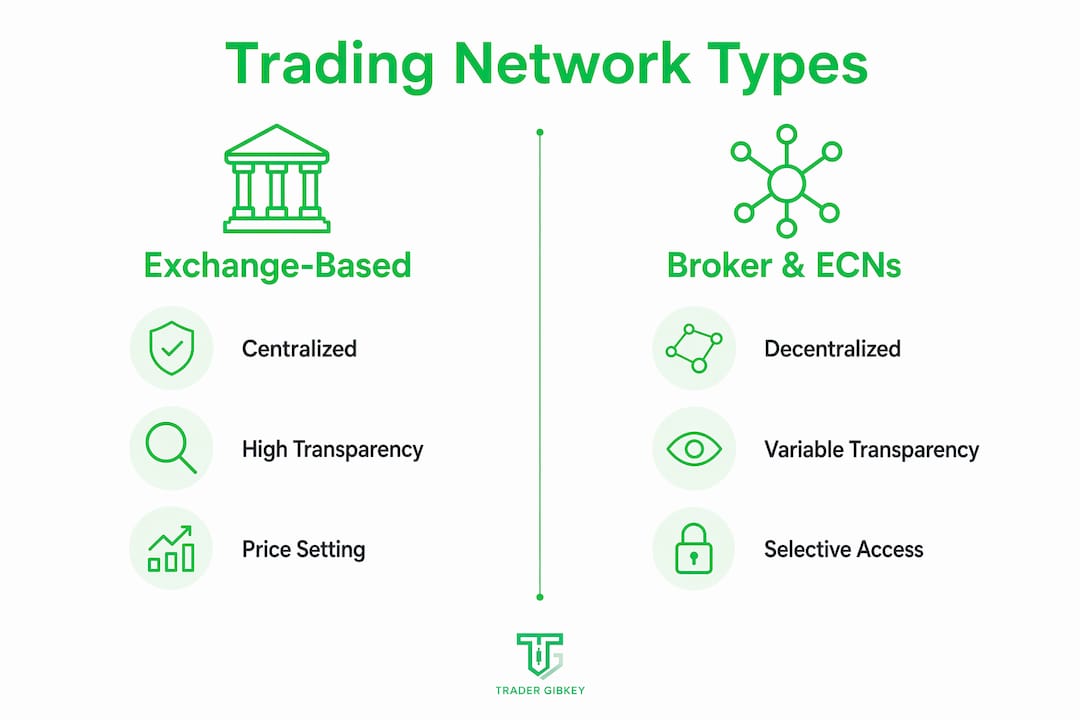
Four main types of trading networks serve different functions, each with distinct effects on liquidity, transparency, and participant access:
- Exchange-based networks match buyers and sellers at scale on centralized platforms. The New York Stock Exchange and Nasdaq are classic examples. Rules are public, prices are visible, and settlement is standardized.
- Broker networks route transactions through intermediaries who negotiate terms on behalf of clients. These networks favor relationships and discretion over pure price transparency.
- Dark pools are private trading platforms where large institutional orders execute without revealing size or intent to the public market. They reduce price impact for big trades but limit transparency.
- Electronic Communication Networks (ECNs) offer automated, transparent electronic trading. ECNs connect participants directly, often cutting out the broker and reducing transaction costs.
| Network Type | Key Function | Transparency | Best For |
|---|---|---|---|
| Exchange-based | Centralized price matching | High | Retail and institutional traders |
| Broker networks | Intermediary-facilitated trades | Medium | Relationship-driven deals |
| Dark pools | Discrete large-order execution | Low | Institutional block trades |
| ECNs | Automated direct matching | High | Cost-sensitive active traders |
Each type serves a different need. Knowing which network you operate in tells you a lot about the rules, risks, and opportunities you face.
How do trading networks operate and evolve?
Trading networks do not appear fully formed. They grow through a predictable sequence, and understanding that sequence helps you spot where a network is strong and where it is fragile.
Networks form by incremental expansion, progressing from bilateral trade through repeated coordination to full reliance on network architecture. Here is how that progression typically unfolds:
- Bilateral exchange. Two parties trade directly. Terms are negotiated each time. There is no shared infrastructure.
- Repeated coordination. The same parties trade again. Patterns emerge. Informal rules develop around timing, units, and settlement.
- Third-party entry. New participants join. The informal rules need to become explicit so everyone can follow them.
- Network reliance. Participants stop negotiating from scratch. They rely on shared platforms, standard contracts, and predictable settlement cycles.
- Maturity. A mature trade network meets three stabilizing conditions: shared reference units, repeatable settlements, and participant trust. It functions like a biological circulatory system, moving value along established pathways with predictable, neutral rules.
Technology accelerates every stage of this process. APIs, automated sanction screening, electronic bills of lading (eBLs), and real-time data streams including shipment tracking, compliance checks, and payments compress what once took years into months. Digital platforms use predictive analytics and risk scoring to keep the network running even when individual participants drop out.
Pro Tip: When you evaluate any trading platform or network, ask whether it has predictable settlement rules and neutral enforcement. Those two features signal a mature network worth trusting with real capital.

Neutral rules and uniform enforcement build participant confidence, which in turn enables stabilized exchange units and repeated settlements. Without that neutrality, networks fragment. With it, they compound in value as more participants join.
What are practical examples of trading networks?
Real-world examples make the definition concrete. Trading networks span centuries and continents, and the pattern of how they work has stayed remarkably consistent.
The Silk Road is the most cited historical example. It did not just move silk, spices, and metals. It moved ideas, religions, and languages. That broader function, carrying information alongside goods, is a feature of every mature trading network, not just ancient ones. UNESCO documents how these networks promoted intercultural dialogue and social cohesion far beyond their transactional purpose.
Modern examples follow the same logic at higher speed:
- Forex markets operate as a global ECN-style network, connecting banks, brokers, institutional traders, and retail participants across time zones. The network runs 24 hours a day, five days a week, with no central exchange.
- B2B trading platforms function as format-neutral gateways exchanging business documents like purchase orders and invoices, regardless of each partner’s internal infrastructure. They offer partner and document lifecycle management with transaction monitoring built in.
- Commodity exchanges like the Chicago Mercantile Exchange (CME) connect producers, processors, and speculators through standardized futures contracts. The network’s value comes from price discovery and risk management tools available to all participants.
- Digital supply chain networks connect manufacturers, logistics providers, customs agencies, and buyers through shared data platforms. A delay at one node triggers automatic rerouting across the rest of the network.
The common thread across all these examples is standardization. Every mature trading network runs on shared units, shared rules, and shared expectations. That is what makes scale possible.
What are the benefits and challenges of trading networks in 2026?
Trading networks deliver real, measurable advantages. They also carry risks that participants who ignore the network’s adaptive nature tend to underestimate.
Core benefits
Speed is the most obvious benefit. Automated matching, electronic settlement, and real-time compliance checks compress transaction cycles from days to seconds. Lower transaction costs follow from scale: the more participants a network has, the cheaper it becomes to execute each trade. Scalability is built into the architecture. A well-designed network handles ten participants or ten thousand without restructuring its core rules.
Resilience is the benefit most traders overlook. Successful networks prioritize resilience via diversified suppliers and alternate routes, dynamically optimizing for speed or robustness depending on market conditions. That means a disruption at one node does not collapse the whole system. It reroutes.
Key challenges
“Modern trade networks act as living, adaptive systems that fragment, detour, and optimize in response to geopolitical or economic pressures. Participants unaware of this adaptability face higher supply chain disruption risks.”
Geopolitical risk is real. Sanctions, tariffs, and trade restrictions can cut off entire network segments overnight. Participants who rely on a single pathway through the network are the most exposed. Technological integration is another challenge. Connecting legacy systems to modern APIs, automated screening tools, and eBL platforms requires time and capital. Complexity management grows with network size. The more participants and pathways a network has, the harder it becomes to monitor for systemic failure points.
Pro Tip: Map your own position in any network you participate in. Know your upstream and downstream dependencies. A single-source dependency is a fragility, not an efficiency.
Key Takeaways
A trading network’s value comes from the quality of its rules and the trust of its participants, not just its size or speed.
| Point | Details |
|---|---|
| Core definition | A trading network connects buyers, sellers, and intermediaries through shared rules and platforms for repeatable transactions. |
| Four main types | Exchange-based networks, broker networks, dark pools, and ECNs each serve different liquidity and transparency needs. |
| Network maturity | Mature networks require shared reference units, repeatable settlements, and participant trust to function reliably. |
| Resilience over scale | Networks that diversify routes and suppliers survive geopolitical shocks better than those optimized only for speed. |
| Data drives modern networks | Real-time APIs, risk scoring, and automated compliance tools are now core infrastructure, not optional add-ons. |
Trading networks are living systems, not static routes
I have spent years watching traders treat the market as a fixed arena with predictable walls. The ones who struggle most are the ones who never ask: what is the network I am actually operating inside, and how is it changing?
The shift I find most underappreciated is the move from static routes to adaptive webs. Trade networks today function more as dynamic webs than linear routes, where connection quality and resilience matter more than scale alone. That is not just a supply chain insight. It applies directly to how you pick your broker, your platform, and your information sources as a trader.
The traders I have seen grow fastest are the ones who treat their network of tools, data sources, and fellow participants as something to actively manage. They ask which connections give them better information. They ask which platforms have neutral, enforceable rules. They do not just plug into the biggest network available and hope for the best.
Spectral graph analysis of trading networks shows that market risk propagates along specific weighted structural pathways among dealers, not visible from surface volume alone. That means the risk you cannot see is often the most dangerous. Understanding the structure of the network you trade in is not academic. It is practical self-defense.
The best thing you can do right now is get curious about the network layer beneath your trades. Who are the intermediaries? What are the settlement rules? Where are the single points of failure? Those questions separate traders who adapt from traders who get caught off guard.
— Gabriel
Deepen your trading knowledge with Tradergibkey
Understanding how trading networks function is the foundation. Applying that knowledge in live markets is where the real work begins.
Tradergibkey has spent over 18 years working inside live market conditions, teaching traders how price action, network structure, and disciplined execution connect in practice. The focus is always on real skills you can use, not theory that sounds good but falls apart under pressure. If you want to build a clearer picture of how markets actually work and how to trade them with confidence, start with Tradergibkey. You can also explore the trader community learning formats Tradergibkey offers to see how structured peer learning accelerates your development.
FAQ
What is the simplest definition of a trading network?
A trading network is a system of connected participants, platforms, and rules that enables secure, repeatable transactions between buyers, sellers, and intermediaries across markets.
What are the four main types of trading networks?
The four main types are exchange-based networks, broker networks, dark pools, and ECNs. Each type differs in transparency, participant access, and how transactions are executed.
How do trading networks become mature and stable?
A trading network reaches maturity when it establishes shared reference units, repeatable settlement processes, and participant trust, allowing transactions to execute predictably without renegotiating terms each time.