
Liquidity is defined as the ease of buying or selling an asset quickly without causing a significant change in its price. Every trade you place is directly shaped by it. Low liquidity means wider spreads, slower fills, and unexpected losses. High liquidity means tighter spreads, faster execution, and lower costs. Understanding market liquidity is one of the most practical skills a beginner trader can build, and it applies whether you trade Forex, stocks, or commodities. The three core measures of liquidity are the bid-ask spread, market depth, and execution speed. Get comfortable with those three, and you will read markets with far more confidence.
What is liquidity in trading and why does it matter?
Liquidity is the ease of buying or selling an asset without a significant price change. It shows up in tight spreads, deep order books, and fast execution. Major Forex pairs like EUR/USD and large-cap stocks show spreads of just a few pennies or fractions of a percent. Illiquid assets, by contrast, can carry spreads several percent wide. That difference is not just a number. It is the direct cost you pay every time you enter or exit a trade.
Think of liquidity like a busy farmers market versus a remote roadside stand. At the busy market, you can buy and sell quickly at fair prices because buyers and sellers are everywhere. At the roadside stand, you might wait a long time, and the seller can name almost any price. The same logic applies to financial markets. The more participants actively trading an asset, the more liquid it is.

Three terms form the foundation of trading liquidity basics. The bid-ask spread is the gap between the highest price a buyer will pay and the lowest price a seller will accept. Market depth refers to how many orders exist at various price levels in the order book. Slippage is what happens when your order fills at a worse price than expected because there were not enough matching orders. These three concepts connect directly to your trading costs and outcomes.
What key market indicators show liquidity?
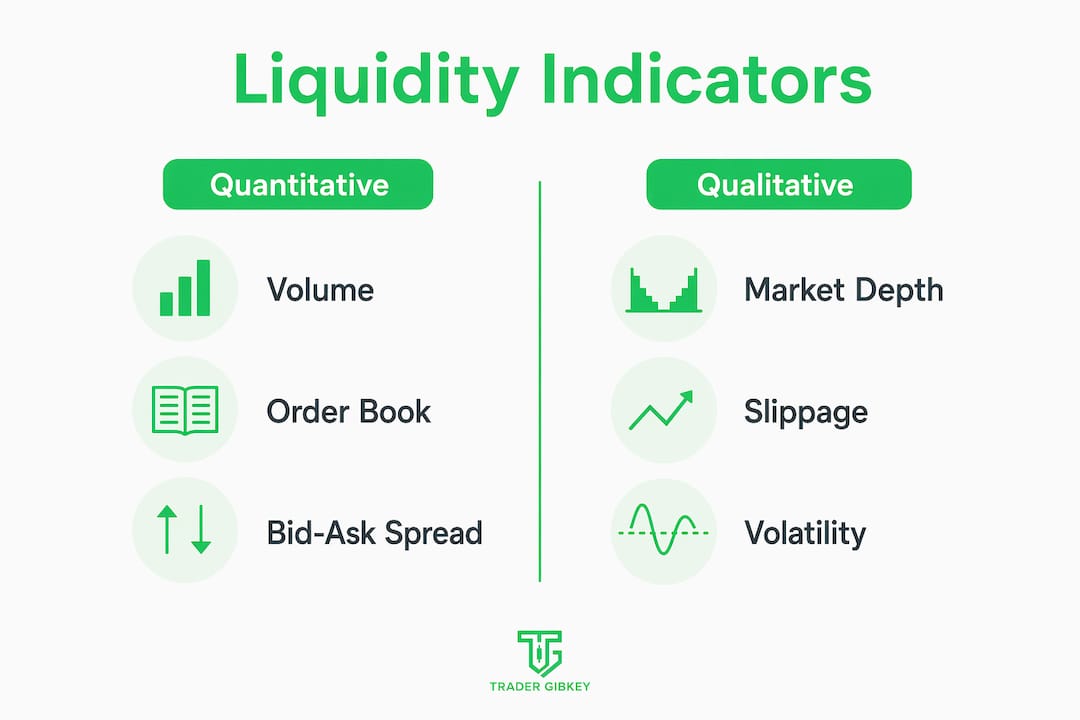
Traders assess liquidity using three main indicators: average daily volume, bid-ask spread, and market depth. Each one tells you something different about how easy it will be to trade an asset.
- Bid-ask spread: A tight spread signals high liquidity. A wide or fluctuating spread warns you that the market is thin. If EUR/USD shows a 0.1 pip spread, that is a liquid market. If a small-cap stock shows a $0.50 spread on a $5.00 stock, that is a 10% cost before you even start.
- Average daily volume: Consistent, high volume means many participants are active. Volume that spikes one day and disappears the next is not the same as sustained liquidity. You want to see volume that holds up day after day.
- Market depth (Level 2 data): This shows the full order book, with buy and sell orders stacked at different price levels. Deep order books absorb large trades without big price moves. Shallow books mean even a medium-sized order can push the price against you.
Pro Tip: Check the Level 2 order book before entering a trade on any asset you are not familiar with. A thin book with only a few orders near the current price is a warning sign, even if the chart looks clean.
Reading these indicators together gives you a much clearer picture than any single metric alone. Consistent volume and tight spreads signal a healthy, liquid market. Wide, fluctuating spreads warn of illiquidity and higher risk.
How does liquidity affect trade execution and costs?
The bid-ask spread is a direct cost. Every time you buy at the ask and sell at the bid, you pay that spread. In liquid markets, this cost is minimal. In illiquid markets, it can eat a significant portion of your profit before the trade even moves in your favor.
Slippage is the second major cost tied to liquidity. Slippage occurs mainly in low-liquidity or volatile markets where there are not enough matching orders to fill your trade at the price you wanted. High-liquidity markets have negligible slippage. Low-liquidity markets can see slippage of several percent, which turns a planned trade into a losing one before the market even moves against you.
Here is a practical example. You place a market order to buy 10,000 units of a thinly traded currency pair. The price shown is 1.2500. But because the order book is shallow, your order fills at 1.2520. That 20-pip slippage is an immediate loss. Now compare that to trading EUR/USD during the London session. Your order fills at exactly 1.2500 or within one pip. That is the real-world difference liquidity makes.
Partial fills are another risk beginners often miss. In a thin market, your broker may only fill part of your order at the intended price. The rest fills at progressively worse prices as the order book gets eaten up. This is called order book impact, and it is why market depth matters more than surface-level volume when you are sizing up a trade.
The hidden cost of trading is often the bid-ask spread. Minimizing this cost is key to long-term profitability, and it starts with choosing liquid markets and liquid times of day.
What are the liquidity risks beginners most often miss?
Most beginners look at volume and assume high volume equals high liquidity. That assumption causes real losses. Volume spikes during news can be completely misleading. A sudden spike in volume does not guarantee a deep, stable market. Poor market depth leads to slippage risk even during high-volume moments.
Liquidity has three dimensions, and you need to understand all three:
- Tightness: The cost of trading, measured by the bid-ask spread. A tight spread means low transaction cost.
- Depth: The volume of orders available at various price levels. Deep markets absorb large orders without big price swings.
- Resiliency: The speed at which a market recovers after a price shock. A resilient market bounces back quickly. A fragile market stays dislocated, trapping traders at bad prices.
A market can look liquid for small trades but completely fail under large orders or sudden shocks. That is the resiliency trap. Beginners often overlook liquidity resiliency, which leads to misjudging true market strength at exactly the wrong moment.
Liquidity also evaporates fast. Markets can appear liquid one hour and turn dangerously thin hours later, especially around major economic news releases or outside regular trading hours. Trading Forex at 3am GMT on most pairs introduces unexpected liquidity risk that many beginners never anticipate.
Pro Tip: Avoid trading in the 30 minutes before and after major news events like Non-Farm Payrolls or central bank rate decisions. Spreads widen sharply, slippage spikes, and the market can move against you before your order even fills.
Times and markets to approach with caution:
- Any Forex pair outside the London or New York sessions
- Small-cap stocks with average daily volume under 500,000 shares
- Any asset immediately before or after a major economic announcement
- Exotic currency pairs, which carry structurally wide spreads at all times
How can beginners apply liquidity knowledge to improve their trading?
Knowing about liquidity is one thing. Using it to make better decisions is another. Here are the practical steps that make a real difference.
- Use limit orders instead of market orders. Limit orders help control your entry and exit prices, reducing the risk of paying wide spreads or suffering slippage. A market order takes whatever price is available. A limit order sets your price and waits.
- Trade during peak liquidity windows. Session overlaps like London and New York offer the best liquidity, minimizing slippage and spread costs. For Forex, the London/New York overlap runs roughly 8am to 12pm Eastern Time and is the most liquid window of the day.
- Check spreads and volume before every trade. Make this a non-negotiable part of your pre-trade checklist. If the spread has widened significantly from its normal range, that is a signal to wait or skip the trade entirely.
- Build liquidity checks into your risk management rules. Liquidity is a risk factor, not just a background condition. Treat it the same way you treat stop-loss placement and position sizing.
- Study the order book on assets you trade regularly. Over time, you will develop a feel for what normal depth looks like versus what a thin, risky book looks like. That pattern recognition is genuinely valuable.
Liquidity knowledge also connects directly to price action strategies. Areas on a chart where liquidity pools cluster, such as around obvious support and resistance levels, attract price movement. Understanding this gives you an edge that pure technical analysis alone does not provide.
Key Takeaways
Liquidity is the single most overlooked factor in beginner trading costs, and mastering it requires understanding spread, depth, and resiliency together, not just volume.
| Point | Details |
|---|---|
| Liquidity definition | An asset is liquid when it can be bought or sold quickly with minimal price impact. |
| Three core indicators | Bid-ask spread, average daily volume, and market depth together measure true liquidity. |
| Three dimensions of liquidity | Tightness, depth, and resiliency must all be assessed, especially in volatile conditions. |
| Slippage is a real cost | Low-liquidity markets can produce slippage of several percent, turning planned trades into losses. |
| Use limit orders | Limit orders protect you from wide spreads and slippage in thin or unpredictable markets. |
What 18 years in live markets taught me about liquidity
Early in my trading career, I made the same mistake almost every beginner makes. I looked at a chart, saw strong volume, and assumed the market was liquid. I placed a trade, and the fill came back 15 pips worse than the price I saw. I did not understand why. Nobody had explained the difference between a volume spike and genuine market depth.
The lesson I had to learn the hard way is that liquidity is dynamic, not fixed. It shifts with the time of day, the news calendar, and the behavior of large institutional participants. A market that is perfectly liquid at 10am London time can be a minefield at 6pm New York time. Treating liquidity as a static background condition is one of the most expensive mistakes a new trader can make.
What changed my trading was focusing on market depth rather than just volume. When I started reading the order book before entering trades, I stopped getting caught in thin markets. I also started treating the bid-ask spread as a real cost, not just a number to ignore. That shift alone improved my decision quality significantly.
My honest advice: before you worry about your entry signal, check the spread. Check the depth. Check the time of day. If those three things do not line up, the best setup in the world can still cost you money. Liquidity is not a background detail. It is the environment your trade lives in. Respect it, and it will protect you. Ignore it, and it will punish you quietly, trade after trade, until you wonder why your results never match your analysis.
— Gabriel
Build your trading foundation with Tradergibkey
Understanding liquidity is one piece of a much larger picture. Tradergibkey offers structured courses and mentorship built on over 18 years of live market experience, covering everything from trading fundamentals to advanced price action strategies. The community is designed for traders who want real skills, not generic advice.

Whether you are just starting out or trying to fix consistent losses, Tradergibkey’s approach focuses on practical execution over theory. You get access to a supportive community of traders, step-by-step learning paths, and a mentor who has traded through real market conditions. If you are serious about building a foundation that holds up, this is where to start.
FAQ
What is liquidity in trading?
Liquidity is the ease of buying or selling an asset quickly without significantly moving its price. It is measured by bid-ask spread, market depth, and execution speed.
Why does liquidity matter for beginner traders?
Low liquidity increases your trading costs through wider spreads and slippage. Beginners who ignore liquidity often lose money before the market even moves against them.
What is the best time to trade for high liquidity?
The London and New York session overlap offers the highest liquidity for Forex traders, minimizing spreads and slippage compared to off-peak hours.