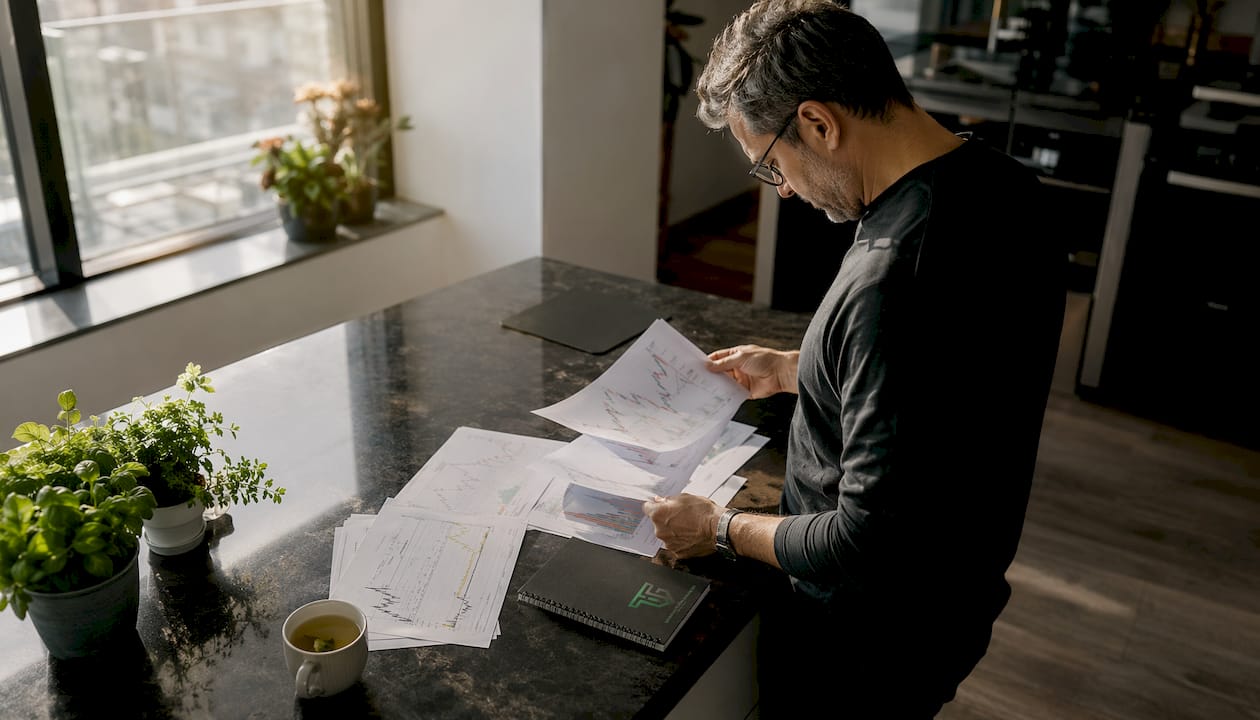
A live trade discussion is a real-time, interactive session where traders analyze active setups, share screens, and talk through entries, exits, and risk management as the market moves. It’s part education, part community, and entirely transparent when done right. Active traders and learners who want to see decision-making in action, not just read about it afterward, get the most from these sessions. Platforms like Discord, YouTube Live, Twitch, and hosted rooms like Tradergibkey’s structured community all run versions of this format.
Table of Contents
- What is a live trade discussion, exactly?
- What actually happens during a live session?
- Why traders join live market trading discussions
- Risks and limitations you need to know about
- How to evaluate a live trading room or mentor
- Pricing and access models for live trade discussions
- How to actually learn from live sessions, not just watch them
- Key Takeaways
- Why live rooms matter more than most traders realize
- Try a structured live trading community with Tradergibkey
- Useful sources and next steps
- FAQ
What is a live trade discussion, exactly?
A live trade discussion combines real-time screen sharing, voice or text commentary, and live Q&A into a single session tied to open market hours. The host, usually an experienced trader or mentor, talks through setups as they develop, explains why they’re entering or exiting, and fields questions from participants watching the same charts.
Main formats you’ll encounter:
- Discord (chat + voice channels): The most common community format. Members type questions in text channels while the host speaks in a voice channel. Screen share is optional but common. Good for casual, ongoing community interaction.
- YouTube Live / Twitch (stream-first): Broadcast-style sessions with live chat. Lower interaction ceiling than Discord, but accessible to anyone with a link. Hosts share their screen, run scanners, and narrate trades in real time.
- Proprietary trading rooms: Custom-built platforms (like the one Warrior Trading developed in 2017 for ultra-low latency streaming) that embed live video, P&L windows, news feeds, and chat in one interface.
- Zoom-style interactive sessions: Smaller, more intimate formats where participants can speak, ask questions directly, and sometimes share their own screens. Common in mentorship programs.
Tradergibkey runs structured daily sessions in a hosted community format, combining live watchlists, price action commentary, and replay archives so members can review sessions after the fact.
Pro Tip: If you’re new to live rooms, start with a YouTube Live or Twitch stream before committing to a paid Discord or proprietary room. You’ll get a feel for the format with zero friction.
What actually happens during a live session?
Sessions follow a predictable rhythm once you know what to look for. Here’s a typical day mapped out:
| Time (ET) | Typical Activity |
|---|---|
| Premarket hours | Premarket scan, macro news brief, watchlist build |
| 8:30–9:30 AM | Final setup review, gap stocks, catalyst check |
| Market open morning | Live trading, real-time commentary, alerts, risk reminders |
| Midday session | Q&A, chart breakdowns, scanner tutorials |
| Afternoon session | Afternoon setups, recap, next-session notes |
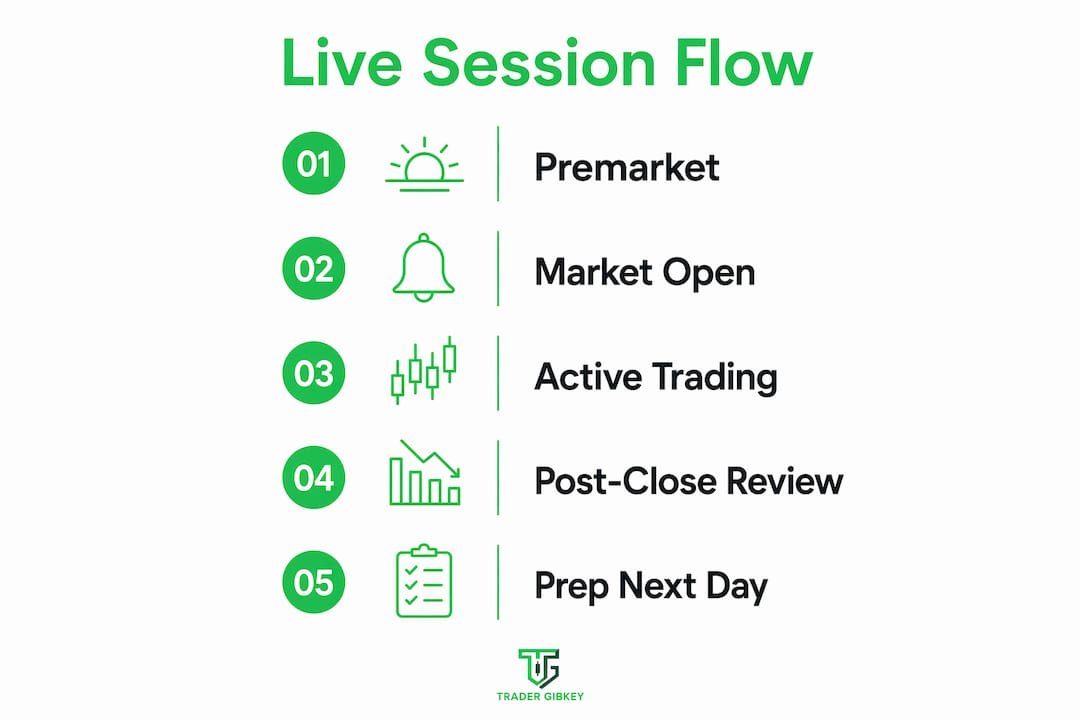
Premarket is where the real preparation happens. Hosts use scanners and premarket watchlist tools to identify gap stocks, volume movers, and catalyst-driven setups before the bell. A well-built watchlist makes the live session focused rather than reactive.
During market hours, the host narrates in real time: entry logic, position size, invalidation level, and how they’re managing the trade as it develops. Good rooms also show a live P&L window so you can see wins and losses as they happen, not just the highlights.

After the close, the best sessions include a trade log review: what worked, what failed, and why. That post-trade debrief is often where the deepest learning happens.
Why traders join live market trading discussions
The core benefit is process transparency. Watching a mentor trade live shows you how they think, not just what they traded. That’s a fundamentally different learning experience than reading a recap.
- Real-time decision-making: You see entries, exits, and adjustments as they happen, which builds pattern recognition faster than any course.
- Unedited P&L: Live, unedited trade logs are the gold standard for transparency. They show losses alongside wins, which builds trust and sets realistic expectations.
- Immediate market context: News catalysts, volume spikes, and sector rotation get explained in the moment, not hours later.
- Community feedback: Other members ask questions you didn’t think to ask. Peer discussion surfaces angles you’d miss trading alone.
- Replay libraries: Missed a session or want to review a specific setup? Recorded archives let you study at your own pace.
Rooms that focus on education provide watchlists, trade recaps, and risk management guidance rather than just posting entry alerts. That distinction matters for long-term skill development.
Risks and limitations you need to know about
Live rooms carry real risks, and going in without a plan is how traders get hurt.
- Copy-trading danger: Acting on someone else’s entry without your own analysis is the fastest way to blow an account. You don’t know their full position size, their account history, or their off-screen hedges.
- Latency gaps: Even a few seconds of delay between a host’s entry and your execution can mean a completely different fill. What looks like a clean entry on screen may already be extended by the time you act.
- Incomplete context: You’re seeing a slice of someone else’s trading day. You don’t know how long they’ve held a position, what their overall P&L looks like for the week, or what they’re not showing.
- FOMO and overtrading: The energy of a live room can push you into trades you wouldn’t take on your own. That’s a psychological risk, not a market risk, but the damage to your account is the same.
Pro Tip: Before each session, write down your own watchlist and setups. Use the live room to compare your thinking to the host’s, not to replace it. That one habit separates learners from copiers.
A quality room, as ProTradingInsights recommends, teaches reasoning and provides pre-trade context and post-trade review rather than simply posting entries.
How to evaluate a live trading room or mentor
Not all rooms are built the same. Here’s a practical checklist before you pay for anything.
Questions to ask before joining:
- Does the host trade real money live, or just narrate paper trades?
- Is the P&L window visible and unedited during the session?
- Are session replays available, and how far back does the archive go?
- Does the host explain entry logic, invalidation, and trade management, or just call entries?
- Are there explicit community rules about copying trades or making earnings claims?
- Is there active moderation, or does the chat run unchecked?
- Can you sample a session for free before committing?
- How long has the mentor been trading live markets?
- Are large earnings claims verified by broker statements?
- Does the room have a structured curriculum, or is it purely reactive?
| Room Type | Primary Focus | Best For | Watch Out For |
|---|---|---|---|
| Educational rooms | Process, chart breakdowns, risk management | Learners building skills | Slower pace; less alert frequency |
| Alert-first rooms | Entry signals, fast execution | Experienced traders with a plan | No context; copy-trading risk |
| Community chat rooms | Peer discussion, idea sharing | Networking and idea generation | Inconsistent quality; no moderation |
Moderated communities with structured review help traders progress faster than ad-hoc chat rooms. Moderation and clear community rules are often the difference between a productive learning environment and a chaotic signal feed.
Free trials, replay libraries, and verified testimonials are among the strongest pre-join trust signals a room can offer.
Pricing and access models for live trade discussions
Most rooms follow a tiered structure. Here’s what to expect at each level:
- Free access: Open streams on YouTube Live or Twitch, limited chat interaction, no replay library. Good for sampling the format.
- Basic subscription ($20–50/mo): Discord access, community chat, watchlists, and some educational content. Live sessions may be limited or delayed.
- Premium subscription ($100–300+/mo): Full live sessions, daily watchlists, replay library, and direct mentor interaction. This is where most serious learners land.
- VIP or mentorship tiers ($300+/mo): Small-group or one-on-one access, breakout rooms, personalized feedback, and sometimes Saturday training sessions.
The price is only justified if the room delivers process education, not just alerts. A $50/mo room that teaches you how to build a watchlist and manage risk is worth more than a $300/mo alert service that hands you entries without context.
Pro Tip: Use any free trial to test one specific thing: does the host explain why a trade is invalid, not just when to enter? If they skip the invalidation logic, the room is an alert service wearing an education label.
How to actually learn from live sessions, not just watch them
Watching is passive. Learning requires a system. Here’s a practical routine:
- Pre-session (30 minutes before open): Build your own watchlist using a scanner like MorningOptions or your broker’s premarket tools. Write down your top two or three setups with entry, target, and stop.
- During the session: Compare the host’s setups to yours. Note where your thinking aligned and where it diverged. Don’t execute live until you’ve tested a setup type at least ten times on a demo account.
- Note-taking template: For each setup the host takes, write: ticker, catalyst, entry logic, invalidation level, outcome, and one thing you’d do differently.
- Demo execution: Treat every live idea as a candidate to validate in a demo account across a fixed sample size before risking real capital.
- Post-session review (15 minutes after close): Pull up the replay. Review two trades: one that worked and one that didn’t. Focus on the decision, not the result.
- Weekly journal check: Track process metrics, not just P&L. Entry timing vs. signal, average risk per trade, and how often you deviated from your plan tell you more than your weekly dollar figure.
Structured community formats that combine daily live sessions, watchlists, and replay libraries are specifically designed to convert live exposure into repeatable skill, not just observation.
Pro Tip: Ask clarifying questions in the chat after a trade closes, not during. Mid-trade questions distract the host and often get answered superficially. Post-trade Q&A is where the real teaching happens.
Key Takeaways
Live trade discussions are most valuable when you treat them as a process education tool, not a signal service. Vet the room, practice on demo, and track your own metrics.
| Point | Details |
|---|---|
| Vet before you pay | Check for live P&L, replay archives, free trials, and verified mentor track record before committing. |
| Demo first, live second | Test every live idea across at least 10 demo trades before risking real capital. |
| Process over P&L | Track entry timing, average risk per trade, and plan adherence, not just weekly dollar returns. |
| Use replays actively | Post-session replay review builds more skill than watching live without a note-taking system. |
| Tradergibkey’s approach | Tradergibkey combines extensive years of live market experience with structured sessions, watchlists, and replay archives to build repeatable trader skills. |
Why live rooms matter more than most traders realize
Live trade discussions are one of the most underused learning tools in trading education, and also one of the most misused. The mistake most traders make is treating a live room like a subscription to someone else’s edge. That’s not how skill transfers.
What actually works is using the live session as a mirror. You show up with your own preparation, your own setups, and your own risk rules. Then you watch how an experienced trader navigates the same market. Where your thinking diverges is exactly where your learning lives.
After 18 years of trading live markets, the pattern I keep seeing is this: traders who improve fastest aren’t the ones who copy the most entries. They’re the ones who ask the most specific questions, review their own replays obsessively, and treat every session as a data point in a longer experiment. The live room gives you the raw material. What you do with it after the close is what actually moves your skill forward.
The other thing worth saying plainly: a live room is not a shortcut. If you’re joining because you want someone else to do the analysis for you, you’ll be disappointed and probably poorer. But if you’re joining because you want to see how a real trader thinks in real time, and you’re willing to do the work of integrating that into your own process, a good live room is one of the best investments you can make in your trading education.
Try a structured live trading community with Tradergibkey
Most live rooms give you access to someone else’s trades. Tradergibkey gives you access to a process, built on 18+ years of live Forex market experience and designed to turn observation into real skill.
When you join Tradergibkey’s community, you get daily live sessions with premarket watchlists, real-time price action commentary, and a replay library you can use to review every session at your own pace. The focus is on price action strategy and structured learning, not alert chasing. Moderation keeps the community focused, and the curriculum is built for traders who want to understand why a setup works, not just when to click.
Join Tradergibkey’s live trading community and sample a session to see the format firsthand. Bring your own watchlist, compare your thinking to the session, and use the replay to review what you missed.
Useful sources and next steps
Before trusting any live room or resource, check for three things: replay availability, a verified P&L track record, and active moderation. If any of those are missing, treat the room as entertainment, not education.
- MorningOptions delivers AI-powered premarket scans and daily trade ideas before market open, useful for building your own watchlist before any live session.
- Trader Community Learning Formats explains how structured sessions and replay libraries convert live exposure into lasting skill.
- Why Beginner Traders Need Community covers how to get value from a live room when you’re still building your foundation.
- How to Engage a Trading Mentorship Group Effectively gives practical tips on asking better questions and using replays productively.
FAQ
What is a live trade discussion in simple terms? It’s a real-time session where a trader shares their screen, talks through setups, and takes questions while the market is open, combining live commentary, charts, and community chat.
Is it safe to copy trades from a live trading room? No. You rarely have the same position size, entry timing, or full context as the host. Use live rooms to learn the reasoning, then make your own decisions.
How do you join live trade discussions as a beginner? Start with a free stream on YouTube Live or Twitch to learn the format, then look for a structured room with a free trial, replay library, and clear community rules before paying.