
Trading psychology is defined as the study of how emotions and mental habits shape trading decisions and determine whether a trader succeeds or fails in financial markets. Every trader, regardless of experience, operates under psychological pressure. Fear, greed, overconfidence, and regret do not just color your mood. They directly alter your execution, your risk management, and your ability to follow a plan. Understanding the mental side of trading is not optional. It is the foundation that separates consistent traders from those who blow account after account with a perfectly good strategy.
What is trading psychology, and why does it define your results?
Trading psychology is the branch of behavioral finance that examines how cognitive and emotional factors influence market decisions. The industry term for this field is “behavioral finance,” and trading psychology is its practical application at the individual trader level. Both terms matter. One gives you the academic framework; the other gives you the daily reality.
The core insight is this: discipline bridges the gap between a strategy that works on paper and an equity curve that actually grows. You can have a statistically sound system and still lose money consistently if your emotions override your rules. That is not a strategy problem. That is a psychology problem.

Emotions like FOMO (fear of missing out), regret, and overconfidence cause traders to jump into setups early, hold losing trades too long, or abandon rules mid-trade. These are not character flaws. They are predictable psychological responses to financial risk. Recognizing them is the first step toward managing them.
What core emotions and biases derail traders?
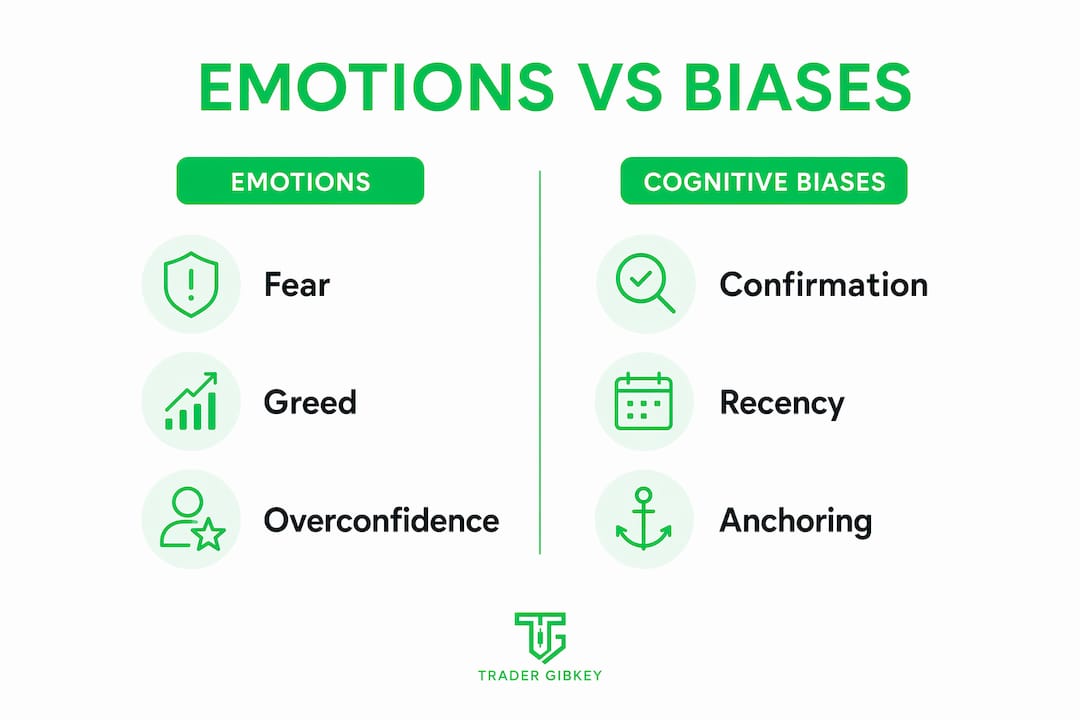
Fear and greed are the two primary emotional drivers in trading. Fear causes premature exits, where you close a winning trade too early because you are terrified of giving back profit. Greed causes overexposure, where you size up recklessly because the last three trades went your way.
Beyond fear and greed, several other emotions and cognitive biases consistently damage decision quality:
- FOMO (fear of missing out): You chase a move that has already happened, entering late and at poor risk-to-reward.
- Regret: You hold a losing trade hoping it comes back, because closing it means admitting you were wrong.
- Overconfidence: A winning streak convinces you that your edge is larger than it is, leading to oversized positions.
- Revenge trading: After a loss, the brain stops trading the chart and starts trading the pain. You take impulsive trades to “win back” what you lost.
- Confirmation bias: You seek out information that supports the trade you already want to take and ignore signals that contradict it.
- Gambler’s fallacy: You believe a losing streak “must” end soon, so you increase size on the next trade without any edge-based reason.
- Status quo bias: You avoid adjusting a losing position because changing it feels riskier than doing nothing.
Cognitive biases like these distort judgment in real time. The dangerous part is that they feel rational while they are happening. You do not notice confirmation bias when you are in it. You just feel confident.
Emotions also cause a specific execution problem: premature exits on winners and extended holds on losers. This flips your risk-to-reward ratio upside down. You cut profits short and let losses run, which is the exact opposite of what a profitable strategy requires.
Why mindset matters more than your technical strategy
A high-win-rate strategy fails if you cannot execute it consistently. Inconsistent execution driven by emotions is the primary reason retail traders fail, not bad strategies. This is the uncomfortable truth most traders avoid.
Think about it this way. Imagine two traders using the exact same price action setup. Trader A follows the rules without exception. Trader B exits early when the trade moves against them by 10 pips, then re-enters out of FOMO when it recovers. Over 100 trades, Trader A builds equity. Trader B erodes it, even though both used the same system.
| Scenario | Good psychological management | Poor psychological management |
|---|---|---|
| Losing trade | Closed at stop-loss, loss contained | Held past stop, loss expanded |
| Winning trade | Held to target, full profit captured | Exited early from fear, partial profit |
| Drawdown period | Reduced size, stayed patient | Revenge traded, increased losses |
| Winning streak | Maintained standard position size | Oversized positions, one loss wiped gains |
The neurological side of this problem is real. Traders experience dopamine release from the act of trading itself, not just from winning. That dopamine hit can drive compulsive overtrading even during losing periods, resembling behavioral addiction patterns. This means willpower alone is not enough. You need structure.
Pro Tip: Set a hard rule that limits you to a maximum number of trades per session. When you hit that number, you stop. This removes the dopamine-driven urge to “just take one more” from the equation entirely.
Mental discipline in trading is what keeps you on the right side of that table above. Without it, even a 65% win-rate system produces a losing account.
How to improve trading psychology with practical steps
Developing a trading mindset means building four core commitments: process over outcome, personal responsibility, rule integrity, and realistic expectations. This is not positive thinking. It is a structured mental framework that lets you make rational decisions even when the market is moving against you fast.
Here is a step-by-step approach to building that framework:
- Write your trading rules down. A rule that lives only in your head is easy to break under pressure. A written rule feels like a contract.
- Use a fixed stop-loss on every trade. Non-negotiable. This removes the decision from an emotionally charged moment and automates your risk management. Check out risk management rules every new trader should know.
- Keep a trading journal. Record not just what you traded, but how you felt before, during, and after. Patterns in your emotional state will become visible within weeks.
- Review your trades weekly. A structured performance review separates what actually happened from what you remember happening. Memory is unreliable under stress.
- Set a daily loss limit. When you hit it, you close the platform. No exceptions. This prevents one bad session from becoming a catastrophic one.
- Practice with smaller size during high-stress periods. Scaling down is not weakness. It is the rational response to recognizing that your emotional state is running a different operating system than your strategy requires.
Structured routines are vital to psychological stability during volatile market conditions. The goal is to reduce the number of decisions you make in real time. Every decision you automate through a rule is one fewer opportunity for emotion to take over.
Pro Tip: After any losing trade, wait at least 10 minutes before considering the next entry. This pause interrupts the revenge trading impulse before it becomes a position.
Mindset is a skill. It develops over months of deliberate practice, not days. Expect setbacks. The traders who separate the top 3% from everyone else are not smarter. They are more consistent.
Common trading psychology mistakes and how to spot them early
The most damaging psychological pitfalls share one trait: they feel justified in the moment. That is what makes them so costly.
- Outcome-focused thinking: Fixating on winning or losing the last trade pulls your attention away from process adherence. One loss does not invalidate your edge. A series of rule violations does.
- Revenge trading: The clearest warning sign is the urge to “get back” what you lost immediately. If you feel that urge, recognize it as a red flag, not a trading signal. Read more about handling FOMO and revenge trades before they cost you.
- Breaking your own rules: If you find yourself reasoning your way around a rule mid-trade, stop. That reasoning is emotion wearing a logic costume.
- Overtrading: Taking trades out of boredom or to “stay active” is a sign that dopamine is driving the session, not your edge. Learn what overtrading actually costs in real terms.
- Ignoring your journal: Skipping your review process is how the same mistakes repeat for months. The journal is not optional. It is your feedback loop.
Patience and adaptability are the two traits that protect you from these pitfalls long term. Patience keeps you out of low-quality setups. Adaptability lets you adjust when market conditions shift without abandoning your core rules. Together, they build the psychological resilience that sustains profits across different market environments.
Recognizing the early warning signs of an emotional spiral matters more than recovering from one. A tight chest, racing thoughts, or the urge to “just check one more chart” are physical signals that your emotional state has shifted. Treat them as data, not noise.
Key Takeaways
Trading psychology is the single most important factor separating consistently profitable traders from those who fail despite having a sound technical strategy.
| Point | Details |
|---|---|
| Definition of trading psychology | It is the study of how emotions and cognitive biases shape every trading decision you make. |
| Primary emotional drivers | Fear and greed cause the most damage, followed by FOMO, regret, overconfidence, and revenge trading. |
| Mindset over strategy | Even a high-win-rate system fails without the discipline to execute it consistently under pressure. |
| Practical improvement steps | Journaling, fixed stop-losses, daily loss limits, and performance reviews build mechanical discipline. |
| Pitfalls to watch | Outcome-focused thinking and revenge trading are the earliest signs of an emotional spiral taking over. |
Why I think most traders solve the wrong problem first
After 18 years watching traders work through live market scenarios, the pattern is always the same. A trader finds a solid setup, a real edge, and then spends months refining the entry trigger. They obsess over indicators, timeframes, and confirmation signals. Then they blow the account anyway, because none of that preparation addressed what happens in their head when the trade goes 20 pips against them.
The disconnect between knowing what to do and actually doing it is not a knowledge gap. It is a psychological one. You already know you should not revenge trade. You know you should honor your stop. The problem is that under real market pressure, your brain is running a completely different program than the one you rehearsed in a demo account.
What I have found actually works is treating discipline like a physical skill. You do not get strong by thinking about lifting weights. You build structured routines, you repeat them until they are automatic, and you measure the results. The same logic applies to your trading mindset. A trading psychology foundation built on written rules, consistent journaling, and honest performance reviews will outlast any indicator combination you can find.
The traders who stay profitable long term are not the ones who feel no emotion. They are the ones who built systems that work even when emotion is present.
— Gabriel
Tradergibkey resources for building your trading mindset
The gap between understanding trading psychology and actually applying it under live market pressure is where most traders get stuck. Tradergibkey was built specifically to close that gap.
With over 18 years of live market experience, Tradergibkey provides structured guidance on price action, emotional discipline, and consistent execution. The blog covers everything from beginner psychology mistakes to advanced habit formation for experienced traders. Whether you are working on controlling FOMO, building a journaling practice, or finding a trading approach that fits your mindset, the resources at Tradergibkey give you a practical, experience-backed path forward.
FAQ
What is trading psychology in simple terms?
Trading psychology is the study of how emotions like fear, greed, and overconfidence affect your trading decisions. It explains why traders break their own rules and how to build the discipline to stop.
What are the most common trading psychology mistakes?
Revenge trading, overtrading, and outcome-focused thinking are the most common mistakes. All three stem from emotional reactions overriding a trader’s planned rules.
How long does it take to improve trading psychology?
Meaningful improvement typically takes several months of consistent practice, including journaling, rule-based trading, and regular performance reviews. There is no shortcut.