
Practical trading experience is the difference between knowing market theory and executing it reliably under real risk. You can study charts for months, memorize candlestick patterns, and pass every quiz in a trading course — but none of that prepares your nervous system for the moment a trade moves against you and your account balance starts shrinking in real time. The skills that actually produce consistent results — calibrated decision-making, disciplined risk control, and a repeatable process — only develop through doing.
Here is what hands-on experience builds that passive learning cannot:
- Decision-making under uncertainty: Real markets force you to act on incomplete information, training your judgment in ways simulations never fully replicate.
- Emotional calibration: You learn your own psychological triggers — tilt, revenge trading, hesitation — only by experiencing them with real stakes.
- Risk management instincts: Sizing positions correctly becomes automatic only after you have felt the consequences of getting it wrong.
- Pattern recognition: Setups start to feel familiar after hundreds of live reps, not after reading about them.
- Process refinement: Each trade gives you data to improve your system, but only if you capture and review it.
The structured trade → journal → review loop, explained in detail below, is the fastest known path from beginner to consistent trader.
Table of Contents
- Why hands-on trading beats courses and watch-only learning
- Common rookie mistakes that practical reps help you stop
- Which skills does live trading experience actually develop?
- What are the best ways to gain real trading experience?
- How to structure your practice: the trade → journal → review loop
- How long does it realistically take to build useful trading experience?
- When should you bring in a mentor or structured program?
- Key Takeaways
- The part most traders skip — and why it costs them
- Tradergibkey gives you the structure to turn reps into real skill
- Useful sources
- FAQ
Why hands-on trading beats courses and watch-only learning
Knowing a concept and applying it under pressure are two completely different skills. You can understand that you should cut a losing trade at your stop — and still freeze when the moment arrives. That gap between knowing and doing is exactly what practical experience closes.
Passive learning (reading books, watching videos, studying theory) builds a mental map of how markets work. What it cannot build is the muscle memory and emotional tolerance required to execute that map when real money is on the line. Deliberate practice — trading, journaling, and reviewing — produces measurable improvement faster than passive study alone.
Here is where theory specifically breaks down:
- Backtesting hindsight bias: When you backtest a strategy, you already know where price went. That knowledge subtly distorts your judgment, making the edge look cleaner than it is in real time.
- Demo trading’s muted stress response: The brain treats simulated losses as math problems. Live trading activates threat-centered responses that demo trading simply does not trigger — which means your demo results will not predict your live behavior.
- Theory skips situational awareness: No course teaches you how it feels to hold a position through a news spike or manage a trade when your internet lags. Those are learned only by living them.
Experience also builds what researchers call calibrated decision-making: the ability to read a setup, weigh the risk, and act without second-guessing yourself into paralysis. Academic evidence confirms that trade quality and risk-adjusted returns improve with account tenure and accumulated experience.
Pro Tip: To convert theory into practice without overtrading, pick one setup and trade it exclusively for 30 days. Depth beats breadth at this stage. You want 30 reps of one pattern, not 3 reps of 10 patterns.
Common rookie mistakes that practical reps help you stop
Every beginner makes a predictable set of errors. The good news is that hands-on practice, paired with honest journaling, exposes each one before it becomes a permanent habit.
- Overtrading: Taking too many trades because boredom or FOMO overrides your rules. Live reps teach you that fewer, higher-quality setups produce better results. Overtrading is one of the fastest ways to drain a small account.
- Revenge trading: After a loss, the brain stops trading the chart and starts trading the pain. You enter the next trade to “get even,” not because the setup is valid. Practice teaches you to recognize this state before you click.
- Poor risk sizing: Beginners often risk too much per trade because the potential gain feels more real than the potential loss. Repeated exposure to drawdowns recalibrates that instinct.
- Holding through stops: Moving or ignoring your stop because you “believe” in the trade is a hard rule violation. Reps make the cost of this habit undeniable.
- Confirmation bias: Seeking out reasons a trade will work while ignoring signals it will not. Journaling forces you to record both sides before entry.
- Skipping post-trade reviews: Without review, you repeat the same mistakes in a loop. The trade → journal → review cycle breaks that loop.
Consider a trader who kept taking entries before a setup fully confirmed. He logged the trades but never reviewed them. After six weeks of consistent losses, he finally read back through his journal and noticed the same early-entry error in 14 of 20 losing trades. One review session revealed what six weeks of live trading had hidden. That is exactly what diagnostic journaling is designed to surface.
Which skills does live trading experience actually develop?
Practical reps build discrete, trainable skills — not just vague “experience.” Here is how each one develops and what you can do to accelerate it.
Execution and order management Entering and exiting trades cleanly, at the right price, without hesitation. Drill: practice entry and exit on a replay platform at 2x speed, focusing on clicking at the exact level your plan specifies.
Risk sizing and expectancy Calculating position size before every trade until it becomes automatic. Track your R-multiples (reward relative to risk) across at least 50 trades to see your true expectancy. Academic research shows that surviving traders develop increasing comfort with calibrated risk as experience accumulates.
Emotional control Recognizing when you are running a “different operating system” — elevated stress, tilt, or overconfidence — and stepping away before it costs you. Drill: rate your emotional state (1–10) before each session and track whether high-stress sessions correlate with worse outcomes.
Pattern recognition Setups start to feel familiar after hundreds of reps. Use replay drills to run through historical sessions rapidly, calling out your setup in real time before price moves. Deliberate practice drills — replaying sessions and repeating focused setup recognition — accelerate this skill because they decouple learning from real-money pressure.
Situational awareness Reading session context: time of day, volatility regime, news proximity. Log these variables in your journal and review whether your edge holds across different conditions.
Post-trade diagnostics Reviewing each trade for process compliance, not just outcome. A losing trade executed correctly is a win for your process. A winning trade that broke your rules is a warning sign.
Measurable progress indicators include: process compliance rate (did you follow your rules?), average R-multiple, MAE/MFE statistics (how far price moved against and for you before close), and win rate by setup type.
What are the best ways to gain real trading experience?
Not all practice methods are equal. Here is a ranked menu, from lowest to highest psychological fidelity, so you can build experience at a pace that matches your risk tolerance and capital.
- Focused backtesting — Manually scroll through historical charts and mark every instance of your setup. Builds pattern recognition without any financial risk.
- Replay-based deliberate practice — Use a platform that replays historical price action bar by bar. Call your entry, stop, and target in real time. Higher fidelity than static backtesting.
- Paper/demo trading with discipline — Trade a demo account as if the money is real: same position sizes, same rules, same journal. Useful for tool fluency, but remember the stress response is muted.
- Simulator with slippage modeling — Some platforms simulate realistic fills and slippage, adding a layer of realism that standard demo accounts skip.
- Small live account with strict sizing — The first time real money is at stake, keep risk per trade at 0.5–1% of a small account ($500–$1,000). The psychological shift is immediate and educational.
- Supervised group sessions — Trading alongside a mentor or community in live market conditions adds accountability and real-time feedback that solo practice cannot replicate.
| Method | Realism | Emotional fidelity | Cost | Learning speed |
|---|---|---|---|---|
| Manual backtesting | Low | None | Free | Moderate |
| Replay drills | Medium | Low | Low | Fast |
| Demo/paper trading | Medium | Low | Free | Moderate |
| Simulator with slippage | Medium-High | Low-Medium | Low | Fast |
| Small live account | High | High | Low capital at risk | Very fast |
| Supervised live sessions | High | High | Mentorship fee | Fastest |
A practical learning framework prioritizes Mind, Method, and Money in that order: build psychological readiness and risk rules before expanding method complexity. Backtesting and demo trading are best used for edge validation and tool fluency, then small live accounts introduce the psychological stakes that matter.
Safety note: Never risk more than 1–2% of your account on a single trade during the learning phase. This keeps you in the game long enough to accumulate the reps you need.
Pro Tip: Start with 30 days of replay drills on your primary setup. Then open a small live account and trade the same setup with 0.5% risk per trade. The contrast between your demo confidence and your live hesitation will teach you more than any course.
How to structure your practice: the trade → journal → review loop
The trade → journal → review loop is the single highest-leverage habit in trading. Practitioner sources recommend daily trading sessions combined with immediate journaling and weekly reviews, with 6–18 months of consistent daily practice before stable results emerge.
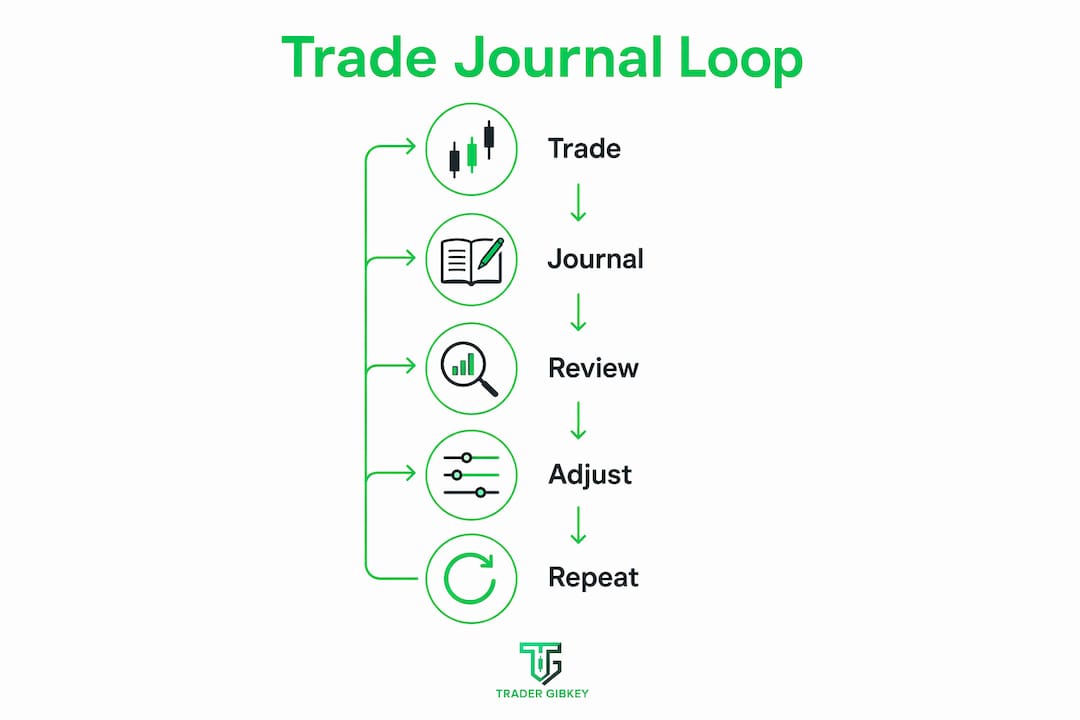
Here is how to run it:
Step 1 — Trade: Execute only pre-planned setups. No impulse entries. Before each trade, confirm your setup criteria, entry level, stop, and target.

Step 2 — Journal immediately: Capture the trade while it is fresh. Delayed journaling loses the emotional data that makes the record useful.
Step 3 — Review weekly: Look for patterns across trades, not just individual outcomes. Are your losses clustered in a specific session time? Are you cutting winners too early?
Sample trade journal fields
| Field | What to capture |
|---|---|
| Date and session | When and which market session |
| Setup type | Which pattern or signal triggered entry |
| Entry, stop, target | Exact price levels planned before entry |
| Actual exit | Where you actually closed the trade |
| R-multiple | Result expressed as a multiple of risk |
| MAE / MFE | Furthest adverse / favorable excursion before close |
| Emotional state (1–10) | Stress or confidence level at entry |
| Rule compliance | Did you follow your plan? Yes / No |
| Key observation | One sentence: what did this trade teach you? |
Diagnostic metrics to track
| Metric | Why it matters |
|---|---|
| Win rate by setup | Tells you which setups actually have edge |
| Average R-multiple | Reveals true expectancy across your sample |
| MAE distribution | Shows whether your stops are correctly placed |
| MFE distribution | Reveals whether you are exiting too early |
| Process compliance rate | Separates skill from rule-breaking outcomes |
Weekly review checklist: Did you follow your entry rules? Did you size correctly? Were your losses within expected R? Did emotional state correlate with results?
Quarterly review: Are your win rate and average R improving? Have you identified and corrected at least one recurring mistake?
Converting journal entries into change means running small, measurable experiments: “For the next two weeks, I will only enter after the candle closes, not on the wick.” One variable at a time. That is how you build a trading approach that is genuinely yours.
How long does it realistically take to build useful trading experience?
Set honest expectations. Skill acquisition in trading depends on deliberate practice quality, not calendar time alone. Here is a realistic milestone map:
- Months 1–3: Learn your platform, run backtests on one setup, complete 30+ replay sessions, open a demo account. Goal: rule fluency, not profitability.
- Months 3–6: Transition to a small live account ($500–$1,000) with 0.5–1% risk per trade. Focus on process compliance, not P&L. Journal every trade.
- Months 6–12: Analyze your first 100+ live trades. Identify your strongest setup. Begin weekly reviews. Adjust sizing only after positive expectancy is confirmed across at least 50 trades.
- Months 12–18: Scale position size incrementally if your metrics support it. Introduce a second setup only after the first is consistently profitable.
Suggested account sizes and sizing rules by learning stage
| Stage | Account size | Max risk per trade | Scale-up criteria |
|---|---|---|---|
| Demo / replay | No real capital | N/A | 30+ consistent rule-compliant sessions |
| Early live | $500–$1,000 | 0.5–1% | Positive expectancy over 50 trades |
| Intermediate live | $500–$1,000 | 1–2% | Consistent positive R over 100 trades |
| Scaling | — | Up to 2% | Stable metrics across 3+ months |
Cost checklist for the learning phase:
- Data feed or replay platform subscription (varies by provider)
- Demo or live brokerage account (often free to open)
- Slippage budget: factor 1–2 pips per trade for realistic cost modeling in Forex
- Education or mentorship fees: varies widely; prioritize programs with structured practice components over content-only courses
Retail FX research shows that learning effects do occur — traders adjust behavior after losses — but improvement is not guaranteed by experience alone. The traders who improve are the ones who combine live reps with structured review. Without that structure, you can trade for years and repeat the same mistakes.
When should you bring in a mentor or structured program?
Solo practice has limits. There are specific signals that suggest you need outside help, and recognizing them early saves both time and capital.
Evaluation checklist — seek structured support if you:
- Consistently break your own rules despite knowing better
- Show negative expectancy after a sample of 50+ trades with no clear improvement trend
- Experience emotional responses (anger, anxiety, obsessive checking) that affect your daily life outside trading
- Cannot identify what is causing your losses after reviewing your journal
- Keep changing your method before giving any single approach enough reps to evaluate fairly
- Have no objective feedback mechanism — no journal, no metrics, no external review
Research confirms that some traders misinterpret signals about their own ability and continue trading despite a poor edge. An outside perspective — a mentor or structured program — provides the objective read that self-assessment often cannot.
What good mentorship actually delivers: process coaching (not just trade calls), live trade review with specific feedback, accountability structures, and a community of traders at similar stages. When vetting a program, look for structured practice components, sample journals or templates, and a demonstrable instructor track record in live markets — not just backtested results.
Trading psychology support is often the missing piece. Many traders have a workable method but cannot execute it consistently because the psychological infrastructure is not in place. A good mentor addresses both.
Key Takeaways
Practical trading experience builds the execution, emotional control, and process discipline that no course or book can substitute — and the trade → journal → review loop is the fastest path to developing all three.
| Point | Details |
|---|---|
| Theory alone is not enough | Live reps build emotional calibration and execution instincts that passive study cannot replicate. |
| The practice loop accelerates growth | Trading, journaling, and reviewing weekly produces measurable improvement faster than unstructured practice. |
| Start small and stage your ramp | Begin with replay drills, then a $500–$1,000 live account at 0.5–1% risk per trade before scaling. |
| Improvement is not automatic | Research shows experience alone does not guarantee progress; structured review helps convert reps into skill. |
| Tradergibkey provides the structure | Tradergibkey’s courses, mentorship, and journaling tools give you the supervised practice framework that solo learning lacks. |
The part most traders skip — and why it costs them
Here is my honest take after watching traders at every level work through this process: the biggest mistake is not a bad strategy. It is treating trading like an information problem when it is actually a performance problem.
Most traders believe that if they just find the right setup, the right indicator, or the right mentor’s signal, everything will click. So they consume more content. They buy another course. They join another group looking for the answer. And they never get meaningfully better because they are not putting in the reps with structured reflection.
Trading is closer to surgery or competitive athletics than it is to studying for an exam. The surgeon does not watch videos of procedures and then operate. They assist, they practice on simulators, they get supervised feedback, and they build up to independent work over years of deliberate repetition. The same logic applies here. Markets reward disciplined execution, not content consumption.
What I have seen work, consistently, is simple: one setup, traded with discipline, reviewed honestly, adjusted incrementally. That is it. The traders who commit to that process for 12–18 months come out the other side with a real edge. The ones who keep searching for a shortcut are still searching.
If you are not journaling every trade and reviewing weekly, you are not practicing. You are just gambling with extra steps.
Tradergibkey gives you the structure to turn reps into real skill
Most traders have the desire to improve. What they lack is a system that converts screen time into measurable progress. Tradergibkey was built specifically for that gap, drawing on over 18 years of live Forex market experience to deliver structured education that goes well beyond theory.
Where solo learning stalls, Tradergibkey’s structured approach picks up. You get price action strategies grounded in live market conditions, not backtested theory. You get mentorship that reviews your actual trades, not generic advice. And you get a community of traders working through the same process, so accountability is built in from day one.
When you join, here is what you can expect:
- Structured courses covering price action, risk management, and trading psychology in a logical sequence
- Live trading sessions where you watch and participate in real market conditions
- Journaling tools and templates to run the trade → journal → review loop from day one
- Personalized mentorship with direct feedback on your setups and process
- Community access through a private group where experienced traders share daily analysis
Whether you are starting from scratch or trying to fix a process that keeps leaking money, Tradergibkey’s program gives you the supervised reps and honest feedback that solo practice rarely produces. Check out the finance skills framework if you want to benchmark your current knowledge before you start. Then come back and build the practical side with Tradergibkey.
Useful sources
- Why You Cannot Learn Trading From Books Alone — Supports the case for deliberate practice over passive study; source for the trade → journal → review loop recommendation.
- Why experience matters in trading — Practitioner evidence that veteran traders learn from mistakes faster and pivot before accounts are compromised.
- Paper Trading to Live Trading Transition — Explains the neuroscience behind why demo trading does not replicate live stress responses.
- How to Learn Trading: A Step-by-Step Roadmap — Covers the Mind, Method, Money framework and staged ramp from demo to live accounts.
- Do individual investors learn from their trading experience? — Academic evidence that trade quality and risk-adjusted returns improve with account tenure and experience.
- What do retail FX traders learn? — Large-sample research showing learning effects occur but improvement is not guaranteed without structured practice.
- The ninety-day deliberate practice plan for traders — Source for replay drills, deliberate practice structure, and the identity-building aspect of professional practice.
- Traders workshop (trade journal & diagnostics) — Practitioner templates for journal fields and diagnostic metrics including win rate, average R, and MAE/MFE.
- FINRA: Day Trading — Regulatory context on day trading risks and capital requirements for U.S. traders.
- SEC: Day Trading — Official U.S. regulatory guidance on day trading risks, margin, and realistic expectations for retail traders.
- Learning by aspiring professional traders — Academic study on how new professional futures traders learn about ability and risk tolerance over time.
FAQ
Does demo trading prepare you for live trading? Partially. Demo trading builds platform fluency and rule familiarity, but it does not replicate the stress response of real money at risk. Use it as a starting point, then transition to a small live account.
How many trades do you need before your results are meaningful? A minimum of 50 trades on the same setup gives you a statistically useful sample. Fewer than that and you are reading noise, not signal.
Can you learn to trade profitably without a mentor? Yes, but it takes longer and the error rate is higher. A mentor compresses the feedback loop, helping you identify and fix mistakes that solo journaling might miss for months.