
The currency market runs 24 hours a day on weekdays, and that single fact changes how you plan your entire trading week. The global forex market schedule works because four regional sessions hand off to each other around the clock, meaning the market never fully sleeps from Sunday evening through Friday evening UTC. The best liquidity sits inside the overlaps, not spread evenly across all 24 hours.
Here are the four major sessions and their standard UTC windows:
- Sydney: 22:00–07:00 UTC
- Tokyo: 00:00–09:00 UTC
- London: 08:00–17:00 UTC
- New York: 13:00–22:00 UTC
| Session | UTC Open | UTC Close | Key Pairs |
|---|---|---|---|
| Sydney | 22:00 | 07:00 | AUD/USD, NZD/USD |
| Tokyo | 00:00 | 09:00 | USD/JPY, AUD/JPY |
| London | 08:00 | 17:00 | EUR/USD, GBP/USD |
| New York | 13:00 | 22:00 | EUR/USD, USD/CAD |
Key Takeaways
The forex market’s 24/5 structure rewards traders who concentrate on peak-liquidity windows, particularly the London–New York overlap from 13:00–17:00 UTC, rather than trading across all available hours.
| Point | Details |
|---|---|
| Market runs 24/5 | Weekly window: Sunday 22:00 UTC open to Friday 22:00 UTC close. |
| Best overlap | London–New York (13:00–17:00 UTC) has the tightest spreads and deepest order books. |
| DST shifts overlap times | Re-verify your local session times every March and November during clock changes. |
| Avoid thin sessions | The post-New York, pre-Sydney window carries wider spreads and higher slippage risk. |
| Tradergibkey | Structured courses and live sessions help traders apply session timing to real price action setups. |
Table of Contents
- What does “24/5” actually mean for your trading week?
- What each major trading session looks like in practice
- Which session overlaps drive the most liquidity?
- How to convert session hours to your local clock
- When should you actually trade? Practical windows and common pitfalls
- Quick reference timetable: sessions and overlaps in UTC
- A trader’s honest take on scheduling and discipline
- Structured practice turns schedule knowledge into real skill
- Useful tools for checking live session times
- Sources
- FAQ
What does “24/5” actually mean for your trading week?
The market’s weekly window typically opens around Sunday 22:00 UTC and closes around Friday 22:00 UTC. That five-day stretch is what traders mean when they say “24/5.” It sounds simple, but the practical reality has a few wrinkles worth knowing.
“Open” does not mean uniform liquidity throughout. The hours between the New York close and the Sydney open are technically live, but order books are thin and spreads can widen noticeably. Experienced traders treat that window as dead time, not opportunity.
Broker hours add another layer. OANDA’s platform, for example, lists FX instruments as running Sunday 17:05 through Friday 16:59 New York time, with minute-level daily breaks some brokers apply. Your broker’s schedule may differ slightly from the theoretical market window, so always check their specific hours page.
- Holiday closures: Liquidity thins sharply on major bank holidays (Christmas, New Year’s, U.S. Thanksgiving). Some brokers reduce available instruments or widen spreads.
- Weekend products: A small number of brokers offer limited weekend trading on crypto or synthetic instruments, but standard FX pairs remain closed.
- Daily breaks: Some platforms apply a brief daily maintenance window, often a few minutes around the 17:00 ET rollover.
Pro Tip: Bookmark your broker’s hours-of-operation page and check it before any major holiday week. A surprise reduced-hours notice can catch you mid-position.
What each major trading session looks like in practice
Each session has its own personality, and knowing that personality helps you match your strategy to the right window. Session characteristics vary strongly by pair, so a EUR/USD scalper and a USD/JPY swing trader are not working the same schedule.
A few practical notes by session:
- Sydney sets the tone for the week’s open but rarely produces the sharp moves newer traders expect. AUD/USD and NZD/USD see their best relative activity here.
- Tokyo tends toward consolidation and range behavior on most days. JPY crosses and AUD/JPY are the pairs to watch. If you trade breakouts, Tokyo often builds the range that London breaks.
- London is where the volume arrives. EUR/USD and GBP/USD see their sharpest intraday moves during this session, particularly in the first two hours after the 08:00 UTC open.
- New York carries strong momentum through its overlap with London, then gradually quiets after 17:00 UTC as European traders close positions.
Which session overlaps drive the most liquidity?
Overlaps are where two sessions run simultaneously, and that’s where institutional order flow concentrates. Three overlaps matter to retail traders:
- London–New York (13:00–17:00 UTC): The busiest window in the entire FX week. EUR/USD spreads tighten, order books deepen, and large moves on economic data releases are most likely here.
- Tokyo–London (08:00–09:00 UTC): A short one-hour window, but it often produces sharp moves as European traders react to Asian session price action.
- Sydney–Tokyo (00:00–02:00 UTC): The quietest overlap. AUD and JPY pairs see modest upticks in activity, but volume stays low compared to the European windows.
The London–New York overlap is the single most important window for most retail traders. Spreads on major pairs are typically at their tightest, and the probability of a clean, high-volume move is higher than at any other time of day.
Pro Tip: Plan your entries for the first 30 minutes of an overlap, not the middle. Institutional flow tends to establish direction early. Mid-overlap entries often catch you in a move that’s already extended. And watch out for major news releases — a scheduled data print can spike volatility in ways that make even a well-timed entry dangerous without a clear risk plan.

How to convert session hours to your local clock
UTC is your anchor. Every session time in this article is stated in UTC, and converting correctly takes three steps.
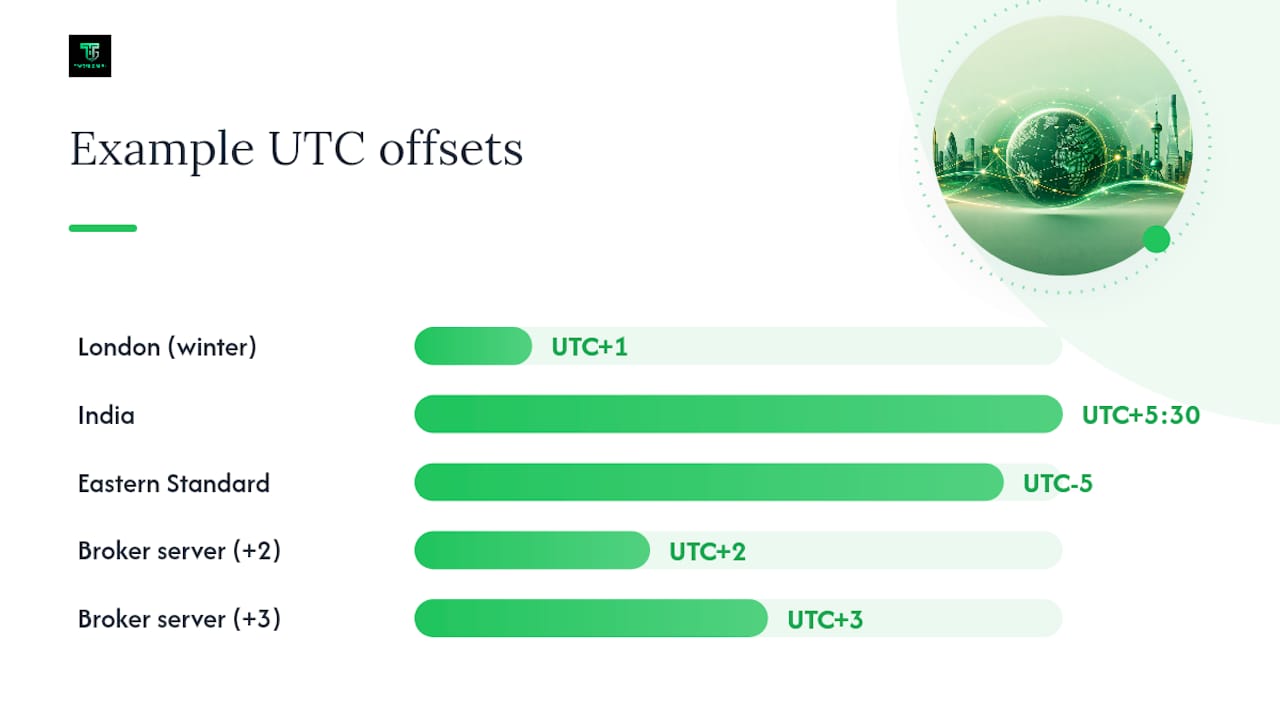
- Find your UTC offset. Check your current local time zone offset from UTC. For example, UTC+1 (London in winter), UTC+5:30 (India), UTC-5 (Eastern Standard Time).
- Add or subtract your offset. London opens at 08:00 UTC. If you’re at UTC-5, that’s 03:00 your local time. If you’re at UTC+1, it’s 09:00.
- Check your local DST rules. Daylight saving time shifts your offset by one hour for part of the year. The U.S., UK, and EU don’t change clocks on the same date, so overlap windows can shift by one hour for a week or two around each transition. During those weeks, verify your times rather than relying on memory.
Broker-server time adds one more variable. Your trading platform’s chart timestamps may show broker server time, which is often UTC+2 or UTC+3 depending on the broker’s location. That’s not your local time and it’s not always UTC. Misreading it is one of the most common reasons traders mis-time entries.
Pro Tip: Use the Forex Market Time Converter as your single reference for local session times. Cross-check it against your broker’s server time during DST changeover weeks — a one-hour error in your session clock can put you in the wrong market entirely.
When should you actually trade? Practical windows and common pitfalls
Knowing the schedule is step one. Knowing when not to trade is equally important.
For liquidity-focused traders, the London–New York overlap (13:00–17:00 UTC) is the primary window. EUR/USD, GBP/USD, and USD/CAD see their best conditions here. For JPY-focused strategies, the Tokyo session (00:00–09:00 UTC) offers the most relevant price action, particularly on USD/JPY and AUD/JPY. Building your daily routine around one or two of these windows, rather than watching screens all day, produces better decisions and less fatigue.
Common pitfalls to avoid:
- Thin liquidity periods: The stretch between New York’s close (22:00 UTC) and Sydney’s meaningful activity is the riskiest time to trade. Spreads widen, slippage increases, and price can move erratically on low volume.
- The rollover window: Around 17:00 ET (22:00 UTC), brokers apply overnight swap charges. Spreads often widen briefly during this window. Holding positions through rollover is fine if planned, but entering new trades right at that moment adds unnecessary spread cost.
- Major news releases without a plan: Economic data prints — NFP, CPI, central bank decisions — can produce moves of 50–100+ pips in seconds. Trading through them without a defined risk plan is not a strategy; it’s a gamble.
Liquidity reality check: According to ForexMechanics, the London–New York overlap consistently produces the tightest spreads on major pairs, while the European night session is the thinnest liquidity window of the trading day. That spread difference directly affects your cost per trade.
Understanding liquidity in trading is what separates traders who time their entries well from those who wonder why their fills always look worse than expected.
Quick reference timetable: sessions and overlaps in UTC
Convert every time above using your UTC offset, and re-verify during DST transition weeks in March and November.
A trader’s honest take on scheduling and discipline
The schedule is not the edge. Knowing that London opens at 08:00 UTC does not make you profitable. What matters is what you do with that window.
My approach is simple: I pick one or two sessions per day and commit to them fully. During the London–New York overlap, I’m at the screen with a watchlist, a clear bias from the Asian session’s range, and defined risk parameters before price moves. Outside those hours, I’m reviewing, journaling, or away from the charts entirely.
A few rules I’d hand to any trader starting out:
- Trade fewer sessions, not more. Fatigue degrades decision quality faster than almost anything else.
- Mark your overlap windows on your calendar every week. DST changes mean you need to re-check times in March and November.
- Never enter a trade in the last 30 minutes before a major data release unless your strategy is specifically built for news trading.
- Log every trade with the session it was taken in. After 30 trades, your journal will tell you which session actually works for your style.
Structured practice turns schedule knowledge into real skill
Knowing the currency market opening times is the foundation. Executing consistently inside those windows is the skill that takes time to build.

Tradergibkey’s courses and mentorship programs are built specifically for traders who want to move from schedule awareness to disciplined execution. With 18+ years of live-market experience behind the curriculum, the focus is on price action strategies you can apply session by session, not generic theory.
- Live trading sessions during the London–New York overlap so you see real setups in real time
- Session-specific drills that train your eye for the conditions each window produces
- Journal review built into the program so your data tells you which sessions suit your style
If you’re ready to trade with a structured plan rather than guessing at timing, explore the Tradergibkey courses and community and see which program fits where you are right now.
Useful tools for checking live session times
Bookmark at least one live converter and check your broker’s hours page before holiday weeks.
- Forex Market Time Converter: Shows each session’s open and close in your local time zone; updates automatically for DST.
- FxOpenHours: Live clock with session status and the weekly UTC schedule at a glance.
- Investing: Maps session and overlap windows visually; useful for quick reference on high-traffic days.
- OANDA Hours of Operation: Broker-specific open/close times including daily breaks; check this if you trade on OANDA or want a real-world example of platform-level hours.
- Tradergibkey Market Hours Guide: Practical session guide with trader-focused context for 2026.
Always cross-reference a converter with your broker’s server time, especially during the first week after a DST change.
This article is general information, not a substitute for advice from a qualified financial advisor. Consult a qualified financial professional about your own circumstances before acting on anything here.
Sources
- Forex market trading hours - Investopedia
- Forex Market Hours - Forex Market Time Converter
- Forex Market Hours 2026 — Live Clock & Time Zone Converter | FxOpenHours
- Hours of operation | OANDA
- Trading hours & time on Forex: When the market really works – ForexMechanics
FAQ
What time does the forex market open each week? The market opens Sunday at approximately 22:00 UTC (Sydney session) and closes Friday at approximately 22:00 UTC after the New York session ends.
Which trading session has the most liquidity? The London–New York overlap (13:00–17:00 UTC) is the busiest window, with the tightest spreads on major pairs like EUR/USD.
Does daylight saving time affect forex session hours? Yes. When the U.S., UK, or EU change their clocks, overlap windows shift by one hour for a week or two. Always re-check your local times during March and November.