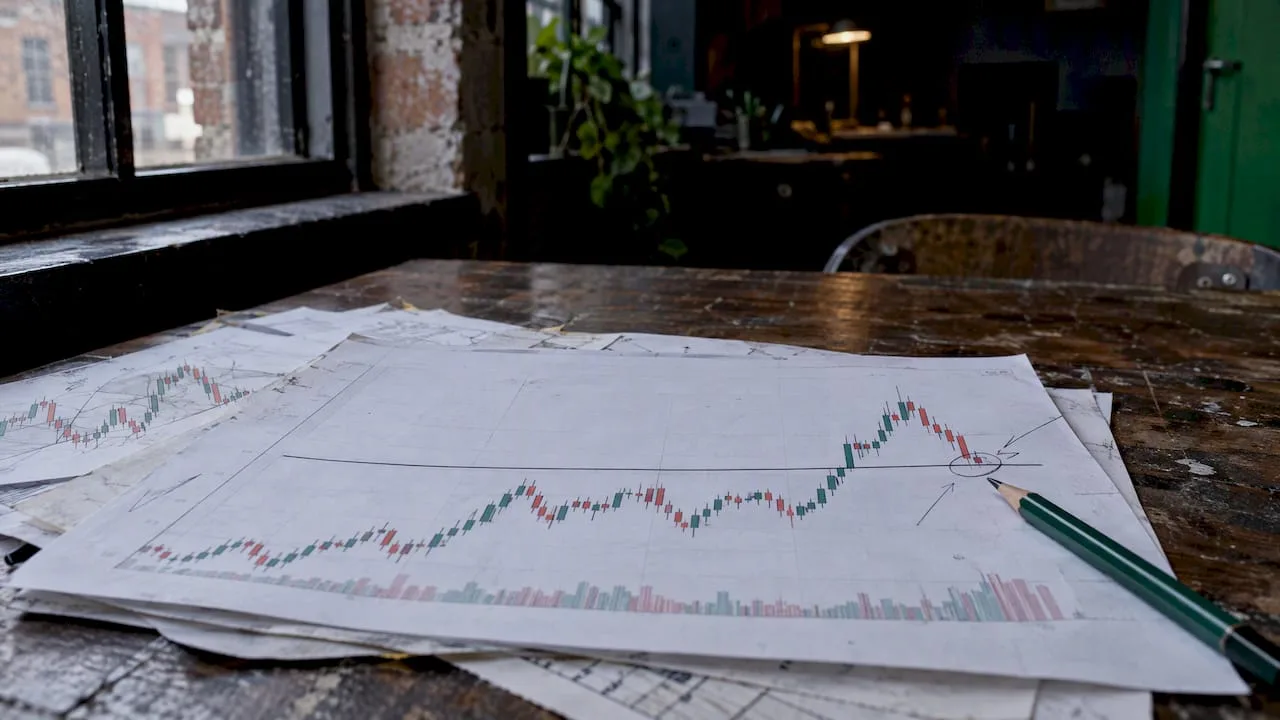
The breakout retest strategy means you do not buy or sell the moment price pushes through a level. You wait for price to come back to that level, test it from the other side, and hold. Only then do you enter, with a stop placed where the idea is clearly wrong. It is slower than chasing the break, and it is far more controlled.
Below we walk through the full setup: how to mark the level, what counts as a real retest, where the stop and target go, and when to simply pass. We also cover the UK risk picture, because spot forex is leveraged and the numbers are sobering.
TL;DR
- A breakout candle is information, not an invitation. The retest is the entry signal.
- Mark a significant level first. If it is not an obvious prior swing or range edge, skip it.
- Require a close back over the level, not just a wick touch, and write your rules down before you trade.
- Your stop sits just beyond the retested level, so risk stays small and defined.
- Waiting means you will miss some fast moves. That is a deliberate trade-off, not a flaw.
Table of Contents
- What the breakout retest strategy actually is
- Why wait for the retest
- The trade-off: you will miss some moves
- Step by step: trading a breakout retest
- A worked example
- When to pass on a retest
- Our perspective: the retest is a risk tool first
- UK risk rules you should know before trading it
- Common mistakes with retest entries
- Want a structured way to learn this?
- FAQ
- Sources
What the breakout retest strategy actually is
Price pushes through a level that traders have been watching: a prior swing high, the edge of a range, a weekly pivot. That is the break. Then price turns around and comes back to touch the level it just crossed. That is the retest. If the level holds from the new side, former resistance now acts as support (or the reverse for a downside break). Traders call this a polarity flip.
The idea is simple, but the discipline is in separating two steps. Research on 1,446 breakout signals frames the breakout as a candidate for a trade and the retest, with confirmation, as the actual entry. When you keep those two steps apart in your head, you stop entering on excitement.
You will see the same setup called a breakout pullback, a retest entry, or break and retest. Same idea, different labels. If you want the wider family of breakout approaches first, our guide to types of forex breakout strategies lays them side by side.
Why wait for the retest
Most breakouts fail to follow through. One futures trading guide estimates that a retest approach can filter out roughly 70% to 80% of fakeouts by waiting for price to return and hold. Treat that as a rough guide from one source, not a promise. Your results will depend on your market, timeframe and execution.
There are two practical benefits.
- Fewer traps. If price breaks a level and immediately collapses back through it, you were never in the trade.
- A better stop. According to the same research, a retest entry puts your stop where the idea is provably wrong, so you can risk less or size up for the same risk budget compared with entering the wider initial swing.
There is also a psychological benefit that our students notice quickly. Chasing a breakout often leads to a stop-out, then a revenge trade. A retest rule gives you a hard rule to follow, so decision quality stays steady.
The trade-off: you will miss some moves
Be honest with yourself about this. The same breakout study notes that waiting filters out losers but also means missing strong, news-driven momentum moves that often do not retest at all. You must decide whether you are playing for higher-probability setups or maximum participation.
We choose the first. Missing a strong move is annoying, but it does not cost you money. A trapped trade does. A chart pattern failure analysis points to entering on the initial breakout without waiting for pullback confirmation as one of the most common retail execution errors.
Step by step: trading a breakout retest

Step 1: Mark a level that matters
Use a prior swing high or low, a clear range boundary, or a trendline with several touches. If you have to squint to see the level, other traders do not see it either. Our swing high and low workflow shows how to mark these cleanly, and the 3-touch trendline checklist helps if your level is diagonal.
Step 2: Demand a decisive breakout
Look for a candle that closes through the level, not one that merely pokes a wick beyond it. A breakout definition from TradeOlogy calls for a decisive close, volume expansion and follow-through, ideally confirmed by a pullback that holds the broken level.
A note on volume: some desk checklists use a threshold of around 1.5x the recent average. In spot forex there is no central volume figure, so retail platforms show tick volume from your broker. It is a rough proxy, so use it as a filter rather than gospel. If you prefer structure over volume, our guide to BoS and CHoCH rules gives you a structural way to judge the break.

Step 3: Wait, and do nothing
This is the hardest step. Price runs away, and you feel the urge to jump in. Do not. Set an alert at the level and walk away from the screen if you need to.
Step 4: Define a valid retest
Write your confirmation rule before the trade. A good one has three parts:
- Price returns to the level or a small zone around it.
- Price holds the level on a closing basis on your trading timeframe.
- A rejection signal appears, such as a pin bar, an engulfing candle or an inside bar breaking in your direction.
If the candle closes back through the level, the retest failed. You pass. There is no second guessing.
Step 5: Enter, place the stop, set the target
Enter on the close of the confirmation candle or on a break of its high (for a long). Put your stop just beyond the retested level, with room for normal noise. Many traders use an ATR-based buffer so the stop adapts to current volatility.
For targets, a common approach is the next significant swing or at least a fixed reward-to-risk multiple. One pullback guide suggests a minimum of 1:1.5. We prefer to pick the target from the chart first and only take the trade if the reward-to-risk is worth it.
A worked example
Here is a hypothetical illustration, not a real trade. Say GBP/USD has been capped by resistance at 1.2800 on the four-hour chart, with three clear rejections.
| Stage | What you see | What you do |
|---|---|---|
| Break | A four-hour candle closes at 1.2840, above resistance | Nothing. Mark 1.2800 and set an alert |
| Pullback | Price drifts back to 1.2805 over the next few candles | Watch the closes, not the wicks |
| Retest | A bullish engulfing candle closes at 1.2830 after holding 1.2800 | Entry on the next candle’s break of the high |
| Risk | Stop at 1.2770, below the level plus a buffer | Risk of about 60 pips from a 1.2830 entry |
| Target | Next swing high at 1.2920 | About 90 pips of reward, so 1.5R |
Notice the trade only exists because price proved the level. If that engulfing candle had closed at 1.2790, the story ends and you move on.
When to pass on a retest
Mechanical filters beat gut feeling. Pass when:
- The level was not a significant prior swing or range edge.
- The breakout candle had no follow-through, or price crawled through the level.
- The retest candle closes back through the level.
- A major news release is minutes away. A Bank of England working paper on the Swiss franc cap removal found that algorithmic trading can consume liquidity and amplify moves in extreme conditions. Technical levels are poor guides in those moments.
- You are already on tilt after a loss. Close the platform.
If fakeouts keep catching you even with these rules, read our breakdown of false breakout trading. For a related setup that also leans on retests, see our notes on double tops in forex.
Our perspective: the retest is a risk tool first
We have traded live markets for over 18 years, and the lesson we repeat most is this: a strategy is not what you do when it works. It is what you do when you are tired, down on the week and staring at a candle that looks like it is about to run.
That is why we teach the retest as a behavior rule, not just a chart pattern. The brain stops trading the chart and starts trading the pain after a couple of losses. A rule like “I only enter after a closing hold at the level” takes the decision out of the moment. You do not need to feel confident. You need to follow the checklist.
We also push our students to keep a journal for every retest trade: the level, the confirmation, the stop, the result, and how they felt. After 30 trades, patterns show up. Maybe you take too many retests against the higher-timeframe trend. Maybe you bail early. You cannot fix what you do not record.
And please be realistic about the odds. Breakout retests do not win every time. What they give you is a defined risk and a repeatable process, which is what lets you survive long enough to get good. We go deeper on the beginner process in our break and retest checklist.
— Gabriel
UK risk rules you should know before trading it
The strategy does not change the risk of leveraged forex. The FCA has said that approximately 80% of customers lose money when investing in CFDs. UK-regulated brokers must also cap leverage for retail clients, between 30:1 and 2:1 depending on the asset.
Three practical points:
- Check your broker. The FCA urges consumers to confirm a firm is authorised on the Financial Services Register before trading.
- Keep your retail protections. The FCA’s same release warns that some poor firms push clients to opt up to professional status, which removes safeguards. If a broker suggests this, speak to the FCA or an independent adviser before agreeing.
- Size by risk, not by leverage. Decide the amount you can lose on one trade first, then work out position size from your stop distance. Our risk management rules for new traders cover this in detail.
This is education, not personal financial advice. If you are unsure whether leveraged trading suits your finances, speak to a regulated financial adviser first.
Common mistakes with retest entries
- Entering on the wick. Price touching the level is not confirmation. A close is.
- Moving the level. If the retest fails, traders redraw the level to fit. Do not.
- Ignoring the higher timeframe. A retest long into a daily downtrend is a harder trade than one with the trend.
- Widening the stop. If the retest fails, the idea is wrong. Take the small loss.
- Trading every break. Skipping weak setups is part of the strategy.
- No test period. Backtest or demo trade at least 30 setups with your exact rules before risking real money.
Want a structured way to learn this?
Reading about retests is the easy part. Applying them live, with feedback, is where most traders stall. At Trader Gibkey we teach price action as a system: levels, structure, entries, risk and psychology, with a supportive community and live sessions.
Our Price Action (Core) plan is £149 per month. If you want one-to-one feedback on your own charts and journal, a Single Session Mentorship is €149 per session, with 3-session (€399) and 5-session (€559) packages available. You can see every option on our offers page.
FAQ
Is the breakout retest strategy better than entering on the breakout?
It is more selective. Waiting for a retest filters out many false breakouts and gives you a tighter stop, but you will miss moves that never come back. Which is better depends on whether you value accuracy or participation.
Which timeframe works best for breakout retests?
There is no single best one. Many traders prefer the four-hour and daily charts because levels are more significant and noise is lower. Pick one timeframe, test it, and keep your rules consistent.
Does price always retest a broken level?
No. Strong, news-driven moves often run without looking back. If there is no retest, you have no trade, and that is fine.
Sources
- Retest in Trading: What 1,446 Breakouts Say About Waiting
- Breakouts and Breakdowns, TradeOlogy Academy
- Why Chart Patterns Fail: 3 Variables to Improve Accuracy
- Fakeouts in Futures: Order Flow Strategies
- FCA highlights continuing concerns about problem firms in the CFD sector
- Bank of England Staff Working Paper No. 711
- Leverage and Margin Limits in the UK
- Pullback Trading Strategy in Forex