
Trade NFP only with a defined scenario. Either take a small, pre-planned position going into the release or wait 15 to 60 minutes for a confirmed follow-through, and never fire a market order in the first minute. Keep your focus on EUR/USD and XAU/USD, where liquidity and range are most predictable. After 18 years of watching this report move markets, the traders who survive it are the ones who plan the trade before the number ever prints.
TL;DR:
- Trading NFP successfully requires pre-planning, small positions, and waiting 15 to 60 minutes for confirmation rather than acting on initial spikes.
- Focus on liquidity pairs like EUR/USD and XAU/USD, using limit orders and reduced size to manage high volatility and spread widening.
- Confirm early market direction through Treasury yields, DXY dollar index, and gold’s inverse movement, especially considering revisions and macro consistency.
- Avoid chasing the first-minute spike, and ensure a clear scenario and size limit are set before the report release to protect against unpredictable moves.
- The most reliable strategies involve either small pre-positions, fade trades after initial reversals, or waiting for the 30-minute close trend confirmation.
Table of Contents
- What Trading NFP in Forex Actually Means
- How NFP Moves the Dollar, Gold, and Yields
- Your Pre-NFP Checklist Before the Release
- The Three NFP Strategies Worth Actually Trading
- Execution and Risk Rules That Actually Protect Your Account
- What to Watch Minute by Minute After the Print
- Common NFP Mistakes and How to Fix Them
- How I Actually Trade NFP
- Want to Practice This Playbook Before the Next NFP?
- Where to Verify These Numbers Yourself
- Sources
- FAQ
What Trading NFP in Forex Actually Means
Trading NFP in forex means positioning around the U.S. jobs report, released monthly by the Bureau of Labor Statistics, based on how the actual numbers compare to what the market expected. The report bundles four figures that matter, and reading only the headline is how most beginners get blind sided.
- Headline payrolls: the net number of jobs added, the figure every news ticker leads with.
- Average hourly earnings: a wage growth read the Federal Reserve watches closely for inflation pressure.
- Unemployment rate: a slower-moving but still market-relevant labor slack indicator.
- Revisions: adjustments to the prior one or two months, which can quietly undo a strong-looking headline.
None of these numbers matter in isolation. What moves the dollar is the surprise, the gap between the consensus forecast and the actual print, because the expected portion is already priced into the market. That surprise reprices expectations for the Fed’s next move, which is why NFP trading strategies built around forex all trace back to the same mechanism: the Fed path channel. A hot jobs number with rising wages tends to push rate cut expectations further out, and the dollar strengthens on that repricing, not on the jobs number itself.
How NFP Moves the Dollar, Gold, and Yields
Treasury yields typically move first, often within seconds, because bond traders reprice rate expectations almost instantly. The DXY dollar index and yields together give you the cleanest early confirmation of direction, more reliable in the opening minute than watching a single currency pair alone.
Once yields and DXY move, the majors tend to follow a fairly consistent pattern:
- EUR/USD: usually the most liquid and cleanest read, moving inversely to dollar strength.
- GBP/USD: similar direction to EUR/USD but with wider natural swings and more noise.
- USD/JPY: sensitive to yield moves specifically, since it tracks the U.S. Japan rate differential closely.
- XAU/USD (gold): tends to move inversely to the dollar, and its percentage move can outpace EUR/USD on the same print.
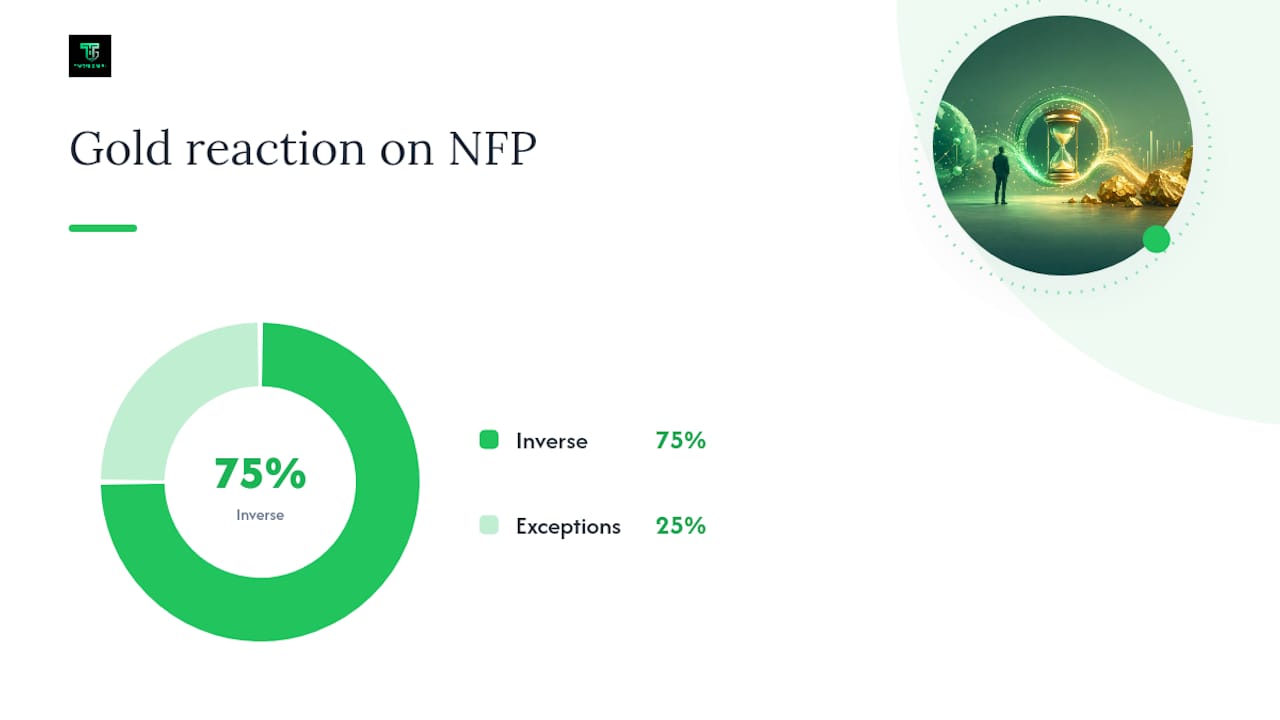
Gold reacts inversely to the dollar on NFP in roughly 75% of releases, which makes it a genuinely useful confirmation tool rather than just a separate trade idea.
Two regime caveats matter here. First, in a flight-to-safety environment, gold and the dollar can rise together, breaking the usual inverse pattern. Second, a strong headline paired with weak wage growth or a sharp downward revision can flip the market’s read entirely within the first 15 minutes. That is why revisions deserve a real look, not a skim.
Your Pre-NFP Checklist Before the Release
Preparation happens the hour before, not during the spike. Here’s the routine worth running every time:
- Confirm the exact release time and consensus forecast. Set an alarm and cross-check the print time against your local session using a live economic calendar rather than trusting memory.
- Pick your top two pairs to watch. EUR/USD and XAU/USD cover most of what you need; watching five pairs at once just splits your attention.
- Set your trade or no-trade threshold in advance. Decide what surprise size actually justifies action, and write it down before the number hits.
- Choose your order type now. Limit orders only. Market orders into a release are how traders get filled 20 to 40 pips from where they clicked.
- Check your broker’s NFP behavior. Confirm whether guaranteed stops are available, how the platform historically handles latency, and whether spreads on your pairs have a known history of blowing out.
- Cut your position size before the print, not after. If it’s not decided beforehand, it won’t get decided calmly in the moment.
Pro Tip: Write your trade plan as an “if this, then that” statement the night before. “If NFP beats consensus by 50k or more and wages confirm, I take EUR/USD short on the 30-minute close.” A plan you can’t state in one sentence isn’t a plan yet.
The Three NFP Strategies Worth Actually Trading
Most traders only know one way to play NFP: watch, panic, click. There are three field-tested approaches, and each fits a different kind of market condition.
- Pre-position small. Take a limited position minutes before release based on a defined macro thesis, not a hunch. Use wide stops that account for the volatility spike, and treat the position as disposable if the scenario invalidates. This only works when you have a genuine conviction, not a coin flip.
- Spike-fade. Wait roughly 15 minutes after release, then look for a clear reversal candle on the 5-minute chart. Enter against the initial spike, with your stop placed just beyond the spike’s extreme, since that level marks where the fade thesis fails.
- Follow-through (30-minute close method). Wait for the 30-minute candle to close in the direction of the initial move, then look for a retest of the breakout level before entering. This is the desk-level confirmation method, and it trades the confirmed trend rather than the noisy first tick.
Which one fits depends on conditions:
- Low liquidity or thin holiday sessions favor spike-fade, since exaggerated first moves are more common.
- A print that aligns cleanly across payrolls, wages, and revisions favors follow-through, since the components agree.
- Pre-positioning only makes sense when your macro read is strong and your size is genuinely small enough to survive being wrong.
Execution and Risk Rules That Actually Protect Your Account
Limit orders are the standard for NFP execution, full stop. A market order sent in the first 60 seconds after release routinely fills 15 to 30 pips away from the price you saw on screen, because liquidity providers pull quotes the instant volatility spikes.
Spreads on EUR/USD and gold can widen several multiples beyond their normal range in the first 60 seconds after release, which is exactly why entering on a limit order with a pre-set invalidation level beats reacting to the tick in front of you.
Position sizing needs to shrink, not stay the same. A common practical rule cuts size to roughly one-third of normal on NFP day, since minute-by-minute variance runs several times higher than an average session. Pair that smaller size with a wider stop tied to the elevated average true range, rather than your usual stop distance, or you’ll get stopped out on noise before your thesis even has a chance to play out.
A few more rules worth locking in:
- Guaranteed stops cost more in spread but remove slippage risk entirely during the spike, worth it if your broker offers them.
- ECN brokers with variable spreads tend to reflect real market conditions more transparently than dealing-desk models during NFP.
- If you trade through a broker with any offshore or unclear regulatory footprint, it’s worth checking their regulatory standing before you rely on their execution during high-impact events.
What to Watch Minute by Minute After the Print
The first hour after release follows a fairly predictable rhythm, and knowing which minute you’re in tells you whether to act or wait.
| Time window | What typically happens | Action |
|---|---|---|
| — | Initial spike, spreads widen sharply | Avoid market orders entirely |
| 1 to 15 minutes | Reversal attempts common, direction unclear | Watch, do not enter yet |
| 30-minute close | Primary confirmation candle forms | Evaluate follow-through entry |
| 60 to 90 minutes | Trend either confirms or fades | Confirm trend before adding |
Your confirmation signals are simple: DXY direction, Treasury yield movement, and whether gold is moving inversely as expected. If all three agree, and wages or revisions support the headline story, the follow-through setup gets meaningfully more reliable than trading on the headline alone.
Common NFP Mistakes and How to Fix Them
The traders who lose money on NFP tend to make the same three mistakes over and over.
- Reading only the headline. Skipping wages and revisions means trading on half the story. Scan revisions right after the headline, every time.
- Chasing the spike. Entering 30 seconds after release because the candle looks dramatic almost always means buying the top or selling the bottom of the initial noise.
- Trading normal size. Full position size during 3 to 5 times normal volatility is how one bad NFP wipes out a month of gains.
Pro Tip: If you’re still learning to spot clean retest entries after a spike, practicing with fair value gap concepts on regular sessions first will make your NFP entries far less guessy when the real volatility hits. For sizing discipline specifically, run through a risk management framework before your next release, not during it.
How I Actually Trade NFP
My own routine hasn’t changed much in years: I decide my scenario the night before, cut size hard, and either wait for the 30-minute close or take a small pre-position with a stop I can live with if I’m wrong. Speed has never been the edge on NFP day. Discipline is. The traders I mentor spend their first few sessions doing nothing but writing scenarios and sitting on their hands through the noisy first 15 minutes, because that patience is the actual skill, not the entry itself.
— Gabriel
Want to Practice This Playbook Before the Next NFP?
Reading a checklist and executing it calmly under real volatility are two different skills, and the gap between them is where most accounts take damage. Tradergibkey builds that gap-closing practice directly into its training, with 18-plus years of live price-action experience behind every scenario drill, rather than theory borrowed from a textbook.

If you want structured repetition, the Price Action (Core) plan runs £149 per month and covers the scenario planning and execution habits this article walks through. For direct feedback on your own NFP trades, a Single Session Mentorship costs €149 one-off and puts your specific setups in front of a live trader instead of a forum. Results depend on the reps you put in, but the structure removes the guesswork about what to practice next. Check current plans and book a session at Tradergibkey.
Where to Verify These Numbers Yourself
Release times and full report text come straight from the Bureau of Labor Statistics calendar. For deeper mechanics, the Fed path explainer and execution playbook cited above are worth a full read.
This article is general information, not a substitute for advice from a qualified financial advisor. Consult a qualified financial professional about your own circumstances before acting on anything here.
Sources
- NFP Trading Guide: How Non-Farm Payrolls Move Forex | Forex Fundamentals Guide
- Forex-basics
- How to Trade NFP in 2026: Practical Playbook | ForexTradeLab
- Chartsnipe
- How to Trade NFP 2026: Pre-Print Setup + Reaction Playbook | KenMacro
FAQ
How Do I Trade NFP in Forex?
Trade it with a fixed plan: either a small pre-position with a wide stop, or wait 15 to 60 minutes for a confirmed move using limit orders only. Reduce your position size and never chase the first-minute spike with a market order.
Is It Good to Trade on NFP Day?
It can be profitable if you trade with a defined scenario and reduced size, since the volatility and range offer real opportunity. It’s a poor day to trade if you’re reacting emotionally to the headline without a plan.
What Time Is NFP in Forex?
NFP releases at 8:30 AM Eastern Time on the first Friday of most months, according to the Bureau of Labor Statistics schedule. Check the exact date each month, since holidays occasionally shift the release day.
What Is Forex NFP?
NFP stands for Non-Farm Payrolls, a U.S. jobs report that includes headline job additions, wage growth, unemployment, and revisions to prior months. It moves forex markets because it reshapes expectations for the Federal Reserve’s next interest rate decision.